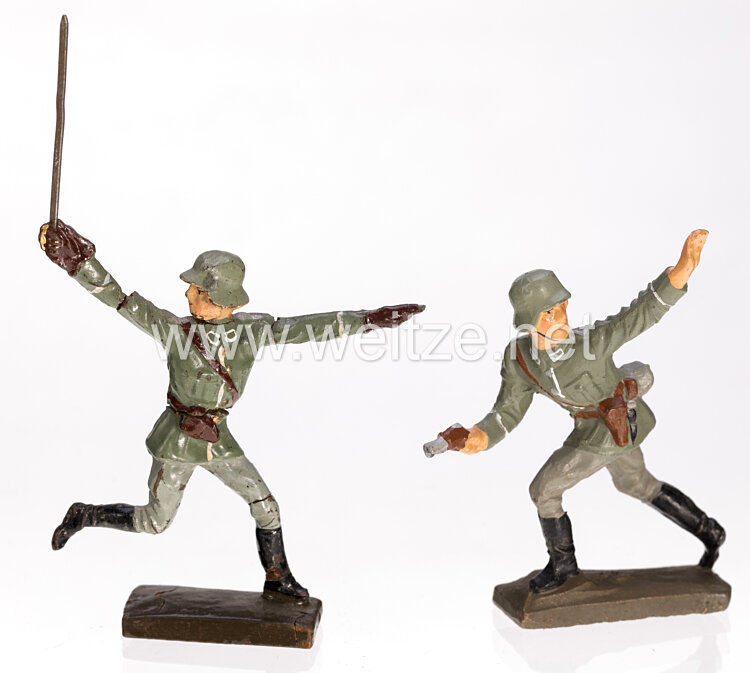
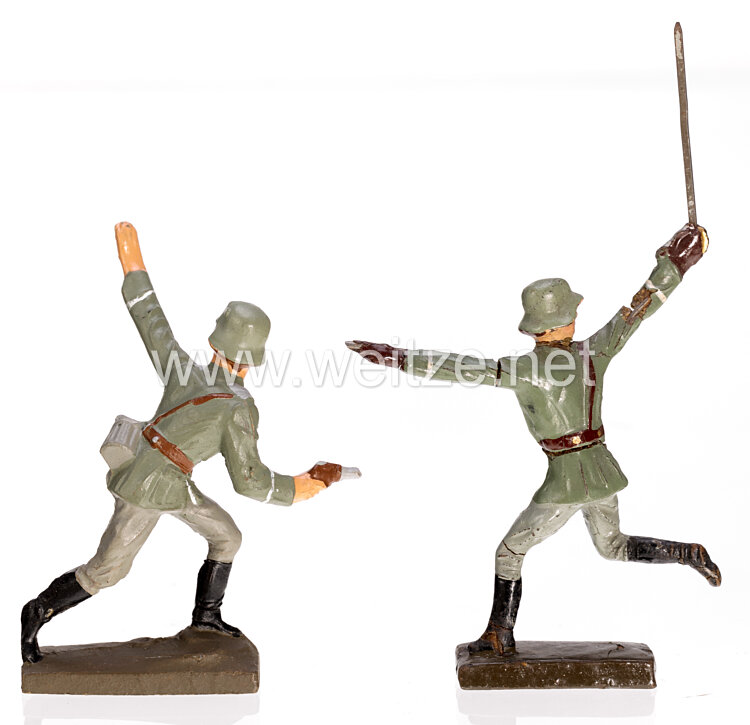
Lineol - Army Officer and Soldier Attacking

, 7 cm, condition 2.
265557
35,00

Lineol - Army Officer and Soldier Attacking

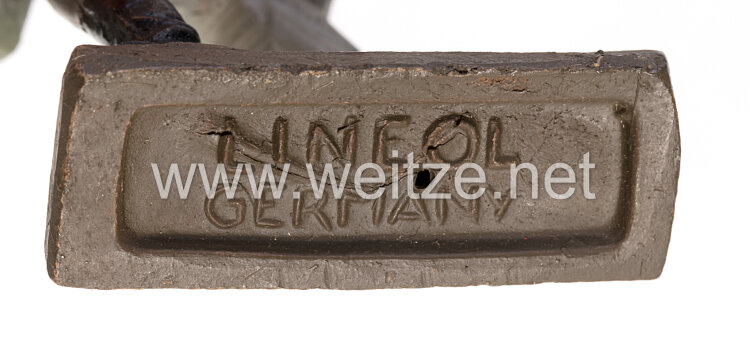
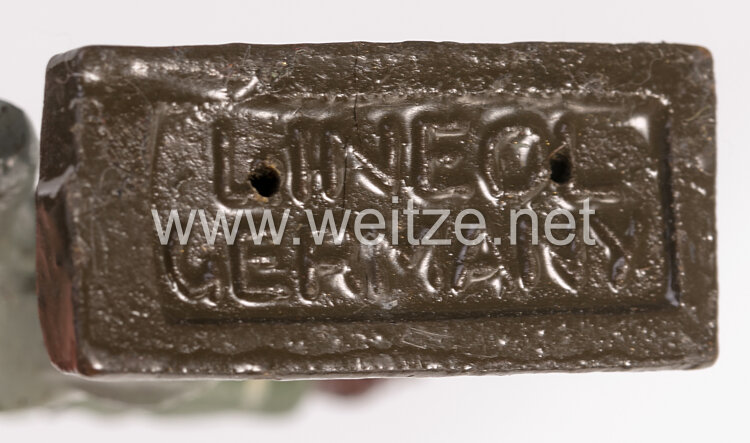
Lineol figures represent a significant chapter in German toy history while simultaneously documenting the military iconography of the early to mid-20th century. This figure group, consisting of an Army officer and a soldier in attack position, embodies the typical design language of the Lineol company from the period between the 1930s and 1940s.

The Lineol company was founded in 1906 by Oskar Wiederholt in Brandenburg an der Havel and developed into one of Germany's leading manufacturers of composition figures. The company name was derived from the words “Linie” (line) and “Elastolin,” the latter referring to the material used. These figures were manufactured from a special composition consisting primarily of glue, chalk, glycerin, and casein, formed around a wire armature. This technique enabled detailed modeling while maintaining robust construction.

The 7-centimeter scale became established as the standard size for Lineol figures and became the industry-standard scale for military toy figures in Germany. This size offered an optimal compromise between detail richness and handleability for children's play. Figures of this size were produced in enormous quantities and found their way into countless German children's rooms.

The depiction of an officer and soldier in attack position reflects the military aesthetics and societal attitudes toward the Wehrmacht of that era. The attack pose was a popular motif for military toy figures as it suggested dynamism and action. Such figures were frequently designed with raised weapons, forward-leaning bodies, and in running positions. The differentiation between officer and enlisted soldier was made clear through different uniform details, rank insignia, and armament.

The uniform representation in Lineol figures was characterized by remarkable attention to detail. Officers were typically portrayed with characteristic features such as peaked caps, boots, belt buckles, and side arms. Painting was done by hand, with field gray serving as the dominant color for Wehrmacht uniforms. Further details such as collar patches, shoulder boards, and branch-of-service colors were carefully executed.

The historical context of these figures is inseparably linked with German history between 1933 and 1945. Toy figures like these served not only for entertainment but were also part of the ubiquitous militarization of society. Children grew up with these figures and internalized military structures and behaviors through play. The toy industry worked closely with official agencies to ensure authentic representations of the Wehrmacht.

After 1945, production changed fundamentally. Lineol initially ceased manufacturing military figures and concentrated on civilian themes. Many of the war figures were destroyed or reworked in the postwar period. This makes well-preserved specimens from the prewar and wartime periods sought-after collector's items today.

The condition rating of 2 according to the standard collector's scale means these figures are preserved in very good to excellent condition. This implies largely intact paint, complete limbs, and no serious damage to the composition figures. Given their age and original purpose as toys, such a state of preservation is remarkable.

From a museum and collector's perspective, such figures document important aspects of everyday history, toy production, and military iconography. They are witnesses to a problematic era and are preserved today in historical collections to document the material culture of this period. The critical historical context must always be considered and communicated.

The Lineol company existed until 1983, with postwar production differing markedly from the earlier military series. Today, original Lineol figures are valued by collectors worldwide, with focus on craftsmanship quality, historical documentation, and toy-historical significance.

r