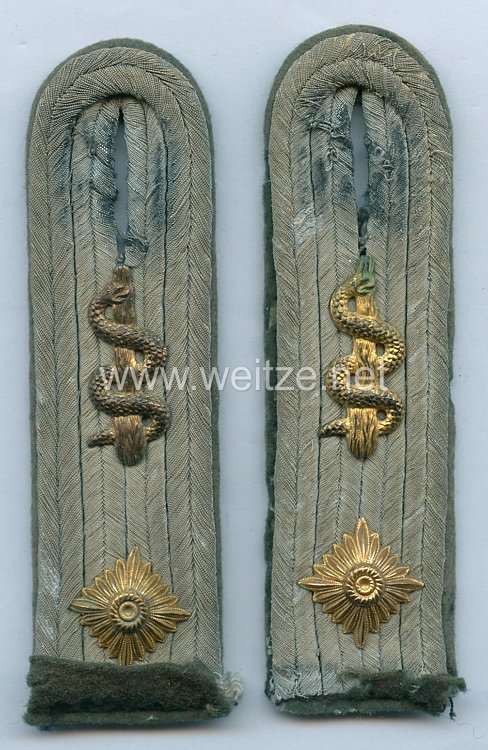
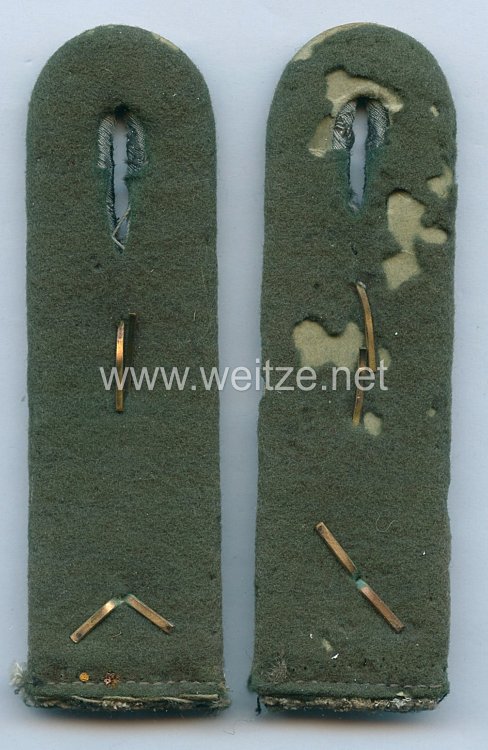
Kriegsmarine Pair of Shoulder Boards Senior Physician of Land Units
These shoulder boards of a Kriegsmarine Oberarzt (Senior Medical Officer) for land units represent a fascinating chapter of German naval history during World War II. These rank insignia combine medical expertise with military rank and reflect the complex organizational structure of the Kriegsmarine.
The Kriegsmarine, which existed as the official navy of the German Reich from 1935 to 1945, required, like all branches of service, a comprehensive medical service. Physicians in the Kriegsmarine held officer ranks and were assigned to various service areas, including ship service, coastal services, and naval land units. These land units included naval garrisons, naval schools, shipyards, and especially the naval infantry as well as naval aviation units.
The rank of Oberarzt in the Kriegsmarine corresponded to the service grade of Oberleutnant zur See (Senior Lieutenant at Sea). This represented the second officer rank, after Leutnant zur See (Lieutenant at Sea). The equivalence in rank between medical officers and line officers followed a long tradition in the German Navy and was intended to ensure the authority of medical officers in daily naval operations. An Oberarzt had typically completed medical training and possessed several years of service time.
The shoulder boards described here were intended for the field-gray uniform, which confirms their use with land units. While naval officers at sea and on ceremonial occasions wore the dark blue naval uniform, members of naval land units frequently used field-gray uniforms that were similar to those of the Wehrmacht. This practice had practical reasons: the field-gray uniform was better suited for land operations and differed less from the uniforms of other Wehrmacht branches.
The sewn-in shoulder boards were permanently attached to the uniform, in contrast to the removable shoulder boards for parade uniforms or dress uniforms. The construction followed the Wehrmacht dress regulations from the years 1935 to 1945, which detailed the design of all uniform components. For an Oberarzt of land units, the shoulder boards typically displayed a silver-colored background with the corresponding rank braid in the form of a single star, combined with the branch color of the Medical Service, which was characterized by a cornflower blue background.
The Medical Service of the Kriegsmarine was organizationally subordinate to the Naval High Command and had its own administration. Medical officers were trained at specialized naval schools and had to acquire, in addition to their medical qualifications, military and navy-specific knowledge. The training included, besides general medicine, specialized knowledge such as the treatment of diving diseases, burns from ship fires, and the special challenges of casualty care at sea.
The use with land units suggests that the wearer of these shoulder boards possibly served in a naval garrison, a naval hospital on land, a naval shipyard, or with the naval ground forces such as naval artillery battalions or coastal defense units. Particularly toward the end of the war, naval personnel, including medical staff, were increasingly deployed for land operations.
The mentioned moth damage is a typical characteristic of textile militaria from this period. Uniform items made of wool were particularly susceptible to moth infestation, especially when stored under suboptimal conditions over decades. This state of preservation is found in many surviving uniform pieces from World War II and diminishes the material but not the historical value of such objects.
As collectibles, such shoulder boards offer valuable insights into the uniform history and organization of the Kriegsmarine. They document the detailed rank structure and the various specializations within the Navy. For military historical research, they are important witnesses to everyday culture and the material legacy of World War II. They also serve as reminders of the often-overlooked role of medical officers who performed their medical duties under difficult conditions.