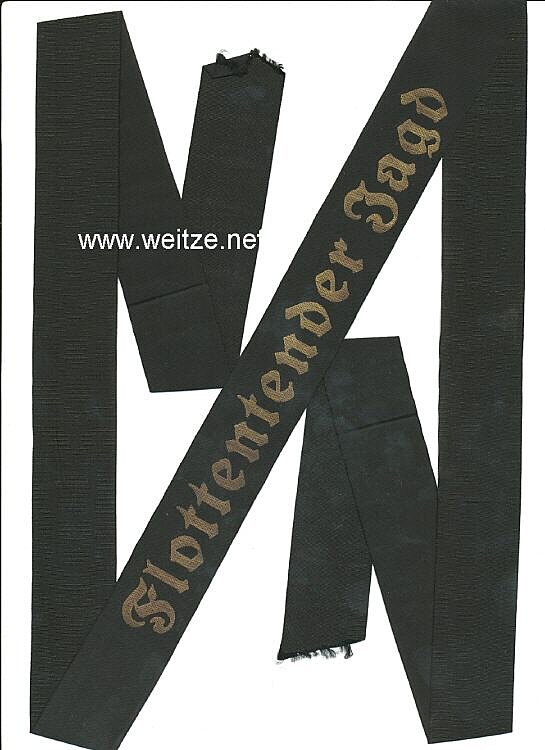
Kriegsmarine Cap Tally "Flottentender Jagd"

Metal thread woven construction, length: 150 cm, condition 2.
145557
90,00

Kriegsmarine Cap Tally "Flottentender Jagd"

The Kriegsmarine cap tally bearing the inscription “Flottentender Jagd” represents an authentic artifact from German naval history during World War II. This metal-thread woven example constitutes a high-quality variant of the standardized headgear identification worn by members of the Kriegsmarine.

The Kriegsmarine, as the naval force of the German Reich from 1935 to 1945, instituted strict uniform regulations governed by various ordinances and decrees. The cap tally formed an integral component of the sailor's uniform and served to identify the respective ship's crew or unit. The tradition of cap tallies in the German Navy dates back to the 19th century and was inherited from the Imperial Navy.

The Flottentender Jagd belonged to the category of auxiliary and supply vessels of the Kriegsmarine. Fleet tenders were specialized supply ships deployed for logistical support of naval formations. These vessels played a crucial role in maritime infrastructure, transporting ammunition, provisions, fuel, and other necessary materials to operational units. The name “Jagd” (Hunt) followed the German naval tradition of naming ships after activities, geographical designations, or characteristic terms.

The metal-thread weaving of this cap tally identifies it as a particularly high-quality variant. While simple cap tallies were made from cotton or artificial silk, higher-quality versions used metallized threads that gave the band a characteristic luster. These metal threads typically consisted of silver-plated or tinned copper wire wound around a textile core. Such versions were more elaborate to produce and are particularly valued today as authentic period documents.

The standard length of approximately 150 cm corresponded to regular Kriegsmarine specifications and enabled the characteristic tying at the back of the head with hanging ends, as prescribed for naval uniforms. The lettering also followed standardized guidelines: the letters were executed in golden-yellow or silver-colored script on a black background, with the designation of the ship or unit appearing in Latin block letters.

The production of cap tallies was conducted by specialized textile manufactories and uniform tailors authorized by the Kriegsmarine. Known manufacturers included various North German establishments possessing the required expertise in ribbon weaving. Quality control was subject to military standards to ensure uniformity and durability.

Fleet tenders like the “Jagd” were indispensable for the operational command of the Kriegsmarine. They enabled naval formations to remain at sea for extended periods without returning to ports. This was particularly significant in the Atlantic and remote operational areas from a strategic standpoint. The crews of these supply vessels made an important, though often less recognized, contribution to maritime warfare.

After the war's end in 1945, most Kriegsmarine units were dissolved or taken over by the Allies. Uniform parts and personal equipment of former crew members entered private collections through various channels. Today, authentic cap tallies represent important military-historical documents providing insight into the organizational structure and material culture of the German Navy.

For collectors and historians, such cap tallies offer valuable information about specific ships and units. Research into ship histories, deployments, and the fates of crews contributes to understanding naval history. At the same time, handling such objects requires historical sensitivity and contextualization within the Nazi period.

The preservation of this cap tally in good condition over nearly eight decades testifies to the quality of materials and workmanship. While metal-thread fabrics were more resistant than pure textile bands, they nevertheless required careful storage to prevent oxidation and mechanical damage.

The study of these maritime artifacts contributes to a comprehensive understanding of World War II naval operations and the daily lives of sailors who served aboard support vessels. The Flottentender Jagd, though not a combat vessel, represented an essential link in the naval supply chain, and its cap tally remains a tangible connection to that historical reality.