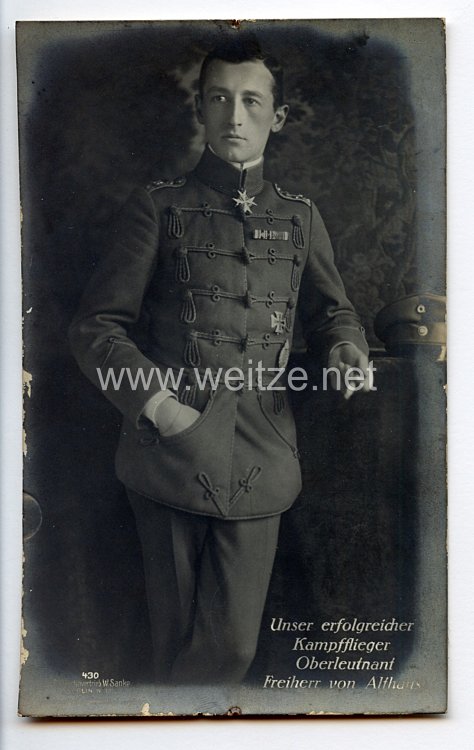
WWI Aviation - Photo Postcard - German Flying Ace "Oberleutnant Freiherr von Althaus"

on Sanke card No. 430, unused, condition 2-.
330457
20,00

WWI Aviation - Photo Postcard - German Flying Ace "Oberleutnant Freiherr von Althaus"

The present Sanke postcard No. 430 depicts Oberleutnant Freiherr von Althaus, one of the most renowned German fighter pilots of World War I. This card belongs to an extensive series of photographic postcards published by the Berlin-based publisher Gustav Liersch & Co. under the name “Sanke” during the war.

The Sanke postcards represented one of the most significant forms of propaganda in the German Empire during World War I. Between 1914 and 1918, the publisher produced several hundred different motifs featuring fighter aces, U-boat commanders, infantry officers, and other military personalities. These cards served not only for message transmission but also for hero worship and strengthening morale on the home front.

Oberleutnant Ernst Freiherr von Althaus (1890-1946) was an exceptional fighter pilot who achieved nine confirmed aerial victories during the war, although unofficial sources suggest up to 21 victories. Von Althaus began his military career in 1909 as a lieutenant in the Royal Saxon Uhlan Regiment. At the outbreak of war in 1914, he initially fought in the cavalry before transferring to the flying service in 1915.

After his training as a pilot, von Althaus was initially deployed as a reconnaissance and bomber pilot. In March 1916, he transferred to Kampfeinsitzer-Kommando Vaux, one of the early fighter squadrons. His career as a fighter pilot developed rapidly, and he soon became one of the most experienced pilots in the Imperial Air Service.

In October 1916, von Althaus assumed command of Jagdstaffel 10, which he led until April 1917. Subsequently, he commanded Jagdstaffel 14 and later Jagdstaffel 24. His military achievements were recognized with the Pour le Mérite, Prussia's highest military decoration, which he received on May 14, 1918 – an honor bestowed only upon the most successful and courageous officers.

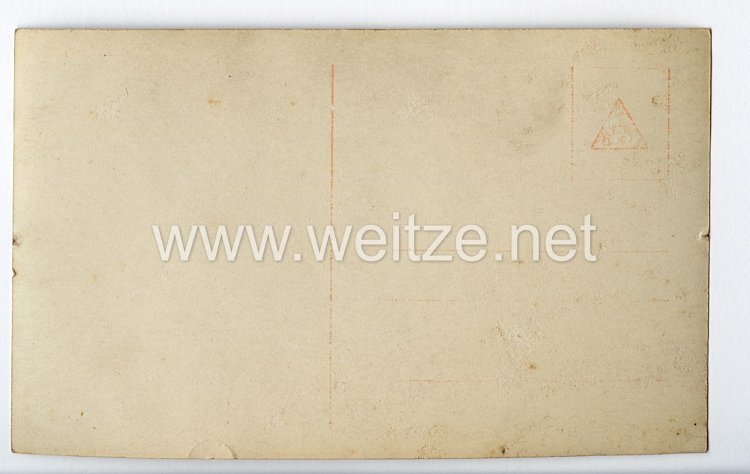
The photographic representation on Sanke cards followed a standardized format: pilots were usually depicted in uniform with their decorations, often in three-quarter profile or frontal view. These professional studio photographs emphasized the status of pilots as modern knights of the air. The reverse side of the cards typically bore the publisher's information and often a number from the series.

The condition rating of “2-” according to the philatelic grading scale indicates a very well-preserved card with possibly only minimal signs of wear. As an unused card – never posted – this specimen possesses particular collector value.

The cultural-historical significance of such postcards cannot be underestimated. They represent the emergence of a new hero type in the 20th century: the fighter pilot. Unlike the anonymous mass warfare in the trenches, aerial combat offered the possibility of individual heroic deeds reminiscent of the romanticized chivalry of earlier epochs. This notion was deliberately promoted through propaganda material such as the Sanke cards.

After the war, von Althaus emigrated to Turkey, where he helped establish the Turkish air force and remained until 1928. He later returned to Germany and died in Stuttgart in 1946. His career reflects the transformation of military aviation from experimental beginnings to a decisive branch of armed forces.

For collectors of military-historical objects, Sanke cards represent important period documents. They combine photographic documentation with propaganda history and offer insights into the visual culture of World War I. Cards featuring Pour le Mérite recipients like von Althaus are among the most sought-after specimens of this series.

r