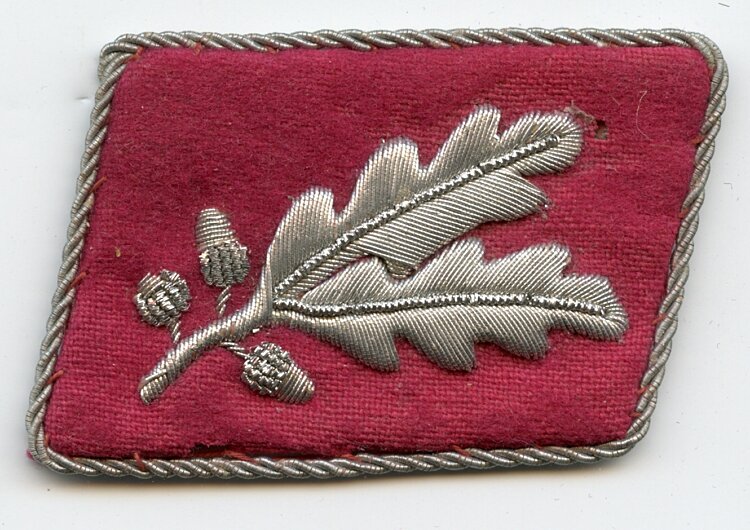
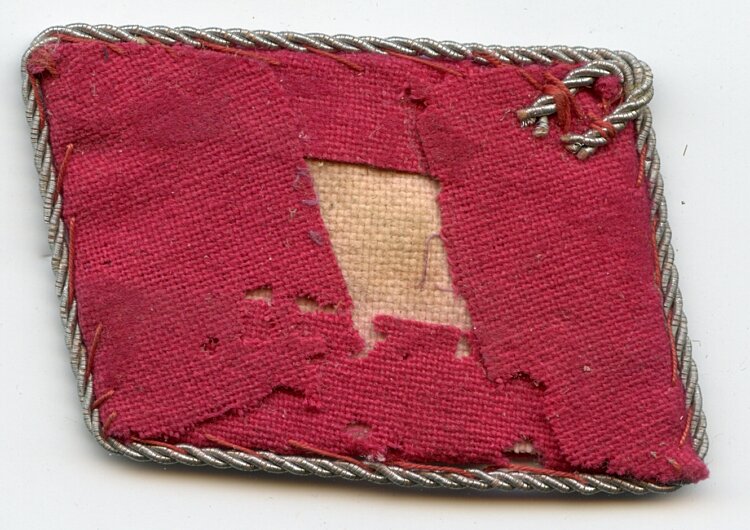
Single Collar Tab for an SA-Oberführer on the Staff of the Supreme SA Leadership
The presented collar tab of an SA-Oberführer from the staff of the Supreme SA Leadership represents a significant rank insignia from the National Socialist period, datable to around 1936. This left collar tab displays artful hand embroidery with silver metal thread in the form of oak leaves on a crimson background and embodies the strict hierarchy and sophisticated rank insignia system of the Sturmabteilung (SA).
The Sturmabteilung was founded in 1920/21 as a paramilitary combat organization of the NSDAP and rapidly developed into the largest political militia of the Weimar Republic. After the seizure of power in 1933, the SA experienced enormous growth in membership, reaching over four million members by 1934. The rank of Oberführer corresponded approximately to a colonel in the Wehrmacht and represented a high leadership rank within the SA hierarchy.
The year 1936, when this insignia was manufactured, marks a phase of consolidation after the dramatic events of the so-called “Röhm Affair” of June 30, 1934. During this “Night of the Long Knives,” SA Chief of Staff Ernst Röhm and numerous other SA leaders were murdered. Afterwards, the SA lost considerable political influence to the SS, but remained as an organization and retained its uniforms and rank insignia.
The Supreme SA Leadership (OSAF) formed the central leadership level of the Sturmabteilung with headquarters in Munich. Officers belonging to the OSAF staff wore special collar tabs that identified their affiliation with this elite level. The use of a crimson background was specific to staff members of the highest leadership level and distinguished them from regular SA units, which wore different collar tab colors.
The hand embroidery with silver thread was characteristic of higher ranks from Standartenführer upwards. In contrast to machine-made or simpler versions for lower ranks, the elaborate handwork demonstrates the high status of the wearer. The oak leaf motif had symbolized bravery, loyalty, and steadfastness in German military tradition since the 19th century and was used in various forms in rank insignia.
The collar tabs were worn in pairs, left and right on the collar of the brown SA uniform. While the right collar tab frequently bore additional symbols or unit identifiers, the left tab typically displayed the oak leaves in the execution corresponding to the rank. The quality of the embroidery and the materials used varied depending on the manufacturer and time of production.
The SA uniform regulations were revised and refined multiple times. The SA Service Dress Regulations detailed the appearance and wearing of rank insignia. For an Oberführer, in addition to the collar tabs, shoulder boards with corresponding rank stars and possibly additional decorations were prescribed.
After the war, SA uniform parts and insignia were classified by the Allies as symbols of unconstitutional organizations. In Germany today, they are subject to the provisions of § 86a StGB, which criminalizes the use of symbols of unconstitutional organizations. Exceptions apply for historical, scientific, and educational purposes, which is why such objects are kept in museums and collections with appropriate documentation.
The condition rating “Condition 2” indicates that the piece was worn and shows slight signs of use, but is overall well preserved. This is typical for personal equipment items from this period that were actively used in service. The hand embroidery still shows the original quality of workmanship despite its age.
From a military-historical perspective, such objects are important testimonies to the organizational and uniform history of the Nazi era. They document the pronounced hierarchy, the symbolic language, and the material culture of paramilitary organizations in the Third Reich. For research, they offer insights into manufacturing techniques, wearing regulations, and social differentiation within the organization.