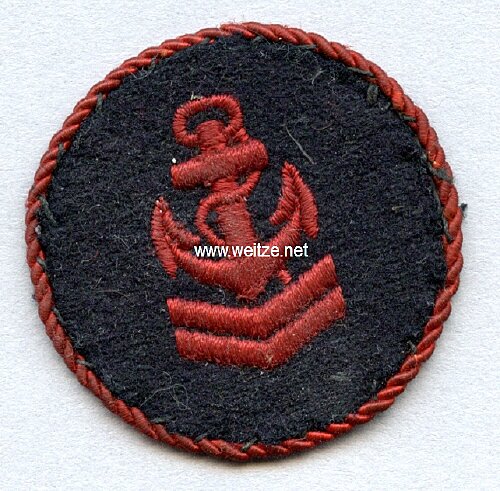
Marine-HJ Sleeve Insignia Reichsseesportprüfung B, as K-Schein

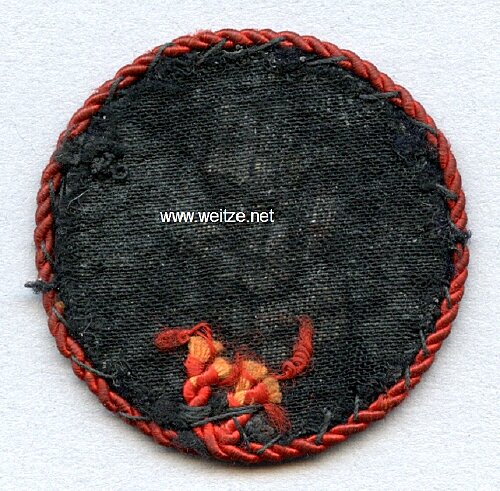
Machine-embroidered version for the blue naval blouse. Worn, condition 2-. Very rare.
229356
125,00

Marine-HJ Sleeve Insignia Reichsseesportprüfung B, as K-Schein

The Marine-HJ sleeve badge for the Reich Maritime Sports Test B, also known as the K-Schein, represents a rare and historically significant artifact of maritime youth training in National Socialist Germany. This machine-embroidered badge was worn on the blue naval blouse of the Marine-Hitlerjugend (Naval Hitler Youth) and documents the close integration between the paramilitary youth organization and maritime training in the Third Reich.

The Marine-Hitlerjugend was established in 1933 as a specialized unit of the HJ under the Reich Youth Leadership. Its primary mission was to prepare young people aged 10 to 18 for later service in the Kriegsmarine (German Navy). The organization provided systematic maritime training and was intended to create a reserve of pre-trained recruits for the Navy. By 1939, over 50,000 youths were organized in the Marine-HJ.

The Reichsseeportprüfung (Reich Maritime Sports Test) was introduced in the 1930s as part of the training program. It was divided into various achievement levels, with Test B (also called K-Schein) representing an intermediate qualification level. The “K” likely stood for Küstenschein (Coastal Certificate) or a similar designation indicating specific nautical knowledge. The examination included theoretical and practical elements of seamanship, navigation, meteorology, and boat handling.

The badge itself exhibits typical characteristics of HJ uniform insignia of that period: It was manufactured in machine-embroidered execution on navy blue base material and worn on the left upper arm of the service blouse. Embroidery was usually done in white or silver-colored thread, corresponding to the maritime character. Manufacturing quality varied depending on production site and year, with earlier examples often more elaborately embroidered than later wartime productions.

The awarding of such achievement badges followed a strictly regulated system. After successfully completing the Reich Maritime Sports Test B, the bearer received the right to wear the corresponding badge on his uniform. This occurred after official conferment by the responsible offices of the Marine-HJ. The badges were recorded in personnel files and served as proof of special maritime abilities.

The blue naval blouse of the Marine-HJ differed significantly from the standard HJ uniform. It was modeled after the Kriegsmarine and consisted of dark blue cloth with a characteristic sailor collar. This uniforming was intended to emphasize the special position of the Marine-HJ within the overall organization and foster identification with the Kriegsmarine.

The historical significance of such badges lies in several aspects: First, they document the systematic pre-military training of youth in the NS state. Second, they demonstrate the professionalization of HJ training in specialized areas. Third, they evidence the close cooperation between the HJ and Wehrmacht, particularly the Kriegsmarine.

After 1945, all HJ references and insignia were prohibited by the Allied occupation powers. The wearing, display, and trade of such objects remain subject to strict legal regulations in Germany under §86a StGB, with exceptions for scientific, historical, and educational purposes.

For collectors and historians, such badges today hold considerable documentary value. The rarity of this specific badge is explained by several factors: the relatively small number of bearers who successfully completed Test B, the destruction of many uniform items after the war's end, and natural deterioration through decades of storage. Examples in worn condition like the one described are authentic contemporary witnesses and provide important insights into the maritime youth education of the Third Reich.

Research into such objects contributes to understanding the total penetration of society by National Socialist organizations and shows how systematically youth were instrumentalized for military purposes.