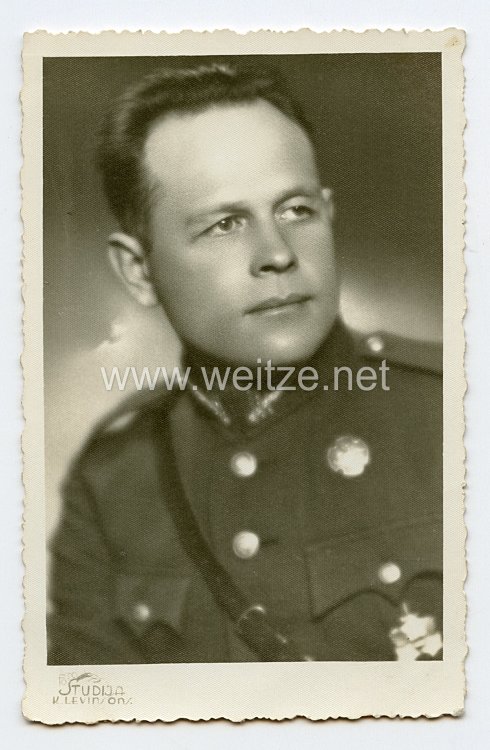
Latvia Portrait Photograph of a Soldier
This portrait photograph of a Latvian soldier from the 1930s represents a significant historical document that provides insight into the military culture and photographic practices of independent Latvia during the interwar period.
After gaining independence in 1918, the Republic of Latvia (Latvijas Republika) developed its own armed forces, the Latvijas Armija. This army played a crucial role in defending the young nation during the Latvian War of Independence (1918-1920) against Soviet and German-Baltic forces. The Latvian army of the interwar period was organized along the lines of Western European armed forces and included various branches such as infantry, cavalry, artillery, and later modern technical units.
Military portrait photography in postcard format was extraordinarily widespread throughout Europe during the 1920s and 1930s. Soldiers had themselves photographed in uniform to send these images to family and friends or to keep as personal mementos. The postcard size (typically 9 x 14 cm or similar formats) was the standard for private photographs at the time and enabled cost-effective postal delivery.
During the 1930s, the Latvian army wore characteristic uniforms distinguished by specific details. The basic color was usually field grey or khaki, with different branches of service marked by various badges, collar patches, and shoulder boards. The uniforms often displayed the Latvian state coat of arms or military rank insignia designed according to a precise system.
Latvia's political situation in the 1930s was marked by increasing instability. Following the coup d'état by Kārlis Ulmanis in 1934, the country developed into an authoritarian regime. However, the army remained an important state institution and symbol of national sovereignty. Military service was compulsory, and serving in the armed forces was considered honorable and patriotic.
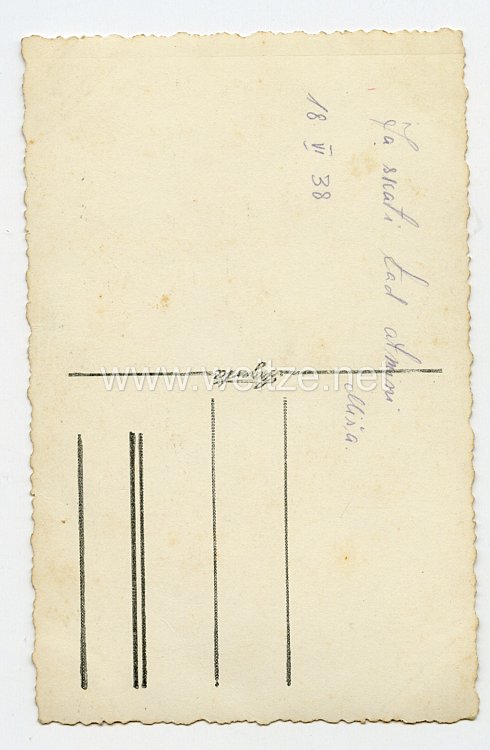
Photographic studios in Latvia's larger cities such as Riga, Liepāja, and Daugavpils specialized in military portraits. These photographs often followed a standardized format: the soldier posed in full uniform, frequently with headgear, sometimes with weapons or other military attributes. The background was usually neutral or displayed military symbols. The reverse side of these postcards often bore the photographer's studio stamp and space for personal dedications.
The photographic technology of the 1930s had already advanced considerably. Cameras had become more portable, and exposure times had shortened, allowing for more natural poses. Images were developed on light-sensitive paper, resulting in the characteristic sepia toning or black-and-white aesthetic of the era.
The historical context of these photographs was fundamentally changed by the dramatic events beginning in 1939. The Molotov-Ribbentrop Pact of 1939 sealed the fate of the Baltic states. In June 1940, Latvia was occupied and annexed by the Soviet Union, the Latvian army was dissolved, and many officers were deported or executed. German occupation followed in 1941, before Soviet rule was re-established in 1944/45, lasting until 1991.
Such photographs acquired particular documentary and emotional value after these events. For many families, they were the only remaining memories of relatives who perished in the turmoil of war, through deportations, or political persecution. The “used condition” of such objects testifies to their history as personal mementos that were preserved, viewed, and passed down.
Today, these photographs constitute important historical sources. They document not only uniforms and military equipment but also social history, individual destinies, and the visual culture of a vanished era. The Latvian War Museum (Latvijas Kara muzejs) in Riga preserves extensive collections of such photographs. For historical research, they offer insights into uniform studies, military hierarchies, and the everyday history of the military during the interwar period.