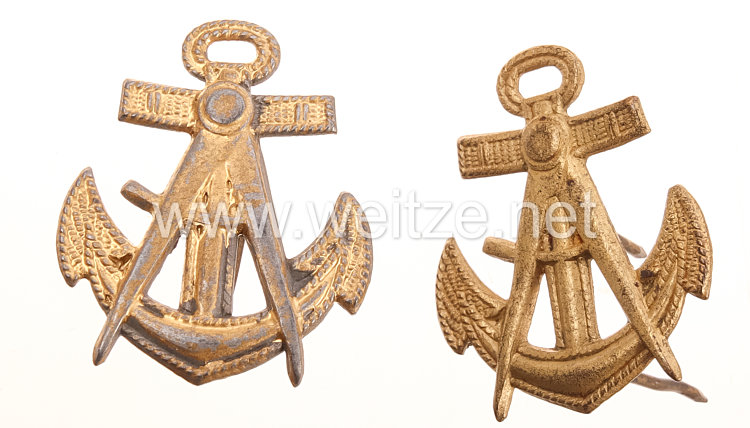
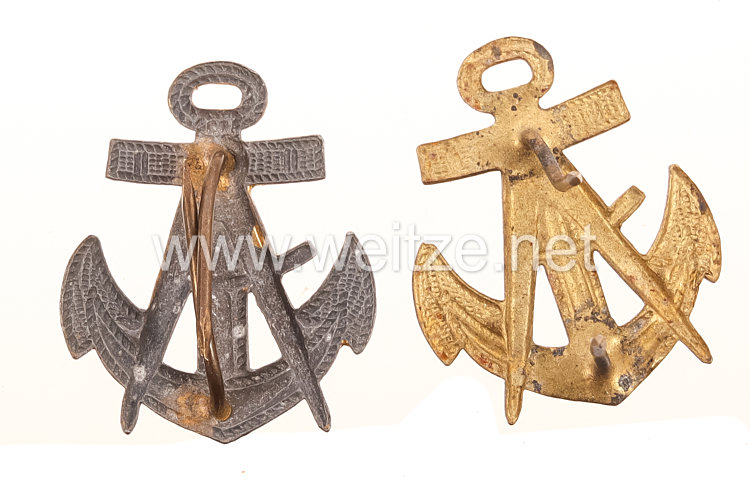
Kriegsmarine Pair of Shoulder Board Overlays for Petty Officers with Portepee of the Carpenter Branch

Zinc alloy, all split pins present, condition 2+
441556
45,00

Kriegsmarine Pair of Shoulder Board Overlays for Petty Officers with Portepee of the Carpenter Branch

The present shoulder board insignia for Kriegsmarine petty officers with portepee in the carpenter specialty represent an authentic example of rank insignia used during World War II in the German Navy. These paired insignia made of fine zinc document the differentiated rank system of the Kriegsmarine and the specific identification of various career paths.

The Kriegsmarine, officially founded on June 1, 1935, was the naval force of National Socialist Germany. After World War I and the restrictions of the Treaty of Versailles, a modern rank system was established during the rearmament under Grand Admiral Erich Raeder and later Karl Dönitz, which was based on Prussian-German naval traditions.

The system of Portepeeunteroffiziere (petty officers with portepee) designated the senior non-commissioned officer ranks, distinguished by special qualifications and responsibilities. The term “Portepee” derives from the French “porte-épée” (sword carrier) and historically identified those non-commissioned officers who were entitled to carry a sword or saber – a symbol of their elevated status. In the Kriegsmarine, the Portepeeunteroffiziere comprised ranks from Maat (mate) upward to Stabsoberbootsmann (staff chief boatswain) or corresponding ranks in specialized career paths.

The carpenter specialty belonged to the technical specialized career paths of the Kriegsmarine. Carpenters were responsible for all carpentry and joinery work aboard ship, particularly for woodwork, repairs to deck structures, hatch covers, and other wooden ship components. Despite increasing metal construction, the profession of ship's carpenter remained important, as wood continued to be used for various purposes aboard, from furniture to insulation to special constructions.

The shoulder boards of the Kriegsmarine were manufactured according to the uniform regulations and corresponding dress codes. The described insignia made of fine zinc were typical of mass production during the war years. While early examples were often made of higher-quality materials such as silver-plated metal, wartime material shortages led to simplified production methods and the use of substitute materials.

The identification of the career path was accomplished through specific specialty badges attached to the shoulder boards. For the carpenter specialty, this was typically a crossed axe and broad axe or similar carpenter-specific symbols. These badges were fastened to the back of the shoulder board by means of split pins, which ensured secure and permanent attachment. The complete preservation of all split pins, as with the described examples, is of particular significance for collectors and historians, as these small fastening elements were often lost.

The rank identification of Portepeeunteroffiziere on the shoulder boards was accomplished through metal braids and possibly through stars, which indicated the respective rank within the group of petty officers with portepee. The basic color of the shoulder boards was dark blue, corresponding to the branch color of the Kriegsmarine.

Organizationally, carpenters were assigned to the technical division. Their training took place both in special naval schools and in practical work aboard ship. Promotion to Portepeeunteroffizier required several years of service, special aptitude, and appropriate courses.

The condition rating 2+ indicates very good preservation with only minimal signs of wear. This is remarkable for objects made of fine zinc, which can be susceptible to corrosion. Careful storage over decades has preserved these historical insignia.

Such shoulder board insignia are today important military-historical sources that document the differentiated organizational and rank system of the Kriegsmarine. They demonstrate the importance of specialized craft professions in the Navy and the recognition accorded to these specialists through their own career path badges. For maritime historical research, they are indispensable study objects for understanding the personnel structure and material culture of the German Kriegsmarine between 1935 and 1945.

r