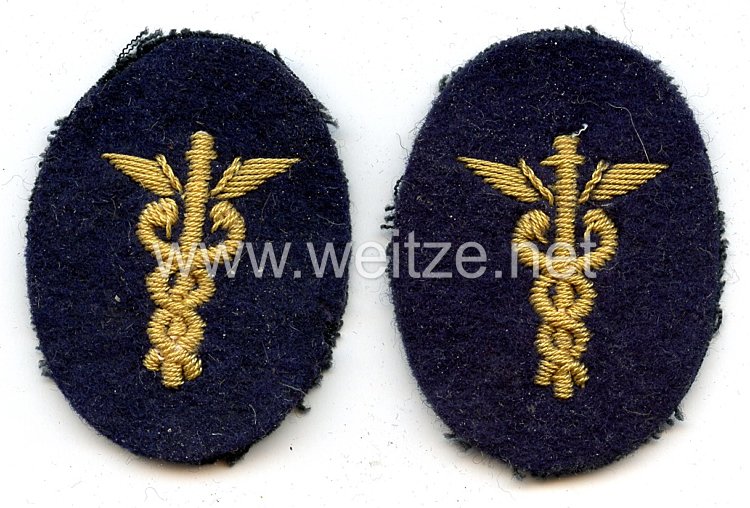
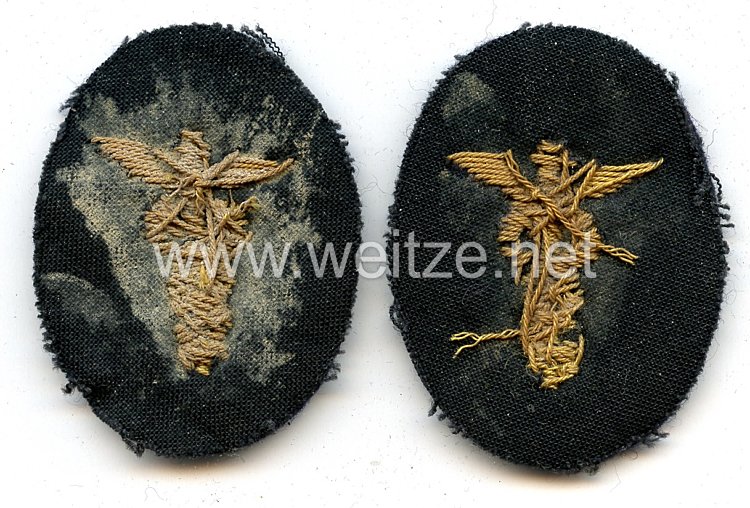
Kriegsmarine Pair of Sleeve Insignia for an Administration Officer
The sleeve insignia for administrative officers of the Kriegsmarine represent a fascinating example of the complex rank insignia system of the German Navy during World War II. These hand-embroidered badges made of Cellon, an early plastic material, were essential components of the uniform and served for immediate identification of an officer's position and specialization.
The Kriegsmarine, officially established in 1935 and replacing the Reichsmarine of the Weimar Republic, developed a comprehensive system of uniform regulations and insignia. Administrative officers formed an important, often overlooked part of the naval organization. They were responsible for logistics, supply, pay, legal matters, and the entire administrative infrastructure without which no modern navy could function.
The sleeve badges or sleeve braids were worn on both sleeves of the uniform jacket and indicated through their specific arrangement of stripes and ranks the precise position of the wearer within the hierarchy. For administrative officers, the color scheme was crucial: while sea-going officers wore gold braids on a dark background, administrative officers used a characteristic color combination that marked their special function within the navy. The dark blue color was typical for administrative positions.
The manufacture of these badges from Cellon is particularly noteworthy. Cellon was a trade name for cellulose acetate, a thermoplastic material that was widely used in the 1920s and 1930s. The use of Cellon for military insignia offered several advantages: the material was lighter than metal wire, more cost-effective to produce, and could still be processed to high quality. The hand embroidery on a Cellon base required considerable craftsmanship and was carried out by specialized manufacturers, often with traditions dating back to the Imperial era.
The quality levels of the badges varied considerably. There was the standard troop version, often machine-made, and the higher-quality officer's version, which was hand-embroidered. The latter was frequently purchased by the officers themselves from private tailors and military equipment dealers, leading to quality variations. The hand-embroidered version described here represents the higher quality level.
The pair of sleeve badges is significant insofar as both sleeves of a uniform jacket had to be equipped accordingly. The symmetrical placement was precisely regulated by uniform regulations. The dress regulations for the Kriegsmarine, which were updated several times during the war, specified exactly how and where these badges were to be worn.
Administrative officers underwent special training that differed from the naval career path. They often came from legal, economic, or administrative professions and were trained for their specific tasks within the naval organization. Their role became particularly important during the war as the logistical challenges of a globally operating navy became immense.
The stated condition 2 in collector grading indicates a well-preserved specimen that may show slight signs of use but is still largely intact. This is remarkable as Cellon-based materials can deteriorate over the decades, especially if improperly stored.
The preservation of such military-historical objects is of considerable importance for research. They enable a detailed understanding of organizational structure, material culture, and the everyday reality of military service. At the same time, such objects must be viewed in the context of their time – as testimonies of a criminal regime whose military apparatus was implicated in the crimes of National Socialism.
Today, such sleeve badges are sought-after collector's items for militaria collectors and important study objects for museums and historical research institutions. They help document and understand the complex structure of the German armed forces.