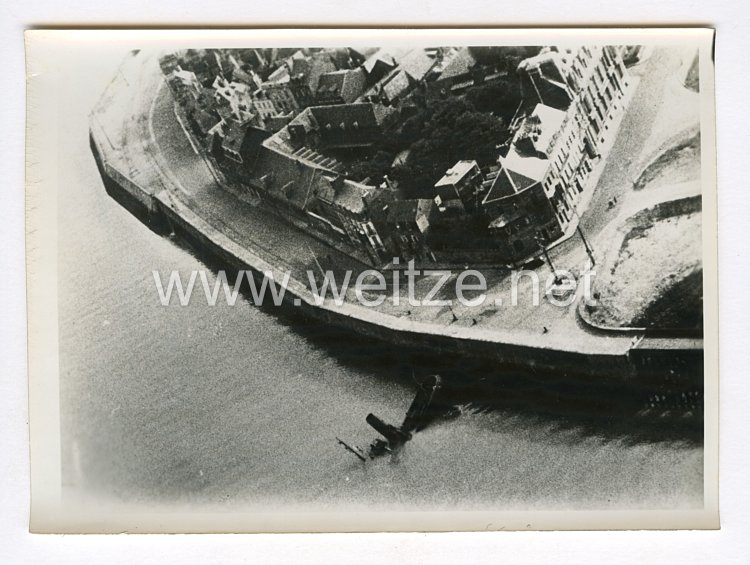
Third Reich Press Photo. Destroyed by Bomb Hit. July 4, 1940.

Dimensions approx. 13 x 18 cm, with description on reverse, used condition. 
314256
10,00

Third Reich Press Photo. Destroyed by Bomb Hit. July 4, 1940.

Press Photography in the Third Reich: Documenting the Bombing War of 1940

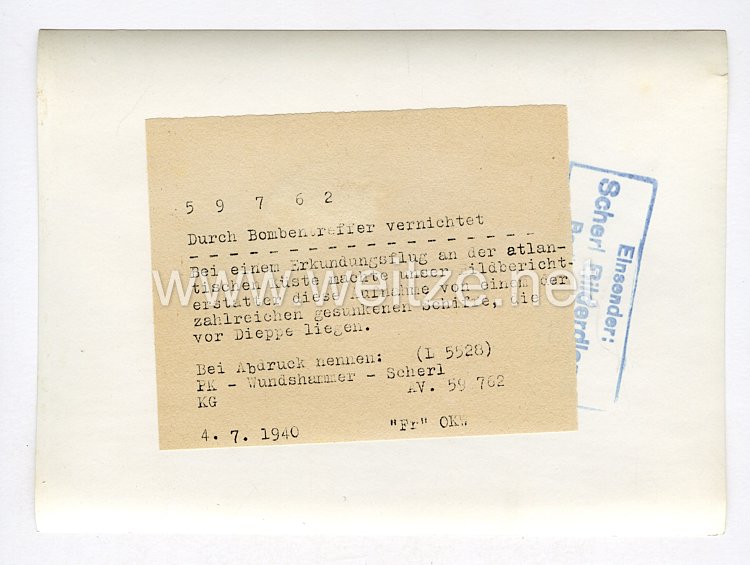
The present object is a press photograph from the Third Reich era, dated July 4, 1940, with the caption “Destroyed by bomb hit”. Measuring approximately 13 x 18 centimeters, it corresponds to the standard format for press images produced for newspapers, magazines, and archives of that period. The description on the reverse clearly identifies it as official propaganda material.

Historical Context: Summer 1940

July 1940 marks a decisive phase of World War II. Following the successful Western Campaign and France's capitulation on June 22, 1940, the German Reich stood at the height of its military successes. Simultaneously, the conflict with Great Britain began to intensify. The Battle of Britain would officially begin in August 1940, but already in July, air raids by both sides were increasing.

The NS Press System and Propaganda Machinery

Control over image and word was of central importance in National Socialist Germany. The Reich Ministry of Public Enlightenment and Propaganda under Joseph Goebbels exercised comprehensive censorship and direction of all media. Press photographs were systematically employed to shape public opinion and justify the conduct of war.

Photographers working for the NS press were frequently organized in the Wehrmacht's Propaganda Companies (Propagandakompanien or PK). These units were established as early as 1938 and accompanied troops to collect material for the home front. Every image underwent strict controls before being approved for publication.

Bombing War and Destruction in 1940

In the summer of 1940, the British Royal Air Force (RAF) intensified its attacks on military and industrial targets in German Reich territory and occupied areas. Simultaneously, the German Luftwaffe began intensified attacks on British ports, convoys, and increasingly on cities. The bombing war, which would later assume devastating proportions, was in its initial phase.

Photographs of bomb damage served multiple propaganda functions: they were meant to portray the enemy as unscrupulous, prepare one's own population for hardships, strengthen the will to persevere, and justify retaliation. The visual language was carefully staged to achieve maximum emotional impact.

Technical Aspects of Press Photography

The 13 x 18 cm format was a standard size for press images, well-suited for reproduction in newspapers. The photographs were typically printed on baryta paper, which allowed for good detail reproduction. The reverse description usually contained information such as date, location, image content, and often a censorship stamp as well as distribution information.

Distribution and Usage

Such press photos were distributed through central photo agencies like the German News Bureau (Deutsches Nachrichtenbüro or DNB) or the Hoffmann Agency to newspapers and magazines throughout the Reich and in allied countries. They appeared in publications such as the “Völkischer Beobachter”, the “Berliner Illustrierte Zeitung”, or local daily newspapers.

Collectible Value and Historical Significance

Today, such press photographs are important historical documents that provide insight into the propaganda methods of the NS regime. They illustrate not only the documented events but also the manner in which these events were to be presented to the public. For historians, the reverse notations are particularly significant, as they provide information about censorship, distribution channels, and intended use.

The used condition of the present photograph suggests that it was actually employed in an editorial office or archive, which increases its documentary value. Such authentic pieces enable us to understand the mechanisms of news control in the totalitarian state and are indispensable for researching the media history of World War II.

Collecting and Preservation Considerations

Original press photographs from the Third Reich period require careful handling and preservation. They represent primary sources that document both historical events and the propaganda apparatus that sought to control their interpretation. Museums, archives, and private collectors maintain these materials not to glorify the regime, but to preserve evidence of how totalitarian systems manipulate information and public perception.