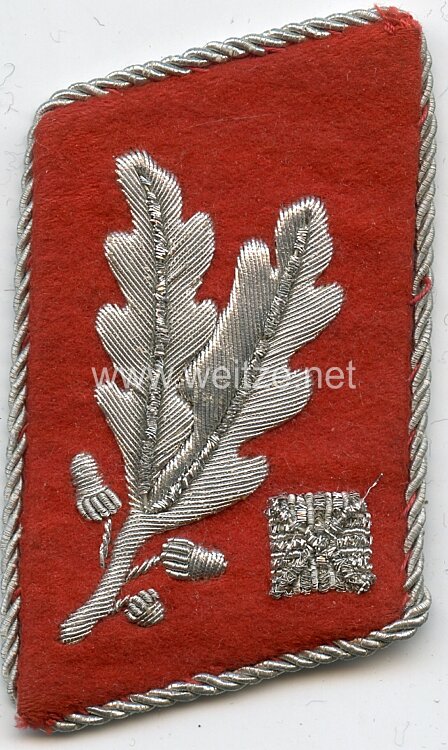
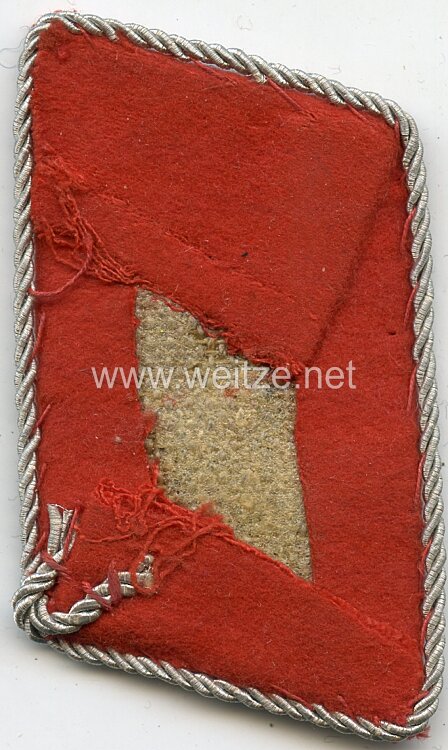
Single Collar Tab for an SA-Brigadeführer on the Staff of an SA-Gruppe

Hand-embroidered in metal thread on red wool, circa 1939. Lightly worn, condition 2.
281856
350,00

Single Collar Tab for an SA-Brigadeführer on the Staff of an SA-Gruppe

The collar tab of an SA-Brigadeführer serving on the staff of an SA-Gruppe represents a significant artifact documenting the organizational structure and rank insignia of the Sturmabteilung (SA) during the National Socialist era. This hand-embroidered insignia in metal thread on a red background embodies the complex hierarchy and symbolic imagery of this paramilitary organization.

The Sturmabteilung was founded in 1920 as a protection formation of the NSDAP and developed into a mass organization with several million members. After the seizure of power in 1933 and particularly following the events of June 30, 1934, known as the “Röhm Putsch,” the SA increasingly lost political significance compared to the SS, but maintained its formal structure and sophisticated rank system.

The rank of Brigadeführer corresponded to a major general in military hierarchy and represented a high leadership rank within the SA organization. The SA was territorially organized into Gruppen (Groups), which were further divided into Brigades, Standarten, Sturmbanne, and smaller units. An SA-Gruppe typically encompassed several brigades and was responsible for a larger geographic area.

The red base color of the collar tab is of particular significance. While most SA members wore collar tabs in various branch colors, red was the designation for staff personnel at the Gruppe level. This made the hierarchical assignment and function of the wearer immediately recognizable. The SA color system followed precise regulations laid down in various uniform regulations.

The hand-embroidery with metal thread identifies these collar tabs as a higher-quality version. While simpler ranks often wore machine-made or printed insignia, hand-embroidered examples were frequently used for higher leadership ranks. The metal embroidery, usually executed in silver or aluminum, displayed the typical SA rank insignia: for a Brigadeführer, these were typically three oak leaves skillfully hand-crafted onto the red background.

The dating to around 1939 is historically significant. At this time, the SA had already lost its greatest political power but continued to exist as an important organization of the NS state. With the beginning of World War II, many SA members were conscripted into the Wehrmacht, but the organization maintained its structures and was involved in pre-military training, air raid protection measures, and other duties on the home front.

Collar tabs were worn in pairs on both collar sides of the brown SA uniform. The present single collar tab may have been a replacement piece or lost its partner over time. The indicated condition grade 2 with slight signs of wear suggests actual use, with the quality of hand embroidery largely preserved.

The uniforming and insignia system of the SA were regulated multiple times through official regulations. The “Uniform Regulations of the SA” specified in detail which insignia in which version were to be worn by which ranks. These regulations were revised and adapted several times over the years, with the basic collar tab system remaining largely constant.

From today's perspective, such objects are important historical sources for researching NS organizations. They document hierarchical structures, production methods, and material aspects of this period. The craftsmanship quality of the embroidery testifies to the importance attached to symbolic representation and external rank insignia in the SA system.

It is important to emphasize that such objects must be viewed in their historical context: as testimonies of an organization that played a central role in establishing and maintaining the National Socialist dictatorship and was involved in numerous acts of violence. Their preservation and scholarly documentation serves historical research and education, not glorification.