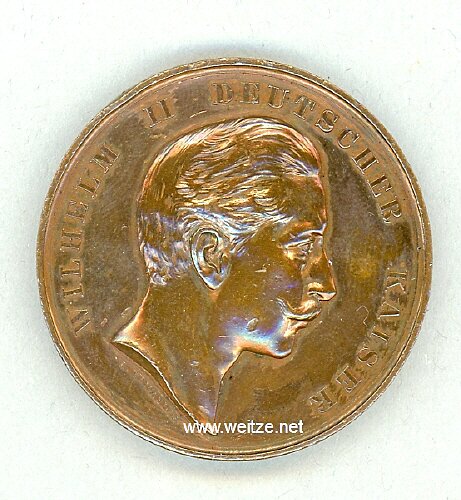
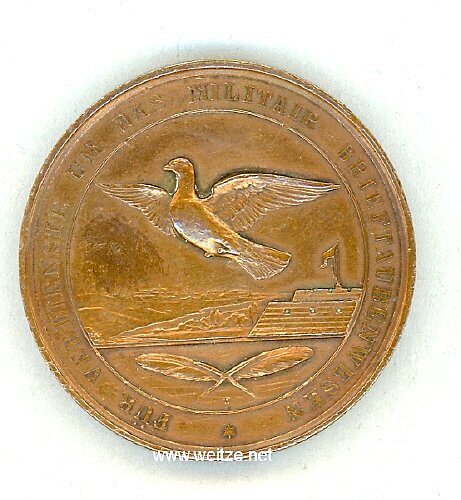
German Reich Bronze Merit Medal for Military Carrier Pigeon Service,

non-portable version, 40 mm, die cutter: “E. Weigand F.”, condition 2
225356
175,00

German Reich Bronze Merit Medal for Military Carrier Pigeon Service,

The Bronze Merit Medal for Military Carrier Pigeon Services of the German Reich represents a fascinating testimony to an often-overlooked facet of military history. This decoration honored the merits of individuals who had distinguished themselves in the development and deployment of carrier pigeons in military communications.

The Military Carrier Pigeon Service gained considerable importance in the late 19th and early 20th centuries. Carrier pigeons proved to be reliable means of communication, especially when other communication channels were interrupted by enemy fire or technical means such as telegraph lines were destroyed. During World War I (1914-1918), carrier pigeons played a crucial role in military message transmission, with thousands of pigeons deployed on all fronts.

The present non-portable version with a diameter of 40 mm was crafted by the die-cutter E. Weigand. The non-portable version differed from the wearable medal by the absence of a suspension loop and ribbon and was primarily designed as a commemorative or honorary piece to be kept in display cases or collections.

The die-cutter Ernst Weigand was a renowned medallist of his time who worked for various state and military institutions. His signature “E. Weigand F.” (where “F.” stands for “fecit,” Latin for “made it”) marks his works and confirms the authenticity and craftsmanship quality of the medal.

The establishment of such decorations for carrier pigeon services occurred in the context of comprehensive military reforms and the professionalization of the German army in the Imperial era. The Prussian War Ministry recognized early the strategic importance of reliable means of communication and systematically promoted the breeding and training of carrier pigeons for military purposes.

During World War I, numerous carrier pigeon stations were established in Germany, and breeders were encouraged to make their best birds available for military service. The pigeons were kept in special lofts at the front and could transmit messages over distances of up to 100 kilometers and more. Their success rate, despite adverse circumstances such as shelling, bad weather, and birds of prey, stood at a remarkable 90 percent.

The bronze merit medal was awarded to individuals who had distinguished themselves through special achievements in breeding, training, or organizing military carrier pigeon services. These included both military personnel and civilians, particularly experienced pigeon breeders who placed their expertise at the service of the fatherland.

After the end of World War I and the collapse of the Imperial Reich in November 1918, the military carrier pigeon service initially lost importance. The provisions of the Treaty of Versailles severely restricted the size and equipment of the German armed forces. Nevertheless, carrier pigeon breeding remained alive as a sport and hobby, and many associations continued to maintain the tradition.

The non-portable version of this medal served primarily representative purposes. It could be presented in framed collections or displayed on special occasions. The condition grade 2 of the present medal indicates very good preservation, with possibly minor signs of use that underscore the historical authenticity of the piece.

Today, such medals are sought-after collectibles that are not only of military-historical interest but also document the history of communication technology and the role of animals in military service. They remind us of a time when the bond between humans and animals in a military context could be of existential importance and saved lives.

r