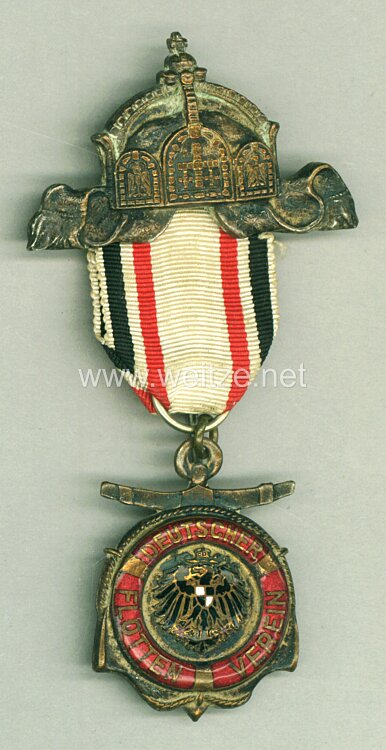
German Fleet Association (DFV)
The German Navy League (Deutscher Flottenverein) and its Honorary Badges
The German Navy League (Deutscher Flottenverein, DFV) was one of the most influential nationalist mass organizations in the German Empire between 1898 and 1934. This organization played a significant role in promoting German naval armament and maritime propaganda under Kaiser Wilhelm II.
Foundation and Historical Context
On April 30, 1898, the German Navy League was founded in Berlin, immediately following the passage of the first Naval Law on March 26, 1898. The association was established on the initiative of Admiral Alfred von Tirpitz, Secretary of State of the Imperial Naval Office, and General Secretary Victor Schweinburg. The League was intended to mobilize public opinion in favor of building a strong German navy and to support the Kaiser's ambitious naval construction plans.
Within a very short time, the DFV developed into a mass organization with impressive membership numbers. By 1901, the League counted over 600,000 members, and at its peak in 1913, membership exceeded one million people organized in more than 1,000 local chapters throughout the German Empire.
Honorary Diplomas and Their Significance
The German Navy League awarded honorary diplomas to particularly meritorious members, patrons, and personalities who had rendered services to the League's objectives. These awards were part of a sophisticated system of recognition and member retention. Recipients of honorary diplomas received special badges as a visible sign of their honor, which they could wear publicly.
The badge for holders of honorary diplomas was a special distinction within the hierarchy of the Navy League. It was manufactured in silver-plated finish and was of higher quality than the regular membership badges. The award was given for exceptional achievements in promoting naval propaganda, significant financial contributions, or long-term meritorious service to the organization.
Design and Manufacturing
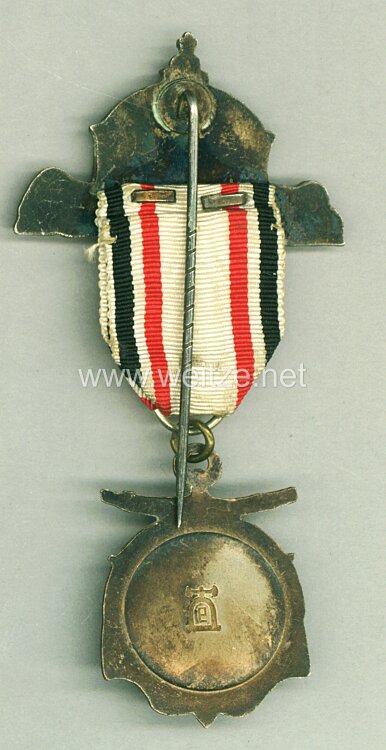
The badges were produced by various renowned manufacturers who marked their products with manufacturer's logos. This practice enables the identification and dating of pieces today. The silver-plated finish emphasizes the honorary character of this award compared to the simpler membership badges.
The badges were typically worn on a ribbon, following the military tradition of German orders and decorations. The long pin on the reverse allowed for secure attachment to clothing. The design followed the iconographic program of the Navy League, which included maritime symbols, patriotic motifs, and often the imperial eagle or anchor.
The Role of the DFV in the Wilhelmine Era
The German Navy League was more than a mere interest group. It functioned as an instrument of state propaganda and was actively supported by the Imperial Naval Office. Through lectures, publications, and events, the organization spread the idea that Germany, as an emerging world power, needed a strong fleet to protect its colonial and economic interests.
This propaganda significantly contributed to approval for the costly naval laws of 1898, 1900, 1906, 1908, and 1912. At the same time, German naval armament intensified tensions with Great Britain and contributed to the constellation that ultimately led to World War I.
After World War I
After the German defeat in 1918 and the provisions of the Treaty of Versailles, which drastically reduced the German Navy, the German Navy League lost its original raison d'ĂȘtre. Although the organization continued to exist until 1934, it played only a marginal role. Its dissolution finally occurred during the Nazi coordination (Gleichschaltung) process.
Collector Value and Historical Significance
Today, the badges and decorations of the German Navy League are sought-after collector's items that represent important testimonies to German naval history and the political culture of the Empire. The honorary badges for diploma holders are rarer than regular membership badges and document the internal hierarchy and award system of this influential organization. They serve as reminders of an era when mass organizations played a central role in mobilizing public opinion and supporting state policy.