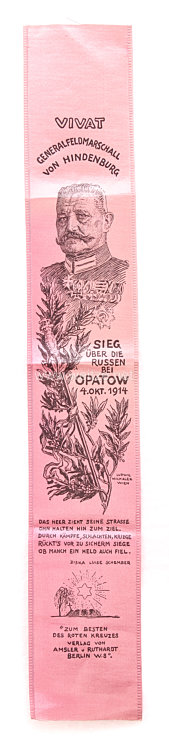
This silk Vivat ribbon represents a significant form of patriotic commemoration culture during World War I. These silk ribbons, manufactured around 1914, served both as bookmarks and wall decorations, documenting important military events from the German perspective.
The ribbon commemorates the victory of German troops under Field Marshal Paul von Hindenburg over Russian forces at Opatów on October 4, 1914. This military success occurred within the context of larger operations on the Eastern Front, where German and Austro-Hungarian troops fought against the Russian Empire. The Battle of Opatów was part of the complex mobile warfare in Poland during the autumn offensive of 1914.
Paul von Hindenburg (1847-1934) had already become a symbolic figure of German resistance through his legendary victory at the Battle of Tannenberg in August 1914, which halted the Russian invasion of East Prussia. Together with his Chief of Staff Erich Ludendorff, he formed a successful military partnership that stabilized the Eastern Front and achieved several significant victories. The veneration of Hindenburg in the German public was immense, making him an ideal figure for patriotic memorabilia.
The Vivat ribbons themselves have a long tradition dating back to the 17th century, when they were used at festive occasions. The term “Vivat” comes from Latin meaning “may he live” - a form of acclamation. During World War I, these ribbons experienced a renaissance as instruments of war propaganda and fundraising.
Particularly noteworthy is the charitable dimension of these objects: proceeds from the sale of Vivat ribbons went to the German Red Cross and other relief organizations. This combined patriotic sentiments with practical support for wounded soldiers and their families. Buyers acquired not only a decorative souvenir but simultaneously contributed to war relief efforts.
Production typically used silk, a high-quality material that was printed or woven with texts, portraits, and patriotic symbols. The length of approximately 40 centimeters was characteristic for these ribbons designed as bookmarks. They frequently displayed portraits of generals, emperors, or other military leaders, combined with battle names, dates, and patriotic sayings.
The production of such memorabilia was part of a comprehensive home front culture that integrated the war into civilian daily life. Alongside Vivat ribbons, there were postcards, pins, medals, and other items celebrating military successes and intended to strengthen public morale.
From today's perspective, these objects offer important insights into the mentality history of World War I. They reveal how military events were publicly staged and commercialized, how hero worship was conducted, and how the connection between front and home was maintained. The enthusiasm expressed in such objects stands in sharp contrast to the actual horrors of industrialized warfare.
The Eastern Front, referenced by this ribbon, was characterized by large-scale movements and shifting battle lines. Unlike the rigidity of trench warfare in the West, the East remained a theater of mobile operations. German successes there, including the victory at Opatów, contributed significantly to the legend-building around Hindenburg.
Collectors and museums today preserve such militaria as important testimonies to the cultural history of World War I. They document not only military events but also the ways societies process, legitimize, and remember wars. The condition rating of 2 for this specimen indicates good preservation, which is quite remarkable for silk ribbons over a century old.
These artifacts remind us of the complex relationship between warfare, commemoration, and society during the Great War, serving as tangible links to a pivotal moment in modern history.