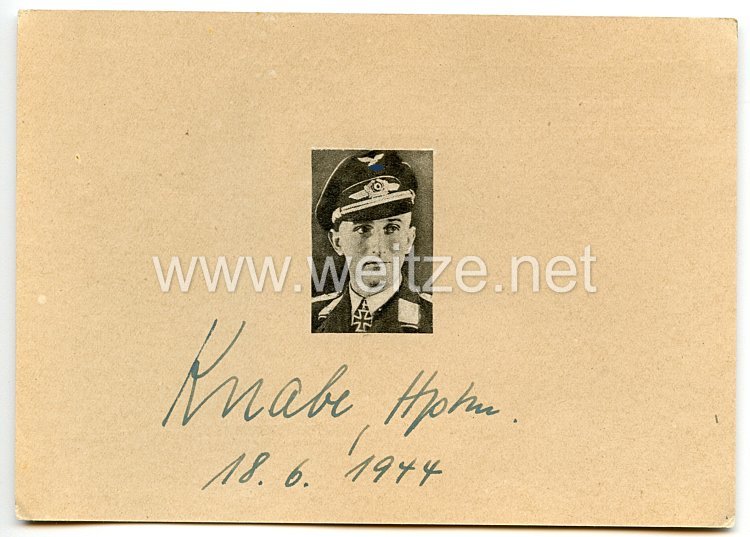
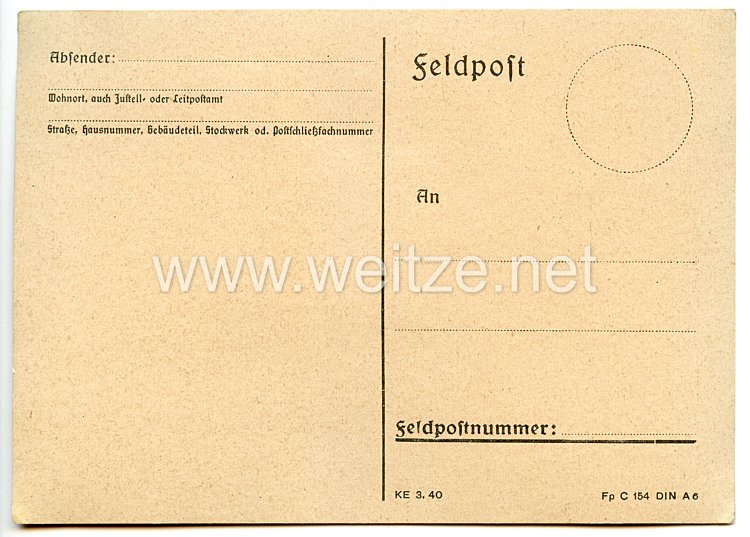
This military field postcard with original signature from Hauptmann (Captain) Konrad Knabe dated 1944 represents a fascinating artifact of German military history during World War II and the practice of autograph collecting during the Nazi era. The object originates from the collection of Hitler Youth member Helmut Ludwig from Marburg an der Lahn and documents a widespread phenomenon among young people in the German Reich: the systematic collection of signatures from decorated soldiers.
Konrad Knabe received the Knight's Cross of the Iron Cross on April 16, 1943, for his service as chain leader (Kettenführer) of the Long-Range Reconnaissance Squadron Lapland within I.(F)/Aufklärungsgruppe 124. This decoration was the highest valor award of the Wehrmacht and was bestowed upon approximately 7,300 individuals throughout the entire war. The award recognized exceptional military achievements, with long-range reconnaissance pilots fulfilling a particularly dangerous and demanding mission.
The Luftwaffe's long-range reconnaissance played a crucial strategic role in World War II. Long-range reconnaissance squadrons like the unit stationed in Lapland conducted deep penetration flights into enemy territory, frequently without fighter escort. In the Arctic region of Lapland, this meant extreme climatic challenges, long polar nights during winter, and limited technical support capabilities. Crews deployed there typically flew aircraft such as the Junkers Ju 88 or Focke-Wulf Fw 189 and gathered intelligence on Soviet troop movements, supply lines, and military installations.
The present document is a field postcard with a pasted newspaper photograph and the handwritten signature “Knabe, Hptm. 18.6.1944”. The field post (Feldpost) was the Wehrmacht's communication system that transported millions of letters and cards between the front and home. Using a field postcard as a medium for requesting autographs was quite common, as these cards were transported free of charge and were readily available in standardized form.
Helmut Ludwig's autograph collection represents a significant contemporary historical phenomenon. During the Nazi era, Knight's Cross recipients were systematically heroicized through propaganda. Their names and photographs regularly appeared in newspapers such as the “Völkischer Beobachter”, “Die Wehrmacht”, or the “Berliner Illustrierte Zeitung”. Young people, especially members of the Hitler Youth, were encouraged to admire these heroes and collect their signatures. Many soldiers willingly responded to such requests, partly from camaraderie, partly in awareness of their propagandistic role.
The practice of collecting military autographs had a long tradition dating back to the 19th century but reached a new dimension in Germany during World War II. Youths like Ludwig often maintained systematically organized collection albums in which they neatly pasted photographs, newspaper clippings, and signatures. Some collectors wrote to the same soldiers multiple times, as documented in Ludwig's case, possibly to have different photographs or documents signed.
The ink signature dated June 18, 1944, was created at a critical point in the war. Two weeks earlier, on June 6, 1944, the Allies had landed in Normandy, and Germany's military situation had deteriorated dramatically. In the north, Army Group Norway under Colonel General Lothar Rendulic still held its positions in Lapland, but strategic initiative had long been lost. Despite this reality, propaganda continued, and Knight's Cross recipients remained important symbolic figures.
From today's perspective, such autograph documents are complex historical sources. They document not only individual military careers but also the Nazi regime's propaganda machinery and its impact on youth. The careful preservation in collection albums demonstrates the care and enthusiasm with which young people like Helmut Ludwig emulated these icons. Simultaneously, they are testimonies to the indoctrination of an entire generation.
The object's condition 2 indicates very good preservation, which is remarkable for a field postcard over 80 years old. The ink signature is clearly legible, and the pasted newspaper photograph shows typical aging characteristics of 1940s paper. Today, such documents are of interest for military-historical research and collectors, not as glorification but as authentic testimonies of a dark epoch in German history. They help understand how propaganda functioned and how an entire society became militarized.
The I.(F)/Aufklärungsgruppe 124 operated in the extreme northern theater, where German forces fought alongside Finnish troops against the Soviet Union until September 1944. The reconnaissance missions over the vast expanses of northern Russia, often in conditions of poor visibility and extreme cold, required exceptional piloting skills and courage. These operations provided vital intelligence for planning defensive operations and identifying Soviet offensive preparations, making the work of reconnaissance crews indispensable despite the Wehrmacht's overall strategic decline.