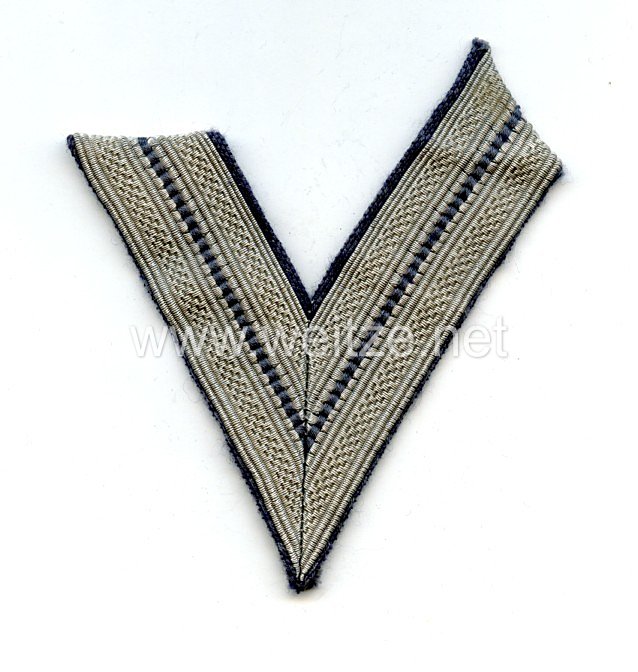
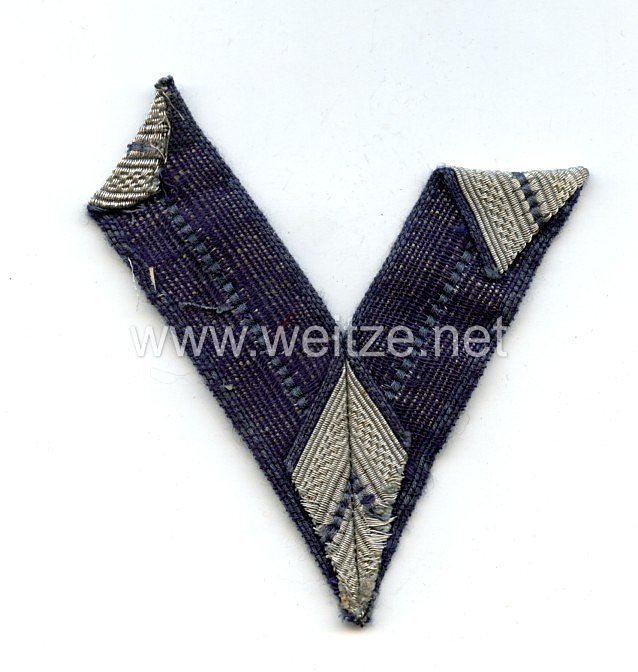
Luftwaffe Sleeve Insignia Senior Lance Corporal

 for the drill tunic, condition 2
418355
20,00

Luftwaffe Sleeve Insignia Senior Lance Corporal

The sleeve insignia of a Luftwaffe Obergefreiter (Senior Lance Corporal) represents a fascinating testament to military rank designation in the Third Reich. This particular specimen was intended for wear on the Drillichbluse (drill tunic), the summer work and service uniform of the Luftwaffe.

The German Luftwaffe was officially established on February 26, 1935, after Adolf Hitler announced Germany's rearmament in violation of the Treaty of Versailles. Under Hermann Göring as Commander-in-Chief, the Luftwaffe developed a comprehensive system of rank insignia and uniform regulations, detailed in the Anzugordnung für die Angehörigen der Wehrmacht (Dress Regulations for Members of the Armed Forces).

The rank of Obergefreiter represented the second level in the hierarchy of enlisted ranks, above the simple Gefreiter (Lance Corporal) and below the Hauptgefreiter (Corporal). The introduction of this rank occurred as part of the reorganization of German armed forces in the 1930s. An Obergefreiter was typically an experienced soldier who had demonstrated special skills or service time but had not yet assumed a junior leadership position.

The sleeve insignia for Luftwaffe Obergefreite consisted of a characteristic chevron with mirror, worn on the left upper arm. The version for the Drillichbluse differed from that for the field tunic or dress uniform in material choice and workmanship. While parade uniforms often featured elaborately embroidered insignia in aluminum or silver thread, versions for the drill tunic were usually made in simpler fashion.

The Drillichbluse itself was an important component of the Luftwaffe uniform. It was manufactured from robust, light gray or sand-colored cotton fabric and served as work and summer uniform. During warm months or in southern theaters of operation, such as North Africa or the Mediterranean region, the Drillichbluse was the standard clothing for ground personnel and many other ranks of the Luftwaffe.

Luftwaffe rank insignia followed a uniform system that differed from other Wehrmacht branches. While the Army and Waffen-SS used different systems, the Luftwaffe maintained its characteristic light blue branch color and specific insignia forms. The placement of sleeve insignia was precisely regulated in service regulations: they were attached to the left upper arm at a specific distance from the shoulder seam.

These insignia were manufactured by various military and civilian suppliers throughout the German Reich. After 1939 and the beginning of World War II, demand for uniform items and insignia increased dramatically. Quality varied by manufacturer and production year, with later war years often showing simplified production with less expensive materials.

For collectors and military historians, such sleeve insignia are important objects of study. They allow conclusions about manufacturing techniques, material availability, and the organizational structure of the Luftwaffe. Condition 2 indicates a well-preserved specimen that shows typical signs of use but still reveals all essential features.

The use of sleeve insignia on the Drillichbluse was particularly important for maintaining military hierarchy even under more informal service conditions. Even in work clothing, ranks had to be clearly recognizable to ensure the chain of command. This was especially significant on airfields, in workshops, and during maintenance work.

After the end of World War II in 1945, all NS uniform items and insignia were banned by the Allies. Many specimens were destroyed, making those that still exist today important historical documents. In Germany, the wearing of such historical uniform items outside scientific or museum contexts is regulated by the Criminal Code.

Today, such objects serve in museums and collections for education and historical instruction about the Wehrmacht and the Nazi regime.

r