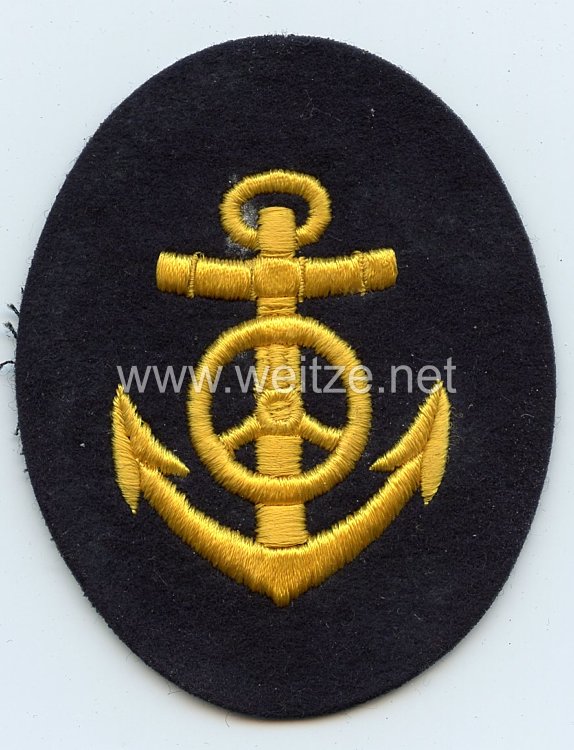
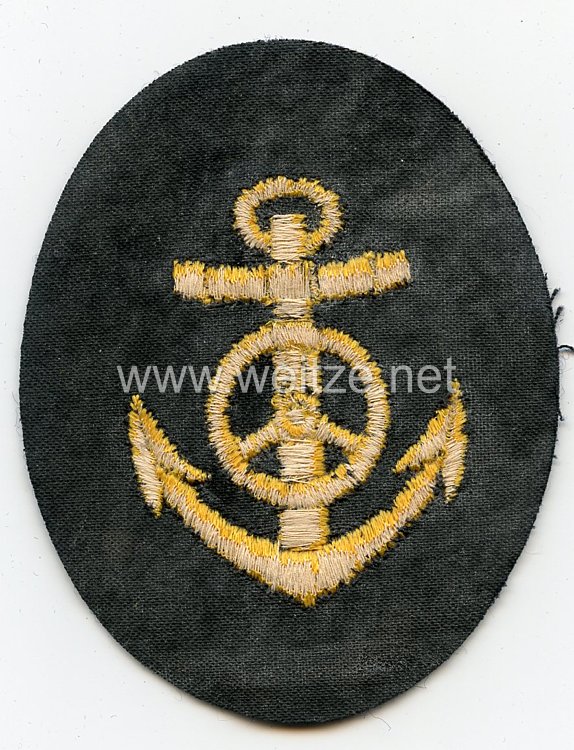
Kriegsmarine Sleeve Insignia for a Motor Transport Petty Officer (Kraftfahrmaat)

for the blue jumper, condition 2-.
376855
10,00

Kriegsmarine Sleeve Insignia for a Motor Transport Petty Officer (Kraftfahrmaat)

Kriegsmarine Sleeve Badge for a Motor Transport Petty Officer (Kraftfahrmaat)

This Kriegsmarine sleeve badge for a Kraftfahrmaat (motor transport petty officer) represents a fascinating chapter in German naval history during World War II. These specialized badges were part of a comprehensive system of career and trade insignia that the Kriegsmarine introduced to identify the various specialties and specializations within the maritime armed forces.

The Kriegsmarine, officially established on June 1, 1935, was the navy of the German Reich from 1935 to 1945. It replaced the Reichsmarine of the Weimar Republic and developed a complex system of rank insignia, career badges, and trade badges to identify the various specializations and ranks of its personnel.

The rank of Maat roughly corresponded to a junior non-commissioned officer in the army and formed the first level of the non-commissioned officer career path. A Kraftfahrmaat was specially trained as a motor vehicle operator and was responsible for operating, maintaining, and often repairing military vehicles. Although the Kriegsmarine was primarily a naval force, it required substantial land-based infrastructure, including extensive vehicle fleets for transporting personnel, materials, and equipment between ports, shipyards, barracks, and other facilities.

The sleeve badge was worn on the blue blouse, which was part of the working and service uniform of the Kriegsmarine. The blue uniform was the characteristic dress of German naval personnel and differed distinctly from the field-gray uniforms of the army. The placement of career and trade badges on the left upper arm was standardized in the Kriegsmarine and regulated by corresponding uniform regulations.

The manufacture of these badges was typically carried out by specialized textile manufacturers and military equipment firms. The badges were machine-embroidered on dark blue base fabric, with symbols usually executed in lighter colors, typically yellow or white. The motor vehicle symbol usually showed a stylized steering wheel or a motor vehicle in side view, surrounded by a laurel wreath or similar decorative element.

The introduction of such specialized badges served several purposes: First, they enabled quick visual identification of a soldier's specialized competence, which was of great practical importance in military organization. Second, they fostered esprit de corps and a sense of belonging within respective specialist groups. Third, they contributed to motivation by making special qualifications publicly visible.

The wearers of these badges had typically completed corresponding training that included both theoretical and practical elements. Motor transport training in the Kriegsmarine included knowledge of mechanics, vehicle technology, traffic regulations, and military driving practice. After successful training and promotion to Maat, the soldier received the right to wear the corresponding sleeve badge.

In the context of warfare, Kraftfahrmaate played an important supporting role. They ensured the mobility of naval units on land, transported vital supplies, and maintained the functionality of vehicle fleets. Their work was particularly important in the extensive naval bases along European coasts, from Norway to the Mediterranean.

The condition designation “2-” in the object description refers to the preservation of the badge. In collector terminology, this indicates a well-preserved condition with slight signs of use, which is remarkably good for a textile piece over 75 years old. Such badges are today sought-after militaria collectibles that represent important testimonies of naval history.

From a historical perspective, these badges are valuable documents of the organizational structure and daily life in the Kriegsmarine. They illustrate the complexity and specialization of a modern 20th-century navy, which encompassed far more than just ship crews but required an extensive system of support services. For military historical research, they offer insights into personnel structure, uniform regulations, and the material culture of the German navy during World War II.

Today, such items serve primarily as historical documentation and objects of study. They help historians, collectors, and museums preserve and understand the complex organizational structure of the Kriegsmarine. They are tangible reminders of a historical period and the individuals who served in these specialized roles, contributing to our understanding of naval history and military organization during one of the most significant conflicts in modern history.