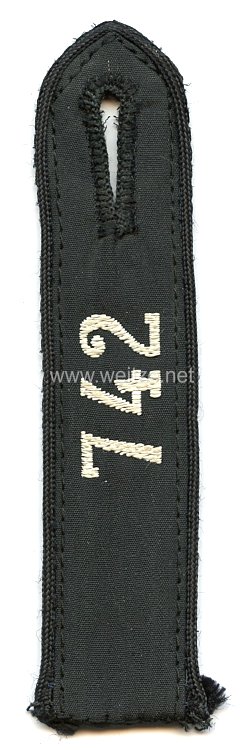
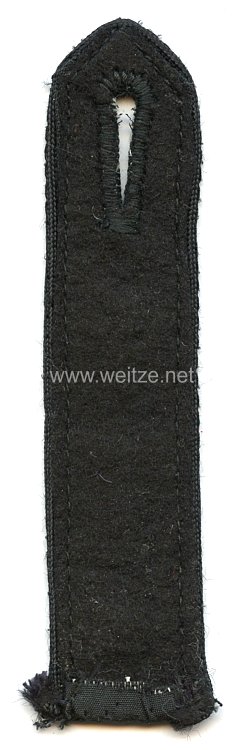
DJ Shoulder Strap Jungbann 742

Bann 742 = Rappoltsweiler, Gebiet Baden, Condition 2+
425655
75,00

DJ Shoulder Strap Jungbann 742

The present shoulder strap of the DJ (Deutsches Jungvolk - German Young People) for Jungbann 742 Rappoltsweiler in the Gebiet Baden (Baden Region) represents a characteristic piece of equipment from the National Socialist youth organization during the Third Reich era. These shoulder straps served as important identification markers for organizational assignment within the strictly hierarchical structure of the Hitler Youth.

The Deutsches Jungvolk (DJ) formed the sub-organization of the Hitler Youth for boys aged 10 to 14 years. Following the founding of the Hitler Youth in 1926, the Jungvolk was established as an independent age group in 1928. With the Law Concerning the Hitler Youth of December 1, 1936 and the complete registration of all youths through the Youth Service Obligation of 1939, membership became virtually mandatory.

The organizational structure followed a militaristic system. A Jungbann theoretically comprised between 600 and 3,000 Pimpfe, as members of the Jungvolk were called. Jungbann 742 was assigned to Gebiet Baden, one of the total 42 HJ regions that largely corresponded to the NSDAP Gaue. Gebiet Baden had its headquarters in Karlsruhe and encompassed the entire Baden territory.

Rappoltsweiler (French: Ribeauvillé) is located in Alsace and became part of the CdZ-Gebiet Elsass (Civil Administration Area Alsace) after the German occupation of France in 1940, which was administratively attached to Gau Baden. The integration of this region into the HJ structure proceeded swiftly as part of National Socialist Germanization policy. The establishment of a Jungbann in Rappoltsweiler demonstrates the systematic registration of youth in occupied territories.

The shoulder straps of the Deutsches Jungvolk were manufactured according to the clothing regulations of the Reich Youth Leadership. They consisted of braided black cords and bore the characteristic marking of the respective unit. The Bann number was typically applied in Arabic numerals. The straps were worn on both shoulders of the Jungenschaftsbluse, the brown uniform of the DJ.

The system of wearing shoulder straps in the DJ was part of a comprehensive uniformization system that served various purposes: it facilitated the military conditioning of youth, enabled clear identification of organizational affiliation, and contributed to psychological integration through uniformity and group identity. The precise marking by Bann enabled seamless control and organization during mass events, marches, and service operations.

The Bannführer (Bann leaders) of the Jungvolk were mostly still adolescent themselves and frequently came from the older HJ. They bore responsibility for extensive pre-military training, ideological instruction, and the organization of field exercises, marches, and camps. Service in the DJ was deliberately designed as a preliminary stage for later admission to the HJ at age 14.

After 1945, all organizations of the NSDAP, including the Hitler Youth and Deutsches Jungvolk, were classified as criminal organizations by the Allied Control Council and dissolved. Wearing their uniforms and insignia was prohibited. Rappoltsweiler/Ribeauvillé returned to France, and the German administrative structure was completely eliminated.

Today, such shoulder straps possess exclusively documentary and museum value as testimonies of a dark period in German history. They remind us of the totalitarian registration and indoctrination of youth under National Socialism and the extension of these structures to occupied territories. The indicated condition grade 2+ designates in collector nomenclature a very good state of preservation with minimal signs of use, which is rarely encountered in textiles from this period.

r