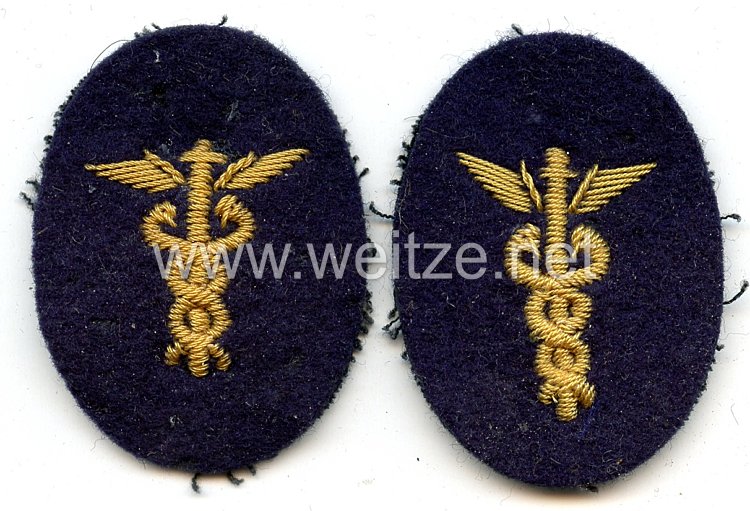
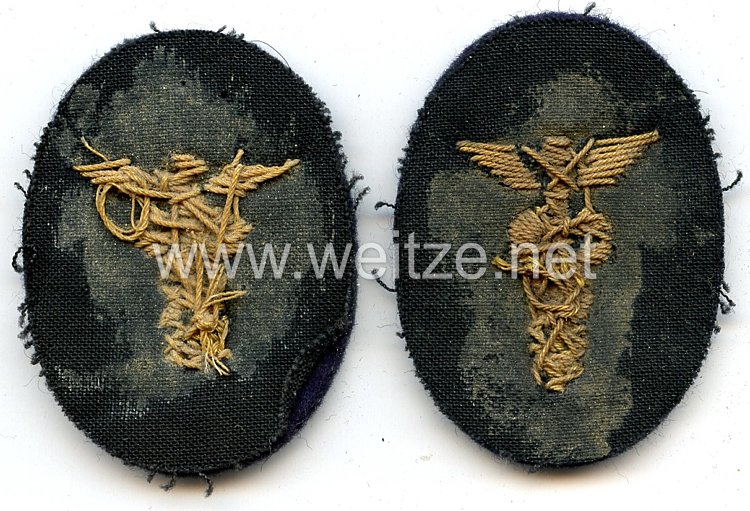
Kriegsmarine Pair of Sleeve Insignia for an Administrative Officer
The sleeve insignia for administrative officers of the Kriegsmarine described here represent an important aspect of the complex rank system of the German Navy during World War II. These hand-embroidered insignia using the Cellon technique testify to the craftsmanship quality and strict uniform regulations that applied in the German Navy.
The Kriegsmarine, officially established on June 1, 1935, was the naval force of National Socialist Germany and replaced the Reichsmarine of the Weimar Republic. With its founding, a comprehensive system of uniforms, rank insignia, and service grade markings was introduced, which was based on the traditions of the Imperial Navy but also contained new elements.
Administrative officers formed an essential component of the Kriegsmarine organization. They were responsible for administrative, logistical, and economic tasks that were indispensable for the operation of the war fleet. Their areas of activity included supply, pay, provisions, clothing, and general administrative duties. Without these officers, the operational readiness of the Navy could not have been maintained.
The sleeve insignia served to identify the various career paths within the Kriegsmarine. While sea officers wore gold stripes on a dark background, administrative officers had special markings that distinguished them from other officer careers. Administrative officers typically wore a light blue or cornflower blue branch color stripe between the gold rank stripes, which marked their special assignment.
The Cellon embroidery was a high-quality manufacturing technique for uniform insignia. Cellon is a celluloid-like material that served as a backing material for the embroidery. This technique enabled particularly fine and durable embroidery work. The hand-embroidered version was more elaborate and expensive than machine-made or woven variants and was often used by officers for their dress uniforms. Such insignia were often manufactured by specialized military effects companies that had to maintain strict quality standards.
The uniform regulations of the Kriegsmarine were laid down in various service regulations and dress orders. The Dress Order for the Kriegsmarine (A.O.) regulated in detail which uniform parts could be worn on which occasions and by which ranks. These regulations were regularly updated and supplemented by amendments.
A pair of sleeve insignia was necessary because they were worn symmetrically on both sleeves of the uniform jacket. The position was precisely prescribed: the insignia were attached to the blouse or jacket on the upper sleeve, with the lower edge of the lowest stripe at a specified distance from the sleeve end.
The rank structure of administrative officers basically corresponded to that of sea officers, ranging from Leutnant zur See (Naval Lieutenant) to Generaladmiral (General Admiral) or corresponding administrative ranks. The number of sleeve stripes indicated the respective rank: one narrow stripe for Leutnant zur See, two for Oberleutnant zur See, two with a thicker stripe for Kapitänleutnant, and so on.
The craftsmanship quality of these insignia also reflects the social status of the officers. Unlike enlisted men and non-commissioned officers, officers had to procure their uniforms themselves, which meant that they purchased from reputable tailors and effects manufacturers. This led to a certain variability in quality and execution, although the basic regulations had to be observed.
After the end of World War II in 1945, the Kriegsmarine was dissolved. Its uniforms and insignia became historical artifacts that today represent important testimonies of naval history. Collectors and museums preserve such objects as part of maritime heritage, whereby the historical context must always be critically reflected upon.
The stated condition 2 in collector's grading indicates a well-preserved piece with slight signs of wear, which is quite remarkable for textiles over 75 years old. The preservation of such delicate materials as Cellon embroidery requires proper storage under controlled climatic conditions.