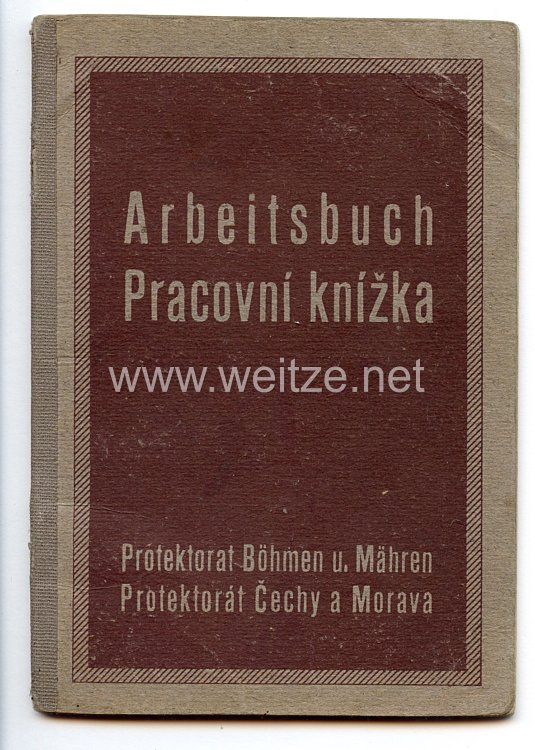
Third Reich - Protectorate of Bohemia and Moravia - Work Book for a Man Born in 1923
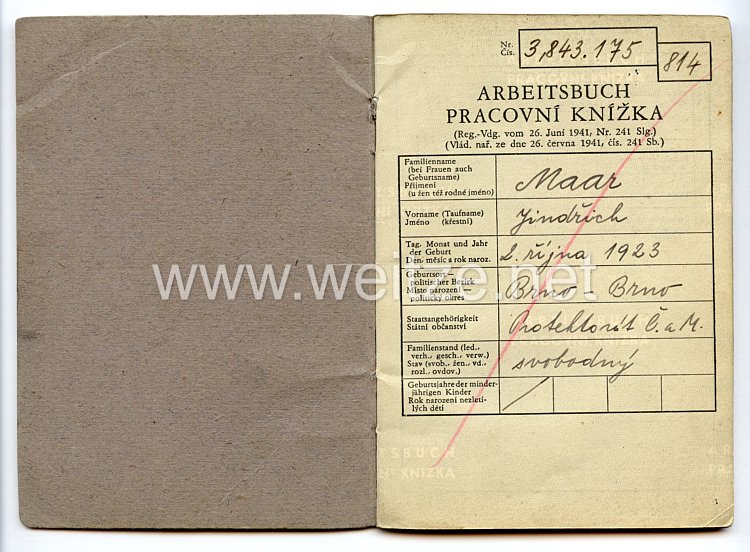
The Arbeitsbuch (work book) from the Protectorate of Bohemia and Moravia represents a significant document of contemporary history from the National Socialist occupation period. This particular specimen was issued on November 7, 1941, in Brno (German: BrĂ¼nn) and documents the work biography of a man born in 1923 through the postwar period until 1947.
Following the destruction of Czechoslovakia in March 1939, the German Reich established the Protectorate of Bohemia and Moravia as a dependent territory under German rule. The Reich Protector, initially Konstantin von Neurath and from 1941 Reinhard Heydrich, exercised actual control, while formally a Czech protectorate government existed. This dual structure is reflected in the bilingual design of the work book, which was printed in both German and Czech.
The Arbeitsbuch was a central instrument of National Socialist labor administration and population control. In Germany itself, the work book was introduced through the Regulation on the Introduction of a Work Book of February 14, 1935. This regulation was successively extended to occupied and annexed territories. In the Protectorate of Bohemia and Moravia, the work book served several purposes: it documented all employment relationships without gaps, controlled labor mobility, and enabled authorities to comprehensively monitor the working-age population.
The holder of this work book, born in 1923, belonged to a generation that spent their formative youth years entirely under German occupation. At 16 years old when the document was issued in November 1941, he stood at the beginning of his working life. The entries extending to 1947 make this document particularly valuable as they document the transition from the war economy to the postwar order.
The time of issuance in November 1941 fell during a phase of increasing radicalization of German rule in the Protectorate. In September 1941, Reinhard Heydrich had assumed the office of Deputy Reich Protector and initiated a brutal wave of repression. The labor deployment of the Czech population was systematically organized for the German war economy. Brno as the second-largest city of the Protectorate was a significant industrial center where armaments factories, mechanical engineering, and textile industry were concentrated.
The bilingual design of the document reflects the complex administrative reality of the Protectorate. While the German Reich held political power, the administration had to function with the Czech population majority. Official documents were therefore frequently maintained bilingually, with the German language always having priority.
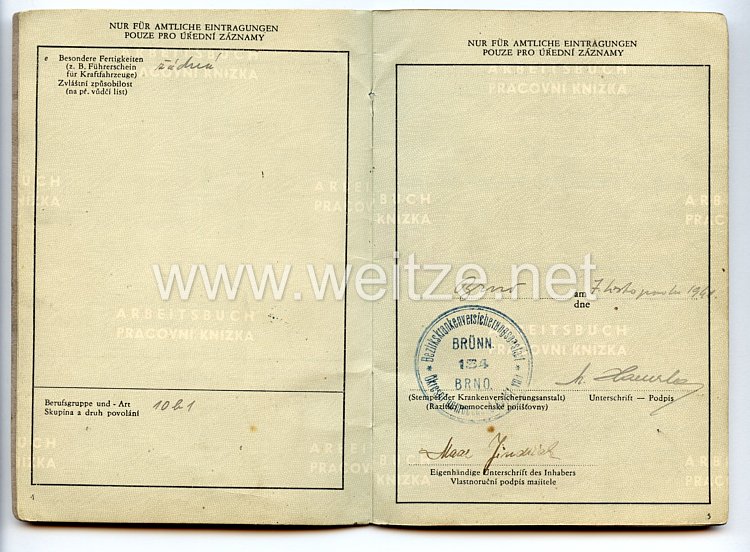
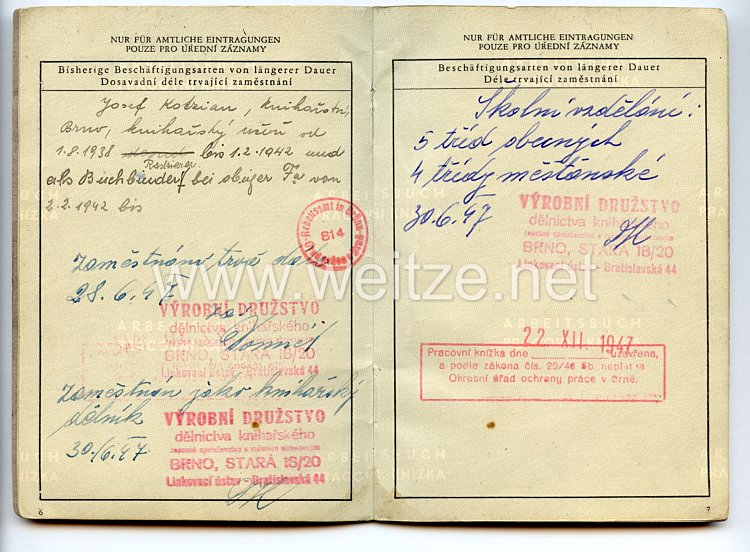
The work book typically contained personal data of the holder, a photograph, information on vocational training, and detailed entries about all employment relationships including employer, activity, start and end of employment, and reason for termination. Employers were required to properly complete the work book upon the employee's departure. Changing jobs without corresponding entry and authorization was not possible, which significantly restricted freedom of movement.
The continuation of entries until 1947 is remarkable as it demonstrates the continuity of this administrative practice beyond the end of the war. After the liberation of Czechoslovakia in May 1945 and the restoration of the Republic, many administrative structures were initially maintained. The work book served the new administration as proof of work biography and possibly also for verifying the holder's role during the occupation period.
The used condition of the document emphasizes its authentic use as a working document over six years. Daily use, carrying it to various workplaces, and repeated deposits and withdrawals with employers and authorities left their marks.
Today, such work books from the Protectorate are important sources for researching the social and economic history of National Socialist occupation rule. They provide insights into individual biographies, forced labor relationships, the organization of the war economy, and transition processes after 1945. For genealogical research and the examination of individual fates, they are of inestimable value.