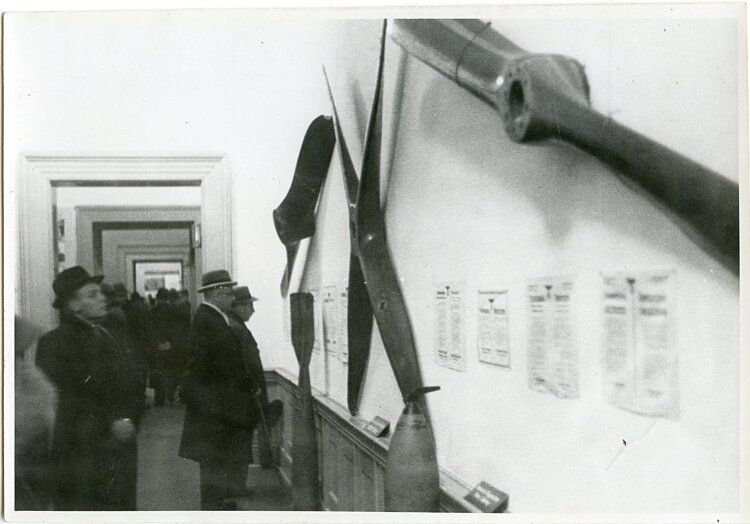
Photograph, Propeller at an Aviation Exhibition

approx. 18 cm x 13 cm, Condition 2
183954
10,00

Photograph, Propeller at an Aviation Exhibition

Historical Context: Photographs of Propeller Exhibitions in Aviation History

This photograph documents an aircraft propeller displayed as part of an exhibition. Such photographs represent important historical documents that not only capture technical artifacts of aviation history but also document the development of museum presentation and public appreciation of flight.

The Significance of the Propeller in Aviation History

The propeller was the dominant propulsion system for aircraft from the beginnings of powered flight until well into the mid-20th century. The Wright Brothers used self-made wooden propellers during their historic first flight in 1903, whose aerodynamic design they developed through their own calculations and wind tunnel experiments. During World War I (1914-1918), propellers became crucial military equipment as fighter planes, bombers, and reconnaissance aircraft became integral components of warfare.

Construction evolved from early two-bladed wooden propellers to more complex metal designs with adjustable blades. German manufacturers such as Schwarz, Heine, and later VDM (Vereinigte Deutsche Metallwerke) were among Europe's leading propeller producers. During the interwar period and World War II (1939-1945), propeller technology reached its peak with highly developed variable-pitch propellers and constant-speed propellers.

Exhibition Practices and Aviation Musealization

The presentation of aircraft propellers and other aviation artifacts in exhibitions began in the early decades of the 20th century. The Deutsches Museum in Munich, founded in 1903 and opened in its new building in 1925, was one of the first institutions to systematically collect and exhibit aviation objects. After World War I, specialized aviation museums and departments in technical museums emerged in many countries, reflecting the rapid development of flight.

Propellers were frequently displayed as representatives of complete aircraft, as they were transportable yet still represented the technical sophistication of aviation. Veterans' associations, flying clubs, and military institutions organized exhibitions where propellers were often prominently displayed. They served as memorial objects for fallen aviators, technical teaching aids, and symbols of technological progress.

Photographic Documentation of Militaria and Aviation Objects

Photographs of exhibition objects have their own documentary value. They show not only the object itself but also contemporary handling, presentation forms, and societal appreciation. In the military-historical context, such photographs served various purposes: as inventory documentation, as promotional material for museums and exhibitions, as teaching materials for technical schools, or as souvenirs for visitors.

The size of approximately 18 x 13 cm corresponds to common photographic formats from the period between the 1920s and 1960s. This could indicate a postcard, a cabinet photograph, or small-format documentary photography. Such formats were frequently produced by museums or purchased by visitors as souvenirs.

Propellers as Collectibles and Memorials

After both World Wars, aircraft propellers became sought-after collectibles and war memorials. In many German communities, propellers from crashed or decommissioned aircraft were erected as monuments. They commemorated air battles, fallen aviators, and the technological dimension of the wars. In barracks, officers' messes, and veterans' clubs, propellers frequently decorated walls as signs of aviation tradition.

The Luftwaffe of the Wehrmacht and later the Bundesluftwaffe maintained a tradition line in which historical propellers served as connections to military aviation history. Similar practices were maintained in other countries, making propellers transnational symbols of aviation history.

Preservation and Contemporary Collector Value

Today, photographs of historical aviation exhibitions are valuable sources for technology history and museum studies. They document lost objects, early exhibition concepts, and the development of public perception of aviation technology. For collectors of military-historical objects, such photographs are interesting as they provide context for other collection pieces and can document the provenance of objects.

The standard condition classification used in trade, here indicated as “Condition 2,” suggests a well-preserved specimen with minimal signs of use. This is remarkable for a photograph that may be several decades old and speaks to careful storage.

In summary, this photograph represents a testimony to aviation history and memorial culture that connects technical innovation, military history, and museum practice.