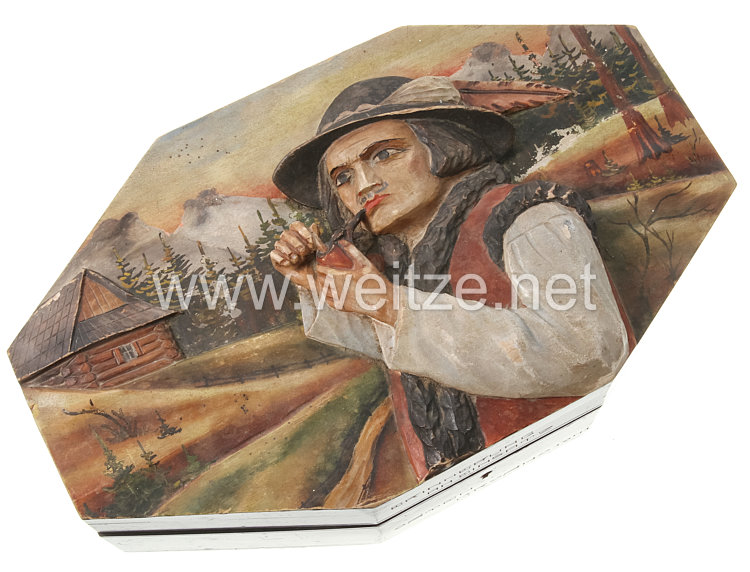
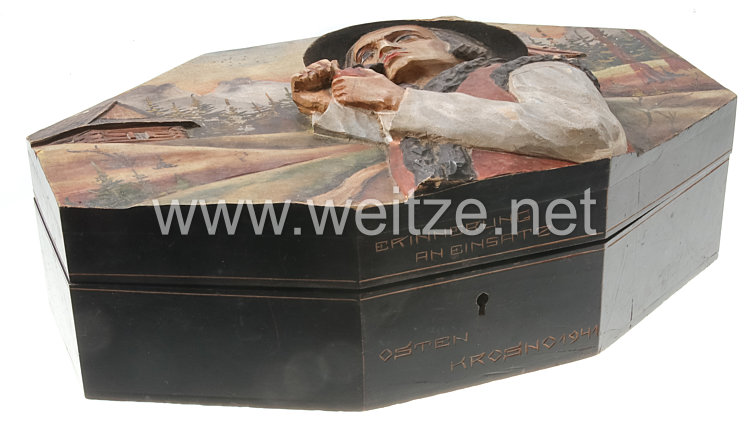
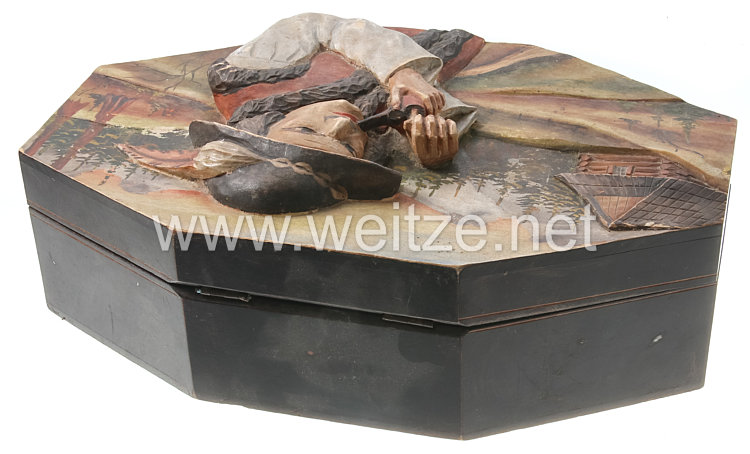
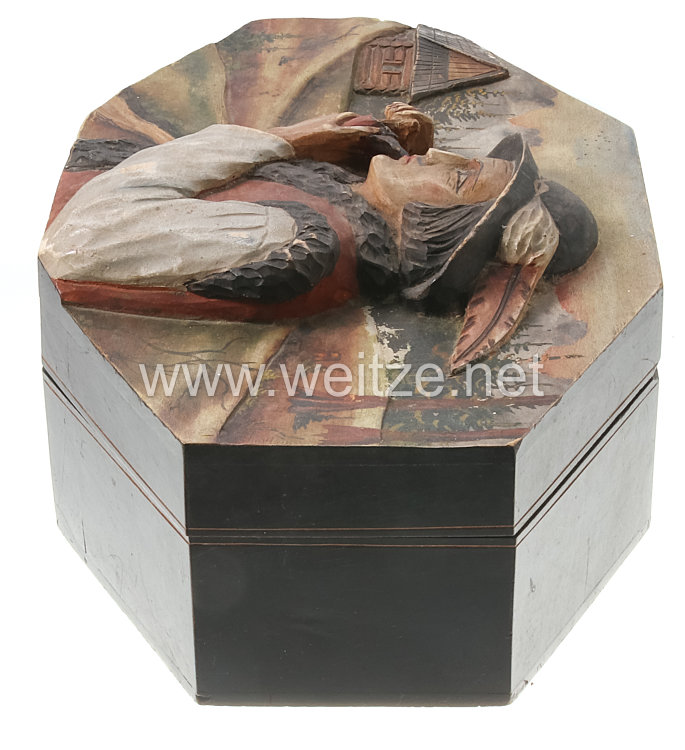
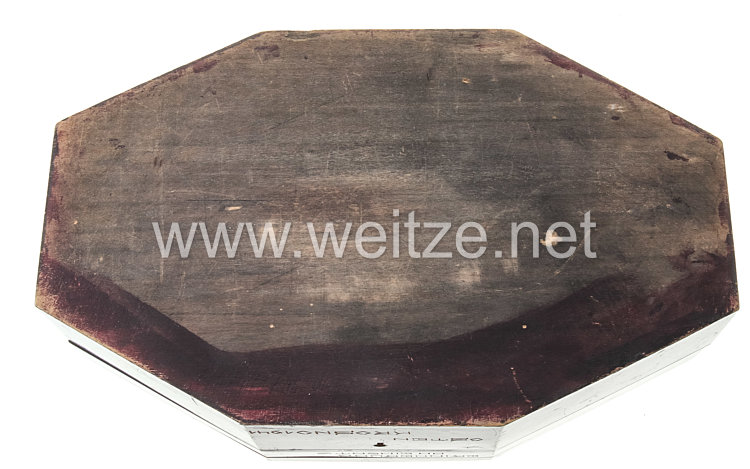
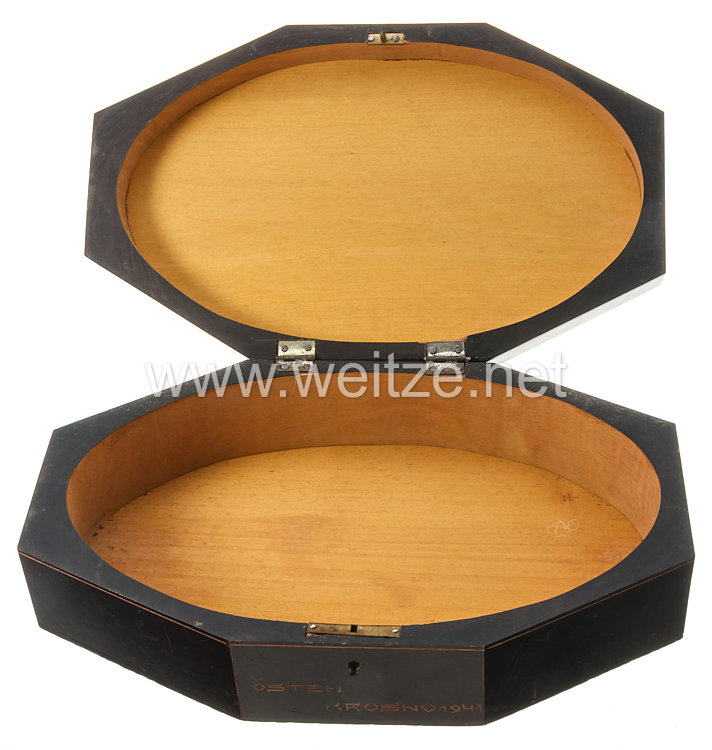
Wehrmacht Souvenir Box of a Landser in Poland Krosno 1941
This wooden souvenir box represents a fascinating artifact from German military history during World War II. Measuring approximately 28.5 cm in width and 9 cm in height, it is a typical example of personal memorabilia created or acquired by Wehrmacht soldiers during their deployment in occupied Poland.
The town of Krosno, located in southeastern Poland, was captured in September 1939 during the German invasion of Poland and remained under German occupation until 1944. In 1941, the year marked on the box, the Wehrmacht was in a phase of intense military activity. This was the year of Operation Barbarossa, the invasion of the Soviet Union in June 1941, during which numerous military units were transferred eastward through Poland.
The term “Landser” evolved during the war as colloquial German slang for the common soldier. This designation, now firmly established in German parlance, conveys a sense of camaraderie and the shared fate of ordinary enlisted ranks. Soldiers in this position frequently sought ways to preserve their experiences and memories or create mementos to send home.
The tradition of bringing souvenirs and mementos from theaters of war was by no means new, extending back to the Napoleonic Wars and earlier. However, during World War II, this practice took on particular forms. Soldiers crafted or acquired local handicrafts, engraved shell casings, carved wooden items, or commissioned personalized objects from local craftsmen.
Such boxes served various purposes: they stored personal documents, photographs, letters from home, cigarettes, or small valuables. Woodworking was traditionally strong in Poland, and local craftsmen frequently offered their services to German soldiers, partly out of economic necessity under occupation, partly due to direct commissioning by the military administration.
The condition with partially loose hinges corresponds to the expected state of a utilitarian object over 80 years old. The classification as “condition 3” according to common military-historical collector categories indicates an average state of preservation, with visible signs of use but without substantial damage to the basic structure.
In historical context, it must be emphasized that 1941 represented a period of consolidation for the Wehrmacht and German occupation policy in Poland. The occupation administration had become established, with the General Government under Hans Frank controlling large parts of occupied Polish territory. Simultaneously, the systematic persecution and murder of the Jewish population intensified, along with the suppression of the Polish civilian population.
Such personal objects raise complex ethical and historiographical questions. On one hand, they are testimonies to individual soldiers' experiences; on the other, they are inseparably connected to a criminal war of aggression and annihilation. Contemporary military-historical research views such objects with nuance: they serve as sources for the everyday history of ordinary soldiers, but must not be considered in isolation from the larger historical context of National Socialist crimes.
The materiality of such objects – wood, simple metal hinges, often plain workmanship – also reflects the material culture of the Wehrmacht. Unlike official equipment items that were standardized and regulated, personal souvenirs show the individual appropriation of memory and the relationship between soldiers and occupied territories.
For modern military history research and museum work, such objects represent important sources. They provide insights into soldiers' living conditions, their movements through Europe, their personal priorities, and their self-perception. Simultaneously, they require careful contextualization to avoid contributing to uncritical glorification or trivialization.
The geographical marking “Krosno 1941” provides precise provenance information, allowing researchers to place this object within specific military operations and occupation structures. Krosno lay within the area of German administration, and Wehrmacht units stationed there would have included various branches and support services, all part of the extensive occupation apparatus.
Today, such artifacts are preserved in military museums, private collections, and research institutions worldwide. They serve educational purposes when properly contextualized, helping new generations understand both the individual human dimension and the larger criminal context of this historical period.