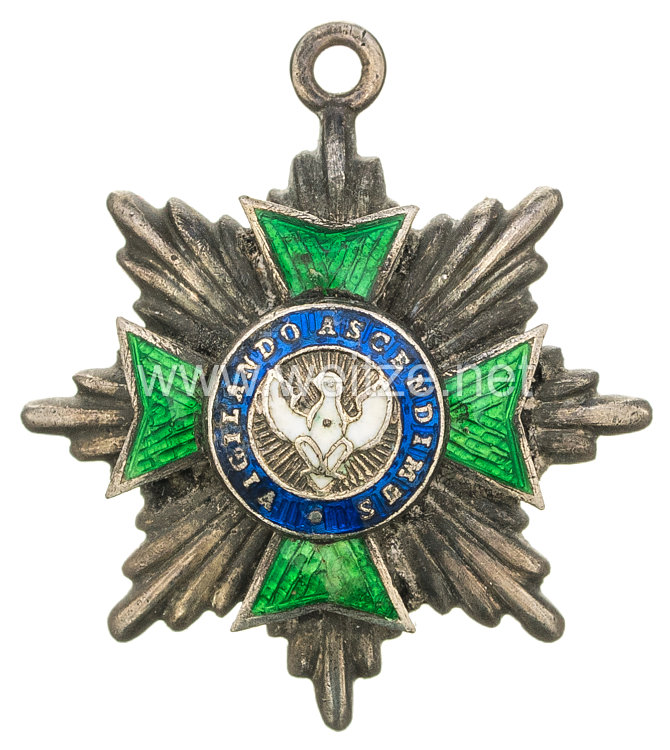
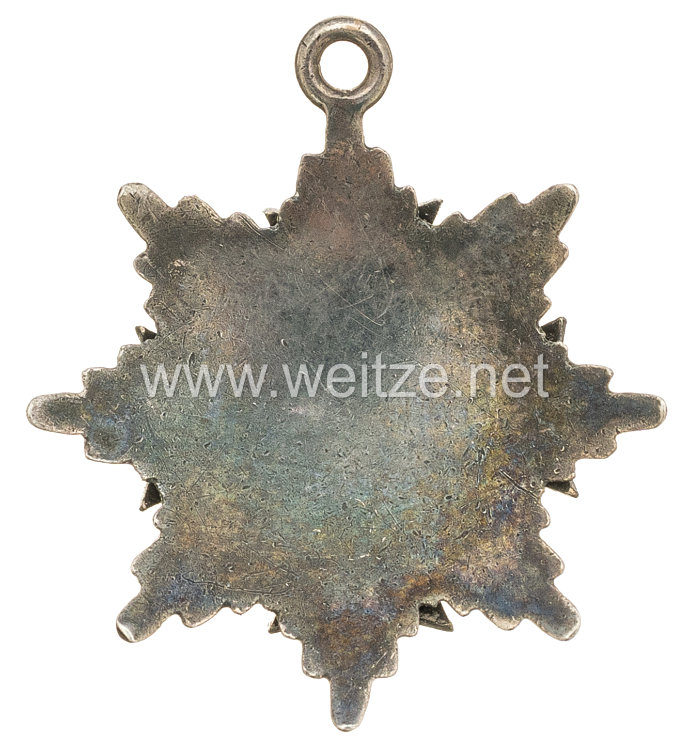
Saxony Weimar Eisenach Grand Ducal Saxon House Order of Vigilance or of the White Falcon Breast Star for Grand Cross
The Grand Ducal Saxon House Order of Vigilance or of the White Falcon ranks among the most distinguished dynastic decorations of the Grand Duchy of Saxe-Weimar-Eisenach and represents a centuries-old tradition of princely orders in central Germany. The large miniature presented here displays the breast star of the Grand Cross, the highest class of this prestigious decoration.
The order was founded on April 21, 1732 by Duke Ernst August I of Saxe-Weimar under the name “Order of Vigilance.” Its establishment occurred during a period when dynastic house orders in the Holy Roman Empire were gaining increasing importance as instruments of foreign policy and for honoring distinguished individuals. The order was originally intended to symbolize the bond between the prince and his most loyal servants and was awarded only in very limited numbers.
After several reorganizations, the order received its definitive form on May 22, 1815, following the elevation of the duchy to a grand duchy by the Congress of Vienna, under Grand Duke Carl August. The statutes were fundamentally revised and the order was divided into different classes, with the Grand Cross representing the highest level. The order now officially bore the name “Grand Ducal Saxon House Order of the White Falcon,” although the designation “of Vigilance” continued to be used historically.
The symbolism of the White Falcon refers to the heraldic tradition of the House of Wettin and specifically the Ernestine line. Since the Middle Ages, the falcon had been regarded as a symbol of vigilance, loyalty, and royal dignity. The order insignia itself consisted of a white enameled cross with golden balls at the cross ends, in whose center was the white falcon on a red ground, surrounded by the motto “VIGILANDO ASCENDIMUS” (Through vigilance we rise).
The breast star of the Grand Cross described here represents a miniature version, likely worn on an order chain. Such miniatures were common at court in the 19th and early 20th centuries when order recipients wanted to wear their decorations on less formal occasions or in civilian dress. The multi-part silver work with fine enameling testifies to the high craftsmanship quality that was customary in the production of such order insignia. The height of 17 mm corresponds to typical dimensions for miniature versions of this period.
The Grand Cross of the order was reserved for the highest dignitaries: foreign monarchs, members of reigning houses, prime ministers, and individuals of extraordinary merit. Among the recipients were names such as Johann Wolfgang von Goethe, who was ennobled and decorated with the order in 1815, as well as numerous European princes and statesmen. The award was made personally by the Grand Duke and was accompanied by solemn ceremony.
The organization of the order followed strict statutes. The order chapter consisted of the Grand Duke as Grand Master and a limited number of knights of the various classes. Besides the Grand Cross, there existed the classes of Commander, Knight First and Second Class, as well as various medals and badges of honor. Order festivals were celebrated on the name day of the reigning Grand Duke.
After the end of the monarchy in Germany in November 1918, the order was continued as a dynastic house order of the former reigning house. Grand Duke Wilhelm Ernst, the last reigning Grand Duke, abdicated but retained the right to award the order as head of the house. The tradition was continued by his successors, although awards naturally became rarer.
The miniature presented here is of particular rarity, as such pieces were produced in far smaller numbers than regular order insignia. The multi-part silver work and fine enameling suggest manufacture in one of the renowned order workshops, possibly by court jewelers in Weimar or by specialized manufacturers in Berlin or Munich.
The condition is rated as 2+, which in the grading scale for military antiques indicates very good condition with only minimal signs of wear. This is remarkable for an object that, due to its function, was worn regularly and whose enamel is particularly sensitive to mechanical damage.
Today, such order miniatures are sought-after collector's items that possess not only artistic and craft value but also represent important testimonies to German and European order history. They document the courtly culture of the 19th century and the complex diplomatic relations between the German princely houses and European high nobility.