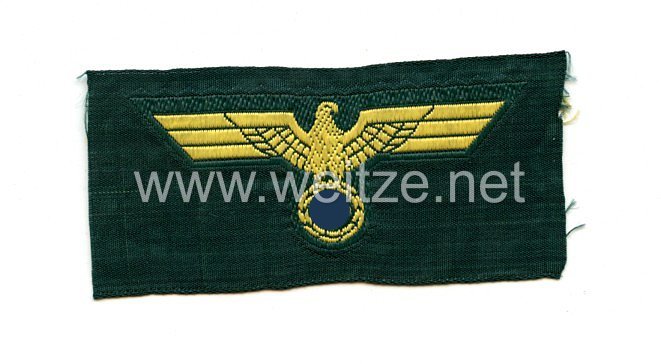
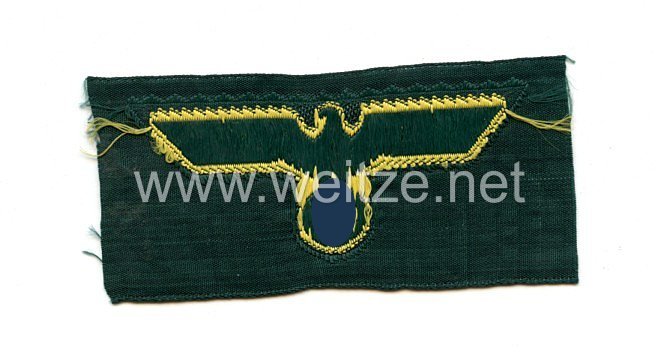
Kriegsmarine Visor Cap Eagle for Enlisted Men of Shore Units

Woven version on green. Condition 2-.
420253
75,00

Kriegsmarine Visor Cap Eagle for Enlisted Men of Shore Units

The Kriegsmarine visor cap eagle for enlisted personnel of land units represents a characteristic insignia of the German Navy during World War II. This woven version on green base fabric was worn by enlisted ranks of the naval infantry and other land-based units of the Kriegsmarine.

The Kriegsmarine, as one of three branches of the Wehrmacht from 1935 to 1945, commanded not only naval vessels and U-boats but also significant land forces. These included naval infantry, coastal artillery, anti-aircraft batteries, and various garrison units. For these land-based formations, special uniforms were prescribed that differed from the classic dark blue naval attire.

According to the Kriegsmarine uniform regulations, members of land units wore field-gray or green uniforms that were modeled on Army uniforms but retained navy-specific insignia. The visor cap for enlisted men of these units was accordingly colored green to distinguish it from the dark blue visor cap of regular naval forces.

The eagle as a national emblem was affixed to the visor cap above the cockade shield. The woven version described here was the standard variant for enlisted ranks. In contrast to the metal eagles worn by officer ranks, textile insignia were used for enlisted men and non-commissioned officers for economic and practical reasons. These were less expensive to manufacture and easier to attach.

The design of the Kriegsmarine eagle followed National Socialist regulations for national emblems. The eagle was depicted with outstretched wings, clutching a swastika in its talons. The eagle's gaze was directed to the left (heraldically right). This representation differed from Army eagles in specific feather styling and proportions.

The weaving technique of these insignia was highly developed. Specialized companies such as BeVo (Bandweberei Ewald Vorsteher), the Bandfabrik Erich Gahr, or other textile manufacturers produced these insignia in large quantities. Weaving was done on Jacquard looms, which made it possible to depict fine details and shading. The green background was woven in simultaneously, guaranteeing a permanent connection between motif and carrier fabric.

The naval infantry and coastal units played an important role, particularly in occupied territories. They secured naval bases, shipyards, and coastal fortifications. Extensive naval land units were stationed in Norway, France, the Netherlands, and the Baltic region. These soldiers wore green uniforms with corresponding insignia.

The manner of wearing was precisely regulated by service regulations. The eagle was placed centrally above the cockade, with the distance and position exactly prescribed. Attachment was done by sewing, performed by the enlisted men themselves or by tailoring services.

After the war ended in 1945, wearing these insignia was prohibited by Allied control regulations. Many uniform items and insignia were destroyed or stripped of their national emblems. Surviving examples became collector's items and historical documents.

Today, such original insignia are important military-historical artifacts. They document uniform history, textile technology, and the organizational structure of the Kriegsmarine. Collectors and museums preserve these objects as witnesses to history. Condition assessment follows criteria such as color preservation, completeness of weaving, and overall appearance.

The scientific significance of these objects lies in their testimony about military organization, wartime production methods, and Wehrmacht hierarchy. They enable conclusions about the size and equipment of Kriegsmarine land units and document a specific aspect of German military history between 1935 and 1945.

For collectors and historians, these woven eagles represent more than mere militaria. They are tangible links to a complex period of history, requiring careful preservation and contextualization. Understanding their production, use, and historical context contributes to comprehensive documentation of World War II military history and the specific role of German naval land forces during this period.