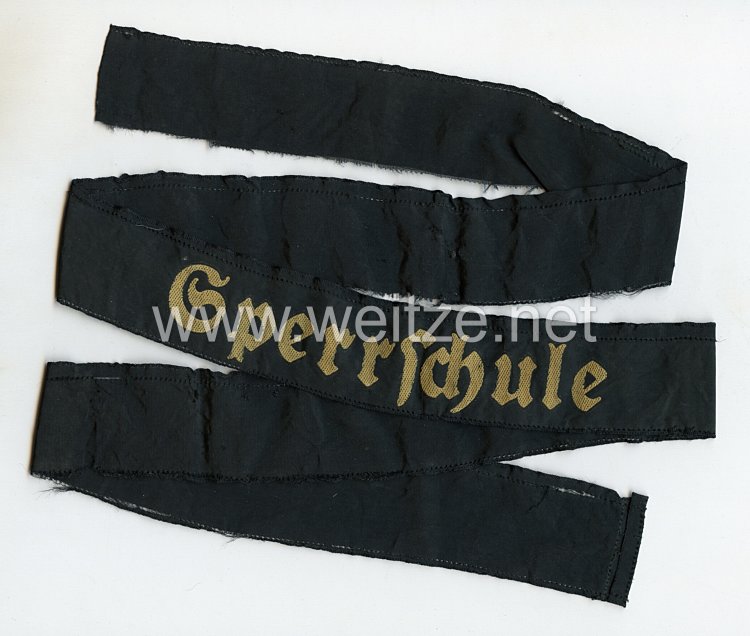
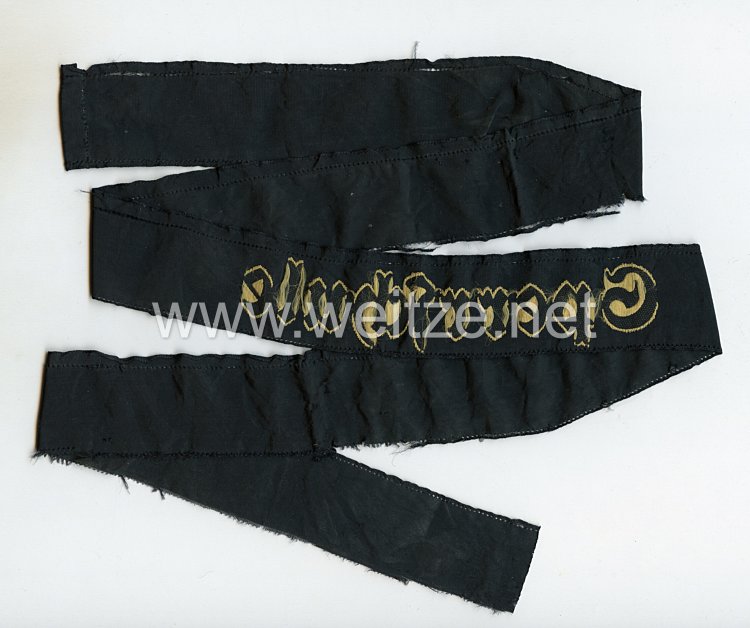
Kriegsmarine Cap Tally "Sperrschule"
The Kriegsmarine cap tally "Sperrschule" represents a fascinating artifact of German naval training during World War II. Cap tallies were an essential component of German naval uniforms, serving not only for identification purposes but also as expressions of pride and belonging to specific units or training establishments.
The Sperrschule (Barrier School) was a specialized training facility of the Kriegsmarine dedicated to training personnel for barrier and mine warfare services. These schools played a crucial role in German naval warfare, as minefields had both offensive and defensive strategic significance. Mining sea routes and harbors was an important means of hindering enemy ship movements and protecting home coastal waters.
The present example features metal-thread weaving, which was characteristic of higher-quality cap tallies. This technique, in which metal threads were woven into the fabric, created a distinctive silver sheen against a black background. The gold or silver letters stood out particularly impressively. In contrast, simpler versions with printed or machine-embroidered inscriptions also existed, which were more commonly used for enlisted ranks.
Kriegsmarine cap tallies followed strict uniform regulations established in various service regulations and dress codes. The Uniform Regulations for the Kriegsmarine (A.V.O.) of September 1, 1933, and its subsequent amendments precisely regulated how cap tallies were to be worn. They were attached to the peaked cap (for officers and petty officers) or the field cap (for enlisted men) and ran around the cap, with the ends hanging down at the back.
The inscriptions on cap tallies varied depending on location and function. While ships bore their own names ("Bismarck," "Tirpitz," etc.), shore establishments, schools, and training facilities carried their respective designations. The Sperrschule belonged to the specialized training institutions that existed alongside major naval schools such as the Naval School Mürwik or the Naval Academy Flensburg-Mürwik.
The barrier and mine warfare services of the Kriegsmarine encompassed various aspects: laying minefields, clearing mines, maintaining barrier vessels, and monitoring net barriers. Training required specialized technical knowledge of various mine types, detonation mechanisms, anchor systems, and tactical deployment procedures. The Sperrschule trained personnel deployed on minesweepers, barrier-breaker units, and harbor security services.
The present specimen shows stitch marks along its entire length, indicating that it was actually attached to a cap and worn. These signs of use give the object historical authenticity and connect it directly with an individual naval serviceman who completed his training at the Sperrschule or served there.
During the war, mine warfare became increasingly important for the Kriegsmarine. German forces laid thousands of mines in the North Sea, Baltic Sea, and along Allied shipping routes. The training provided at institutions like the Sperrschule was essential for maintaining Germany's mine warfare capabilities. Personnel learned to handle various mine types including contact mines, magnetic mines, and acoustic mines, each requiring different deployment and handling procedures.
After the war's end, many cap tallies were taken as souvenirs or kept by veterans. Systematic denazification led to the destruction of many military items, making surviving examples of military historical interest today. They serve as material witnesses to the organizational structure and daily life in the Kriegsmarine.
Collectors and military historians value cap tallies as important sources for researching Kriegsmarine history. They document the diversity of units, ships, and training establishments and help reconstruct the complex structure of the German Navy during World War II. Each tally tells a story about a specific institution and the men who served there, providing tangible links to individual experiences within the larger historical narrative.