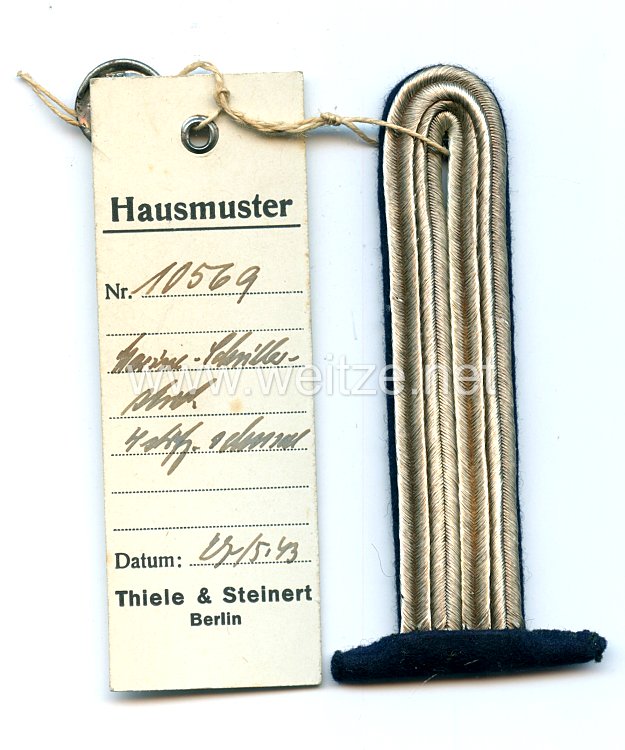
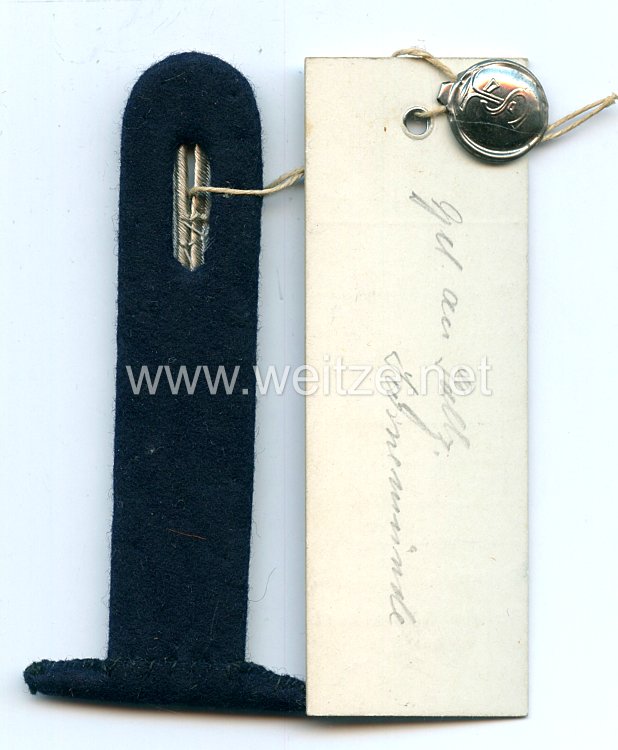
Kriegsmarine Single Shoulder Board for a Fähnrich

Blue cloth base with strap. Sample piece from the firm “Thiele & Steinert”, sealed as a house sample, inscribed and dated ...5.1943. In mint condition.
356653
150,00

Kriegsmarine Single Shoulder Board for a Fähnrich

This single shoulder board for a Fähnrich of the Kriegsmarine represents a significant testament to German naval uniform regulations during World War II. Dated May 5, 1943, and marked as a sample piece by the renowned firm Thiele & Steinert, it documents the precise manufacturing standards and quality controls maintained even during the later war years.

The Kriegsmarine, as one of the three branches of the Wehrmacht from 1935 to 1945, developed a complex and strictly regulated system of rank insignia and uniform regulations. Shoulder boards, also called shoulder straps, served as essential identifying features for the rank of a naval serviceman. The rank of Fähnrich designated an officer candidate who had successfully completed non-commissioned officer training and was on the path to becoming a Leutnant zur See (naval lieutenant).

The characteristic blue cloth base corresponds to the traditional coloring of the German Navy, which had its roots in the Imperial Navy. This dark blue color, often referred to as “navy blue,” had been the distinguishing feature of German naval forces since the 19th century and was also adopted by the Kriegsmarine. The mentioned strap, a type of loop for attachment to the shoulder area of the uniform, was a functional element that ensured the secure fastening of the shoulder board.

The firm Thiele & Steinert of Dresden was among the established manufacturers of uniform insignia and military equipment in the German Reich. The fact that this piece was sealed and inscribed as a house pattern underscores the importance of quality control and standardization in the military clothing industry. Sample pieces served as references for series production and had to meet the exact specifications of military regulations.

The date May 5, 1943 places this object in a critical phase of World War II. At this time, the Kriegsmarine was in the midst of the Battle of the Atlantic, the fierce struggle for control of sea routes between Europe and North America. German U-boats had already caused significant losses in Allied tonnage but were increasingly under pressure from improved Allied defensive measures. In May 1943, Admiral Karl Dönitz would be forced to temporarily withdraw his U-boats from the North Atlantic due to unsustainable losses.

The training of officer candidates such as Fähnrichs remained a priority for the Kriegsmarine despite the tense war situation. The naval officer schools in Mürwik-Flensburg and other locations continuously trained recruits to compensate for increasing losses. The Fähnrich stood between non-commissioned officers and fully trained officers, already bearing initial leadership responsibility but still in the training phase.

The designation as “in mint condition” indicates that this sample piece was never worn and served exclusively as a reference and quality sample. Such sample pieces were carefully preserved by manufacturing firms and were often marked with seals, stamps, and handwritten notes documenting dates, specifications, and approvals.

The Kriegsmarine's uniform regulations were precisely defined in various service regulations and dress codes. The Anzugsordnung für die Kriegsmarine (Dress Regulations for the Navy) precisely defined which uniform parts could be worn on which occasions and in which combinations. Shoulder boards had to be manufactured exactly according to regulations concerning materials, dimensions, coloring, and the attachment of rank insignia.

Today, such sample pieces are of particular historical and collector interest, as they are often in better condition than actually worn uniform parts and provide important information about manufacturing processes, quality standards, and the organization of the military clothing industry. They document not only military hierarchy but also industrial organization and efforts toward standardization even under wartime conditions.

This shoulder board thus represents more than just a piece of cloth with military insignia; it is a material witness to the organizational complexity, industrial capabilities, and hierarchical structures of the Kriegsmarine during one of the most turbulent periods in modern history.

r