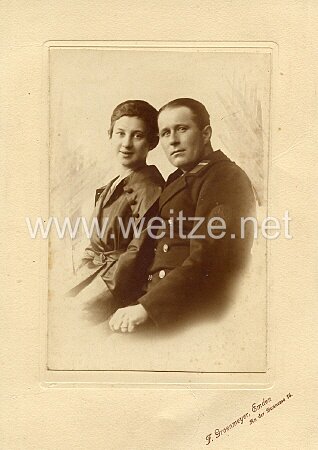
Cabinet Card Photo Imperial German Navy Chief Machinist's Mate in Overcoat with His Wife
This cabinet photograph from around 1900 documents a significant moment in the life of an Ober-Maschinistenmaat (Senior Engine Room Mate) of the Imperial German Navy and offers a fascinating glimpse into the maritime military culture of the German Empire during the Wilhelmine era.
The Kaiserliche Marine (Imperial Navy), which experienced unprecedented expansion under Kaiser Wilhelm II, evolved from a coastal defense force into a world-class fleet. The Ober-Maschinistenmaat belonged to the specialized technical non-commissioned officers responsible for operating and maintaining the increasingly complex steam engines and mechanical systems of modern warships. This position required extensive technical knowledge and years of experience, making the bearer of this rank a highly qualified specialist.
The cabinet format, typically measuring approximately 14 x 20 cm, was the most popular photographic format for portraits between the 1870s and World War I. These photographs were mounted on sturdy cardboard and frequently kept in special albums. The term “cabinet” derives from the cabinets in which such photographs were originally displayed. For naval personnel, it was customary to be photographed in uniform, especially on special occasions or together with family members.
The overcoat (Überzieher) worn in the photograph was an important component of naval attire. This type of coat was worn over the regular uniform and served both practical and representative purposes. Naval overcoats were typically made of dark, heavy cloth and displayed the characteristic rank insignia and service badges of the Imperial Navy. The sleeve insignia of an Ober-Maschinistenmaat differed distinctly from those of deck officers and indicated technical specialization.
The hierarchy within the engine room personnel of the Imperial Navy was precisely regulated. The career path led from simple machinist through Maschinenmaat to Ober-Maschinenmaat and could continue to Maschinenobermaaten or even to commissioned engineer officer. This career track required not only technical skill but also leadership qualities, as Ober-Maschinistenmaate often supervised small teams of machinists.
The presence of the wife in this photograph is of particular cultural-historical significance. In Wilhelmine society, family portraits expressed bourgeois values and social status. For naval personnel who were often at sea for months, such photographs were important mementos of domestic life. Marriage to a non-commissioned officer of the Imperial Navy offered a woman a certain social status, but was also associated with long periods of separation and uncertainty.
The period around 1900 marked a phase of intense naval armament in the German Empire. Under Grand Admiral Alfred von Tirpitz, the Navy Laws of 1898 and 1900 were passed, providing for the massive expansion of the war fleet. This led to an increased need for qualified technical personnel. Machinists and their superiors became indispensable members of ship crews, as modern naval warfare increasingly depended on the reliability of engine propulsion.
The photographic documentation of naval personnel also had an official character. Photographers in the major naval bases such as Kiel, Wilhelmshaven, and Flensburg specialized in naval portraits. They were familiar with the various uniforms, rank insignia, and traditions, contributing to the visual documentation of the Imperial Navy.
Such cabinet photographs are valuable historical sources today, documenting not only military aspects but also providing social-historical insights. They show the connection between military service and private life, between technical progress and personal pride, between imperial ambition and individual life reality. This photograph thus represents a piece of German naval history from a time when the German Empire aspired to world political significance and regarded its fleet as a symbol of national greatness.