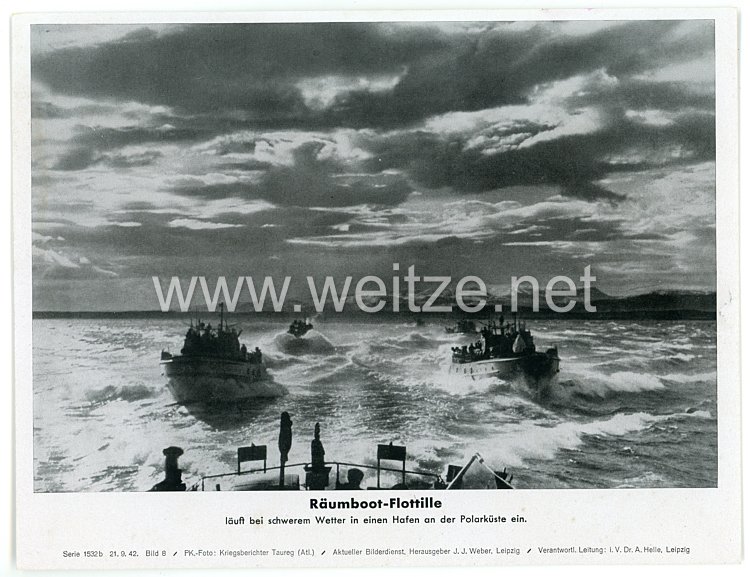
Third Reich - Printed Press Photo “Reichsminister Speer at the Polar Front” February 17, 1944
Historical Context: Reich Minister Albert Speer and the Polar Front 1944
This press photograph from February 17, 1944, published by Aktueller Bilderdienst, documents a visit by Reich Minister Albert Speer to the so-called Polar Front during World War II. This document represents an important testimony to National Socialist propaganda and press work in the late phase of the war.
Albert Speer and His Role in the Third Reich
Albert Speer (1905-1981) had been Reich Minister for Armaments and Munitions since February 1942, later renamed Reich Minister for Armaments and War Production. After Fritz Todt's death in an airplane crash, Speer assumed this central position and became one of the most influential figures in the Nazi regime. His main task was to organize and rationalize the German war economy. Through comprehensive reorganization measures, he initially succeeded in significantly increasing armaments production despite increasing Allied air raids.
The Polar Front and Its Strategic Significance
The term “Polar Front” in the Third Reich's military nomenclature referred to the northern front sectors, particularly in northern Norway and the Murmansk region. This area was of considerable strategic importance: it was along these routes that Allied supply lines to Murmansk and Arkhangelsk ran, through which the Soviet Union received war material. German troops, primarily the 20th Mountain Army under General of Mountain Troops Lothar Rendulic, were engaged here in defensive combat under extreme climatic conditions.
Speer's Front Visits and Their Significance
Front visits by high-ranking Reich ministers served several purposes. On one hand, they were meant to boost troop morale and demonstrate the leadership's solidarity with fighting soldiers. On the other hand, Speer used such inspection tours to personally learn about the Wehrmacht's needs and requirements. In February 1944, the German Reich was already in a precarious military situation: setbacks on the Eastern Front were dramatic, and Allied invasion plans for Western Europe were looming.
The Aktueller Bilderdienst and NS Press Propaganda
The Aktueller Bilderdienst was one of several official or semi-official photo agencies responsible for distributing press photographs in the Third Reich. These services were ultimately subordinate to the Reich Ministry for Public Enlightenment and Propaganda under Joseph Goebbels. Press photos were centrally produced and distributed to newspapers and magazines to ensure a uniform portrayal of events and control public opinion.
The photographs were carefully staged and censored. They were meant to convey strength, determination, and confidence in victory, even when the military situation was already hopeless. Images of fronts, armaments production, and leadership figures played a central role in maintaining home front morale.
Technical and Archival Aspects
The format of 23.5 x 18.5 cm corresponds to a standard format for press photos of that era. The absence of printing on the reverse suggests that this copy may not have been used for immediate publication or served as an archive copy. Normally, press photos bore stamps, captions, censorship marks, and publication instructions on the back.
Historical Context
The date of the photograph, February 17, 1944, falls in a phase of the war when the German Reich was under increasing pressure on all fronts. The Soviet Union had completely seized the initiative on the Eastern Front, and German troops were in retreat. In Italy, the Allies had landed at Anzio, and air raids over Germany itself were intensifying. In this context, Speer's visits also served to ensure maximum utilization of all resources and maintain fighting morale.
Collector Value and Source Criticism
Today, such press photographs are important historical sources that provide insight into the propaganda machinery of the Nazi regime. However, they must be viewed critically, as they do not depict reality but rather a deliberately constructed image. For collectors and historians, they are nevertheless significant because they document the regime's self-presentation and the mechanisms of opinion formation. The good condition (Condition 2) makes this specimen a valuable contemporary document of Nazi press policy and World War II history.