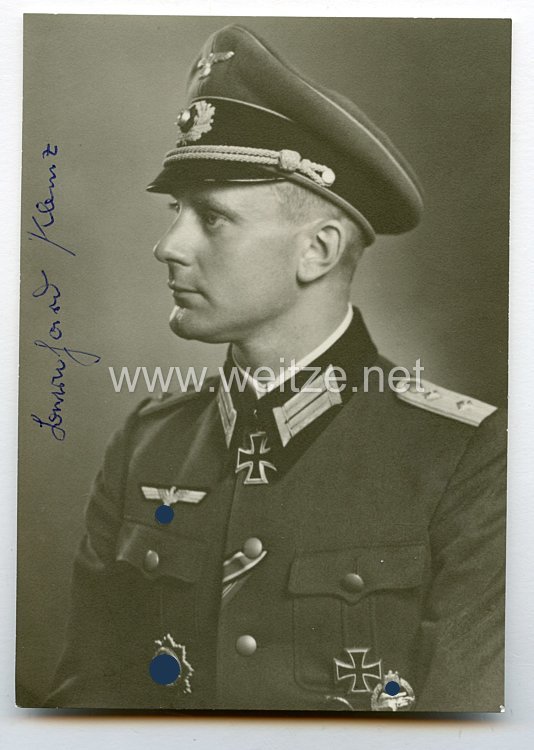
Army - Postwar Signature of Knight's Cross Recipient Bernhard Klemz

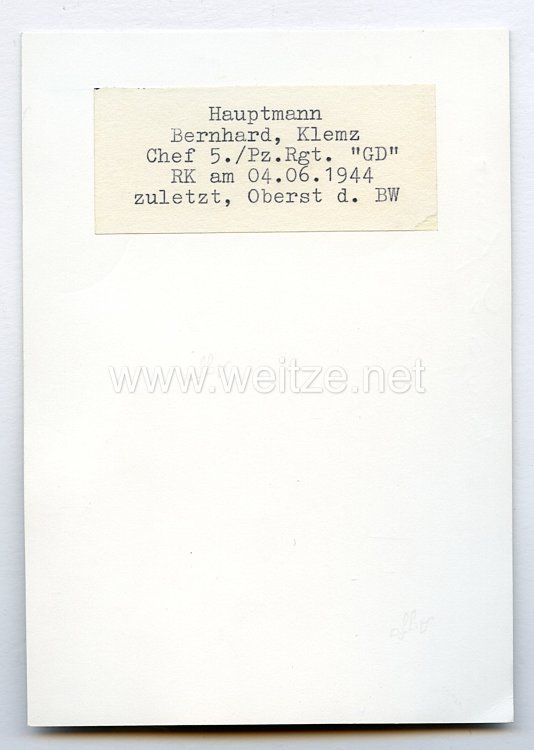
Photograph measures approximately 10 x 14 cm. The photograph is a reprint, post-1945, condition 2.
412653
50,00

Army - Postwar Signature of Knight's Cross Recipient Bernhard Klemz

Historical Context: Post-War Autographs of Knight's Cross Recipients

This object represents a characteristic example of the post-war autograph culture that developed around former recipients of the Knight's Cross of the Iron Cross. Bernhard Klemz belonged to those soldiers of the Wehrmacht who were honored with this significant military decoration during World War II.

The Knight's Cross of the Iron Cross was instituted on September 1, 1939, by Adolf Hitler as a revival of a Prussian tradition. It represented the highest grade of the Iron Cross and was awarded for exceptional bravery or outstanding military leadership. Throughout the war, approximately 7,300 members of the Wehrmacht, Waffen-SS, and other military formations received this decoration.

After 1945, a special collector culture developed around autographs and photographs of former Knight's Cross recipients. This post-war phenomenon had several dimensions: on one hand, military-historical documentation played a role; on the other hand, a commercial market for such memorabilia developed. Veterans were frequently asked for autographs at meetings or through correspondence, often using contemporary or subsequently produced photographs as a basis.

The photograph described here is a post-war print, meaning the image itself was developed after 1945. This was a common practice, as original wartime photographs were often lost or in poor condition. Collectors and veterans themselves frequently had new prints made from preserved negatives or from other photographs.

The dimensions of approximately 10 x 14 cm correspond to a standard format that was common in the post-war period for such autograph photographs. This size was practical for collecting albums and postal shipping, which were the prevailing means of communication between collectors and veterans.

Bernhard Klemz served as a member of the Army (Heer) during World War II. The Heer formed the bulk of German forces and was deployed in all theaters of war from 1939 to 1945. The awarding of the Knight's Cross to Army personnel followed strict criteria and had to go through a detailed proposal process, from the commander through superior staffs to the High Command.

The post-war period was a time of adjustment to civilian life for many Knight's Cross recipients. Veteran meetings and traditional associations offered opportunities for exchange but were also critically observed. The confrontation with the past proved complex, and autographs became a medium that oscillated between personal memory, historical documentation, and problematic hero worship.

From a military-historical perspective, such post-war autographs and photographs are of documentary value, especially when they can be connected with biographical data and unit affiliations. They supplement archives and enable the reconstruction of military careers and structures. At the same time, they require critical source evaluation, as the circumstances of their creation often remain unclear and subsequent idealizations cannot be excluded.

The indicated condition 2 suggests, according to common collector grading systems, a good to very good state of preservation, possibly with slight signs of use. This is typical for post-war material and influences both historical and collector value.

In summary, this object stands as an example of the multi-layered memorial culture of the post-war decades. It documents both military-historical facts and the way society and individuals dealt with this burdened past. For historical research, such materials offer insights into networks, communication channels, and the construction of memory in the second half of the twentieth century.