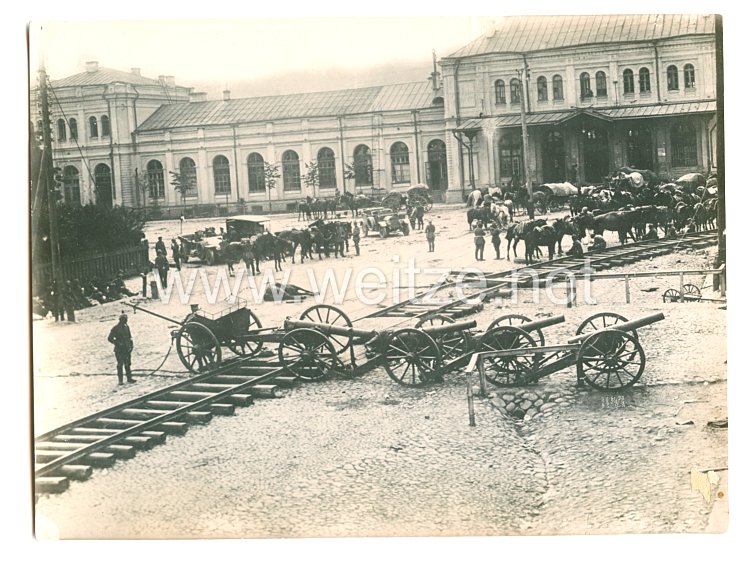
World War I German Army Press Photograph: Capture of the Fortress of Kovno
This press photograph from World War I documents a significant military event on the Eastern Front: the capture of Fortress Kovno (present-day Kaunas, Lithuania) by German troops in August 1915. Such press photographs played a crucial role in war reporting and propaganda for the German Army during the Great War.
Fortress Kovno was one of the largest and most strategically important Russian fortifications in the western part of the Tsarist Empire. Developed between 1879 and 1915, it consisted of a ring of nine main forts and several intermediate works that protected the city of Kovno and an important railway junction. The fortress controlled the crossing over the Neman River (Memel) and formed a central point in the Russian defensive line.
As part of the Summer Offensive of 1915, also known as the “Great Retreat” from the Russian perspective, German and Austro-Hungarian troops conquered large parts of Russian Poland and pushed northeast. The 10th Army under General Hermann von Eichhorn received orders to capture Kovno. The siege began on August 8, 1915, and by August 18 the fortress fell after intense artillery bombardment by heavy German siege guns, including the famous 42-cm mortars known as “Big Bertha” and Austrian 30.5-cm howitzers.
The rapid conquest of Kovno surprised both the Russians and the Germans themselves. Approximately 20,000 Russian soldiers were taken prisoner, and the Germans captured about 1,300 artillery pieces along with large quantities of ammunition and equipment. The fall of the fortress had far-reaching strategic consequences and contributed to the further Russian withdrawal from Poland and Lithuania.
Press photographs like this one were an important instrument of military public relations during World War I. The Bild- und Filmamt (Picture and Film Office, or BUFA), officially founded in 1917, had predecessors in various military press offices that were already active from 1914. These offices organized war correspondents and photographers who worked at the front, and whose images were intended for the press at home and in neutral countries abroad.
The photographs were carefully selected and often provided with detailed captions that emphasized their propagandistic value. They were meant to document military successes, strengthen morale on the home front, and demonstrate the superiority of German forces. The capture of such a significant fortress as Kovno provided excellent material for these purposes.
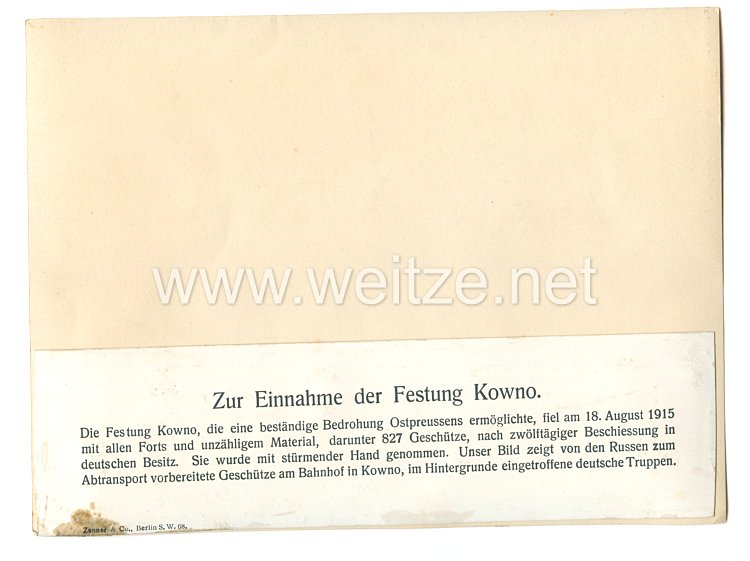
The captions on the reverse of such press photographs typically contained information about the depicted event, date, location, and sometimes technical details about the photography. These inscriptions are valuable sources for historians today, as they provide contemporary interpretations of events and insight into the propaganda work of the time.
The format of approximately 17.5 x 23.5 cm corresponds to a common press format of the period, which was well-suited for reproduction in newspapers and illustrated magazines. Publications such as “Illustrierte Zeitung,” “Berliner Illustrirte Zeitung,” or “Die Woche” regularly published such war photographs, reaching an audience of millions.
World War I photography marked an important turning point in the visual documentation of conflicts. While the war itself could not yet be fully captured in moving pictures, technical advances in photographic technology enabled unprecedented visual reporting. Photographs became a central medium of war experience for the civilian population.
Today, such press photographs are important historical documents that not only document military events but also provide insight into the media landscape, propaganda methods, and visual culture of World War I. They are testimonies to a time when modern mass media and industrial warfare came together and fundamentally changed public perception of wars.