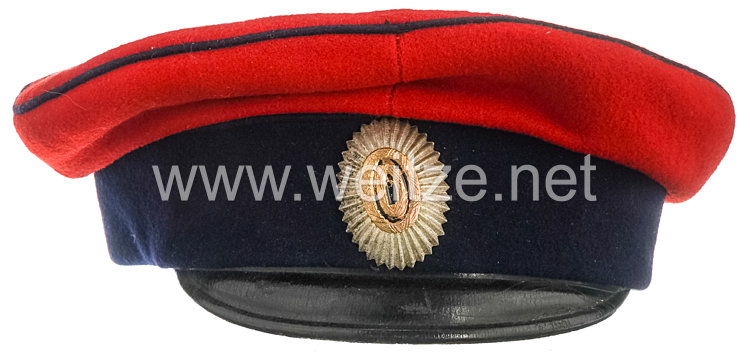
Tsarist Russia - Visor Cap for Officers of the 1st Ural Cossack Regiment
The officer's visor cap of the 1st Ural Cossack Regiment represents a significant piece of military uniform history from Tsarist Russia on the eve of World War I. Manufactured around 1910, this headdress embodies the centuries-old tradition of Cossack regiments that served as elite mounted units in the service of the Russian Crown.
The 1st Ural Cossack Regiment belonged to the most prestigious cavalry units of the Russian Empire. The Ural Cossacks, one of the eleven Cossack hosts (Voysko), settled along the Ural River and had served the Russian Crown since the 16th century. Their military organization was formalized in the 18th century under the Tsars, and they developed into an indispensable component of the Russian armed forces.
The characteristic saddle-shaped form of the cap, known in Russian as Furazhka (фуражка), was typical for officer uniforms of the late Tsarist period. The coloring of this cap – red cloth with blue band and dark blue-black piping – was by no means arbitrary. In the Russian military of the 19th and early 20th centuries, regimental colors were strictly regulated by the imperial military administration. The branch color red was characteristic for cavalry units, while the specific shades of blue and combinations of trim identified the particular regiment.
The metal officer's cockade on the front was an essential identification mark. The Russian officer's cockade typically consisted of the imperial colors black-orange (the colors of the Order of St. George) in the form of an oval rosette. For officers, these cockades were usually made of metal, while enlisted men wore lacquered or embroidered versions. The cockade symbolized the oath of allegiance to the Tsar and the Russian Empire.
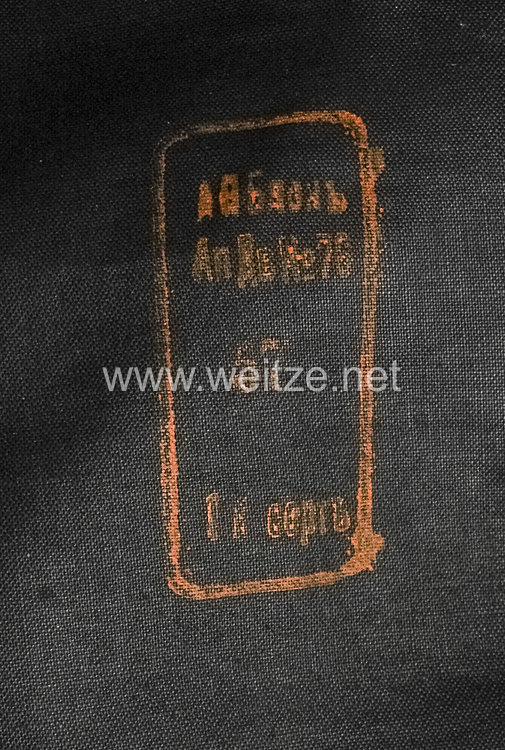
The black lacquered leather visor served not only practical purposes but was also a status marker. Officer visor caps differed significantly from those of enlisted men in materials, workmanship, and details. The black silk lining inside the cap underscores the quality of this officer's equipment. Such caps were frequently manufactured by specialized military tailors in St. Petersburg, Moscow, or larger garrison towns.
The period around 1910 was one of modernization for the Russian Army. Following lessons learned from the costly Russo-Japanese War (1904-1905) and the internal unrest of the 1905 Revolution, uniforms and equipment were revised. Nevertheless, the Cossack regiments retained their traditional colors and distinctions, reflecting their special position within the armed forces.
Cossack officers formed a distinct social class in Tsarist Russia. Many came from traditional Cossack families where military service was passed down through generations. Officer rank required not only military capabilities but also financial means, as officers had to procure their uniforms and equipment themselves. This explains the high quality and careful workmanship of such uniform pieces.
The 1st Ural Cossack Regiment participated in numerous military campaigns, including the Napoleonic Wars, the Caucasus Wars, and later World War I. The regiment's history was closely tied to Russian expansion in Central Asia and the defense of the empire's southeastern borders.
Such visor caps were worn on various occasions: with parade uniform, in daily service, and at official functions. They were part of an extensive wardrobe that officers were required to possess, which also included the traditional Papakha (the high fur cap of the Cossacks) and various versions of service uniforms.
The preservation of this cap in good condition is remarkable considering that many such objects were lost or destroyed during the turbulent events of the Russian Revolution of 1917 and the following Civil War. Many officers of the Tsarist army emigrated, and some took their uniforms into exile, which explains how such pieces were preserved outside Russia.
Today, such uniform pieces are important historical artifacts that provide insight into the military culture, craftsmanship, and social structure of the fallen Tsarist Empire. They document an epoch that ended abruptly with the fall of the Romanov Dynasty and the conclusion of a centuries-old military tradition.