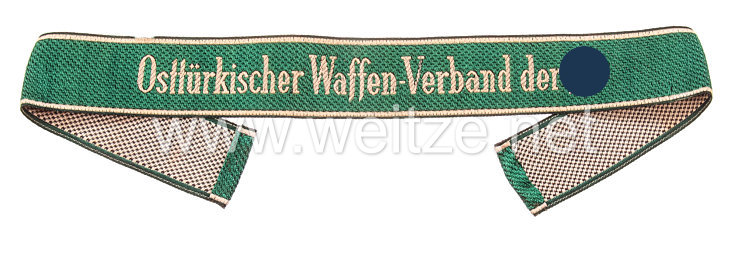
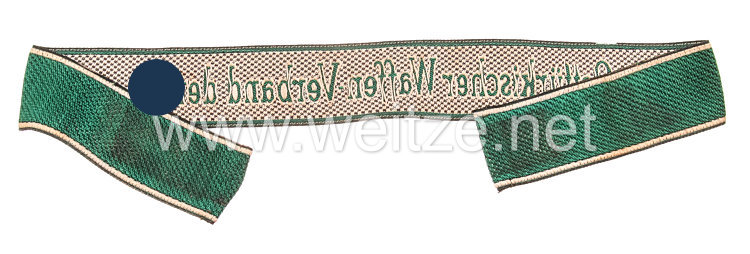
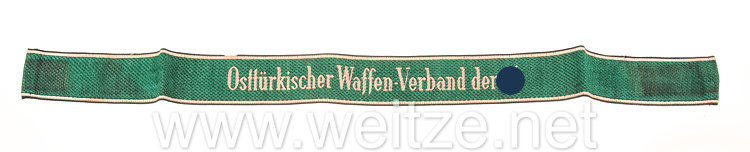
Waffen-SS Cuff Title “Osttürkischer Waffenverband der SS”

Bevo-woven construction in white on green background. Full length 44 cm, ends hemmed. Condition 2.
These cuff titles were found in April 1945 by American soldiers in the uniform depot of the SS Standortkommandantur Dachau near München. The depot contained numerous additional cuff titles, collar tabs, sleeve shields, uniforms, etc., which were not issued before the end of the war. Upon the capture of KL Dachau and the garrison, these items fell into the hands of US soldiers and became popular war souvenirs.
417452
650,00

Waffen-SS Cuff Title “Osttürkischer Waffenverband der SS”

The armband of the East Turkic SS Armed Unit (Osttürkischer Waffenverband der SS) represents a significant chapter in the complex history of foreign volunteer formations within the Waffen-SS during World War II. This particular cuff title was designed for Muslim volunteers from the Turkic-speaking regions of the Soviet Union who served in German armed forces.

The Eastern Legions and later the East Turkic units were established from 1941 onwards in the context of Operation Barbarossa, the German invasion of the Soviet Union. The Wehrmacht and subsequently the Waffen-SS specifically recruited among Soviet prisoners of war and defectors from various ethnic minorities, including Azerbaijanis, Turkmen, Uzbeks, and other Turkic-speaking peoples. This recruitment policy was based on the German strategy of exploiting ethnic and national tensions within the Soviet Union.

The East Turkic SS Armed Unit was only formally established in the final months of the war. In autumn 1944, SS leadership decided to unite various East Turkestani units under a common command. The formation was to constitute the East Turkic SS Armed Group or the East Turkic Armed Unit of the SS, with the exact designation varying in historical sources.

The armband described here was manufactured using the BeVo weaving technique, a high-quality weaving method developed by the company Bandfabrik Ewald Vorsteher from Wuppertal-Barmen. The white lettering on a green background corresponded to SS color guidelines for foreign Muslim units. The green base color was symbolically chosen to represent Islam and distinguished these units from other volunteer formations.

Of particular historical significance is the provenance of this piece. As documented in the object description, it was discovered by American troops in April 1945 in the uniform depot of the SS garrison command at Dachau. During the liberation of Dachau concentration camp and the capture of the entire SS complex on April 29, 1945, US soldiers encountered extensive stocks of uniform components that were never issued. This explains the good condition of many of these pieces—they were never worn or deployed in the field.

The fact that these armbands were stored in large quantities at Dachau indicates that the planned establishment and equipping of the East Turkic units could not be fully realized before the war's end. The chaotic conditions of the final months of the war, the collapse of German logistics, and the rapid advance of Allied forces prevented the systematic distribution of these equipment items.

These armbands were taken by American soldiers as war souvenirs, a widespread practice among all Allied forces. Such personal mementos today document important aspects of military history and serve as material witnesses to historical events. The circumstances of discovery are often as significant as the objects themselves, as they provide insight into production quantities, inventory levels, and the discrepancy between planned and actual use.

The historical context of foreign SS units remains a difficult chapter in history. Recruitment often occurred under coercion, through propaganda, or from the desperate situation of Soviet prisoners of war. Many of these units saw little combat and were regarded as traitors by advancing Soviet troops at war's end, which often had tragic consequences for those involved.

Today, such objects in collections and museums serve as important study materials for researching the complex history of World War II, SS organization, and the role of foreign volunteers in German armed forces. They are material witnesses to a dark period and contribute to understanding historical contexts.