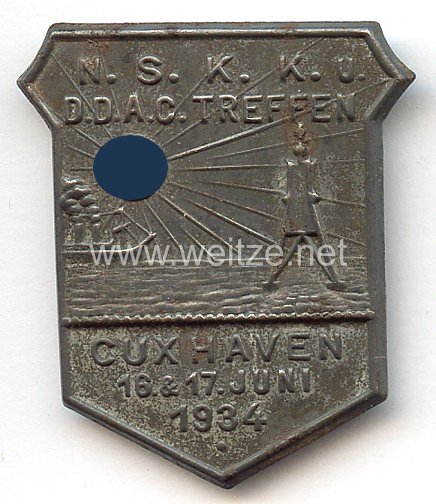
NSKK and DDAC Rally Cuxhaven June 16th & 17th, 1934

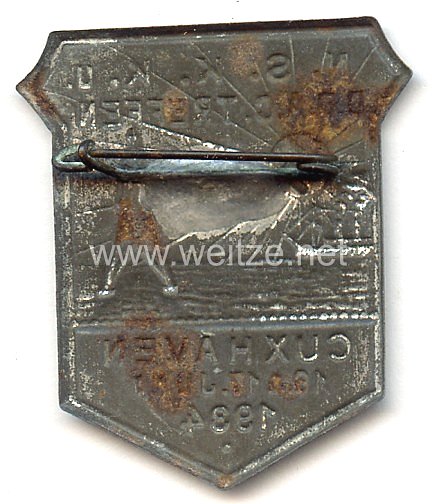
Pressed sheet metal badge, with pin fastener, Condition 2.

364452
100,00

NSKK and DDAC Rally Cuxhaven June 16th & 17th, 1934

This badge documents a significant event in the history of National Socialist transportation organizations: the joint meeting of the National Socialist Motor Corps (NSKK) and the German Automobile Club (DDAC) in Cuxhaven on June 16 and 17, 1934.

The NSKK was founded on April 1, 1930, initially as a sub-organization of the SA, and developed into a paramilitary formation that organized and controlled motorized transport in Nazi Germany. After the seizure of power in 1933, the NSKK expanded rapidly and assumed numerous tasks in the areas of motor vehicle training, traffic education, and preparation for military motorization. The DDAC was originally a traditional automobile club that was brought into line (Gleichschaltung) in 1933 and worked closely with the NSKK.

The year 1934 was of particular significance for both organizations. The meeting in Cuxhaven took place just weeks before the dramatic events of June 30, 1934, which went down in history as the “Röhm Putsch” or “Night of the Long Knives.” This purge also had repercussions on the structure of the NSKK, which loosened its dependence on the SA and assumed a more independent position within the Nazi organizations. In August 1934, Adolf Hühnlein was appointed Corps Leader of the NSKK and directed its further expansion.

Event badges like this one from Cuxhaven were typical mementos at meetings, parades, and propaganda events of Nazi organizations. They served several purposes: they documented participation in the event, strengthened members' sense of belonging, and functioned as visible signs of loyalty to the movement. Such badges were typically produced by local manufacturers and purchased by participants or awarded as recognition.

This stamped iron badge is characteristic of the cost-effective mass production of such event badges. Unlike official service badges or decorations, which were often made from higher-quality materials such as bronze, tombac, or silver-plated metal, event badges frequently consisted of stamped and painted sheet iron. This production method made it possible to manufacture large quantities at relatively low cost, which was important for local and regional events.

The choice of Cuxhaven as the venue was strategically significant. The city at the Elbe estuary was an important transportation hub and port city, which thematically fit well with the focus of the motorized transport organizations. The North German region played an important role in the development of automotive technology and motoring in Germany. Such regional meetings served to consolidate organizational structures at the local level and mobilize members.

The event in June 1934 took place during a phase of intense consolidation of Nazi rule. The Gleichschaltung of society was largely complete, and organizations like the NSKK and DDAC played an important role in permeating everyday life with National Socialist ideology. Motor vehicle events combined technical presentations with political propaganda and military displays.

The badge bears the typical characteristics of its time: the exact date, the naming of both organizations, and presumably corresponding symbolism. Such badges were usually worn on civilian clothing and publicly documented participation in Nazi events. Today they are important contemporary historical documents that provide insight into the organizational culture and propaganda practices of the Nazi regime.

From a military-historical perspective, the NSKK is particularly significant because it played an important role in preparing the Wehrmacht for motorized warfare. The organization trained drivers, maintained workshops, and conducted technical training. During World War II, many NSKK members were transferred to motorized units of the Wehrmacht and Waffen-SS.

The badge's preservation condition of “Condition 2” indicates a well-preserved specimen that has survived the passage of time with only minor signs of wear. This is noteworthy for sheet iron badges, as the material is susceptible to corrosion and paint damage. Such objects are important testimonies to the material culture of National Socialism and enable historians to reconstruct the everyday reality and organizational practices of that era.