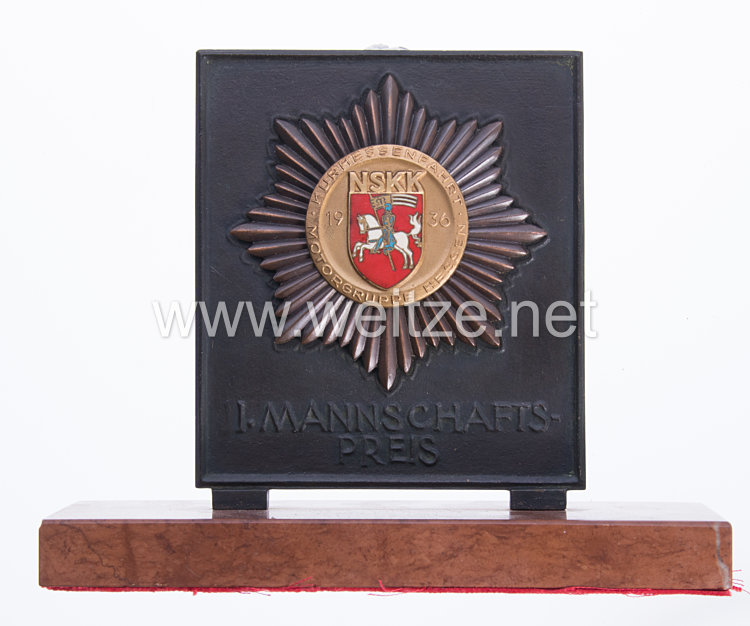
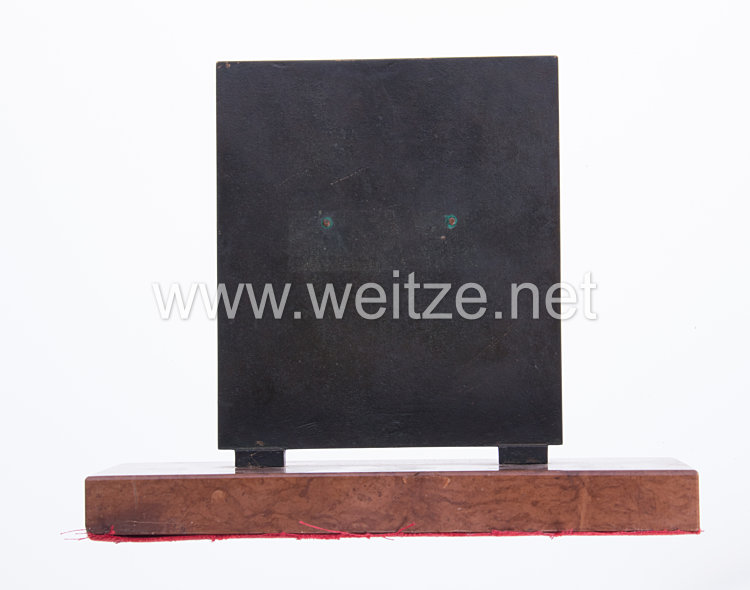
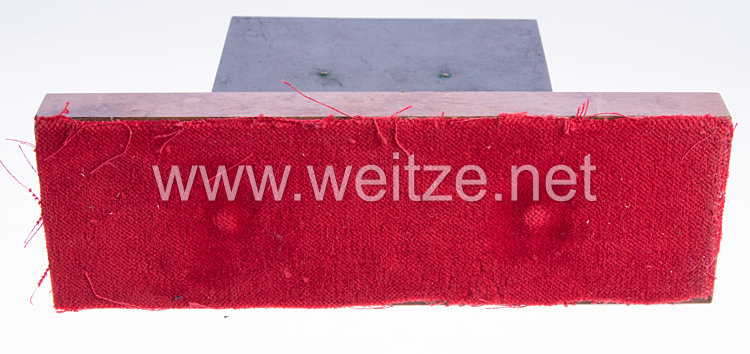
NSKK - Large Non-Wearable Victory Prize N.S.K.K. Motorgruppe Hessen, 1936 Kurhessenfahrt 1st Team Prize
NSKK Victory Prize from the 1936 Kurhessen Rally: Motorsport in Service of National Socialist Propaganda
This NSKK victory prize from the Motor Group Hesse dating to 1936 represents a significant artifact of National Socialist motorsport culture and its propagandistic instrumentalization. The plaque with applied bronze star and enameled coat of arms mounted on a marble base documents the first staging of the Kurhessen Rally, a motorsport event that served to promote motor vehicle operations and paramilitary training.
The National Socialist Motor Corps (NSKK - Nationalsozialistisches Kraftfahrkorps) was founded on April 1, 1931, as a sub-organization of the SA and elevated to an independent formation of the NSDAP on August 23, 1934, under Corps Leader Adolf Hühnlein. The primary mission of the NSKK consisted of motor vehicle technical training and preparation for motorized warfare. After the seizure of power in 1933, the NSKK developed into a mass organization with over 500,000 members by 1939.
The Motor Group Hesse formed one of the regional subdivisions of the NSKK, which were organized hierarchically according to the Führer principle. The Corps was structured into Motor Upper Groups, Motor Groups, Motor Brigades, Motor Standards, and further subunits. Hesse represented an important region for motorsport activities due to its central location and industrial significance.
The 1936 Kurhessen Rally took place during a historically significant year. 1936 marked a year of international self-presentation for the Nazi regime, particularly through the Olympic Games in Berlin. Motorsport events like the Kurhessen Rally served multiple purposes: they were intended to demonstrate supposed technical superiority, inspire enthusiasm for motor vehicles among the population, and simultaneously promote paramilitary training. Such orientation rallies required map reading, teamwork, and discipline – all skills of military relevance.
This prize was manufactured as a non-wearable victory prize, in contrast to wearable decorations such as badges or medals. The execution with bronze star and enameled coat of arms on a marble base corresponds to the typical design of representative NSKK prizes from the pre-war period. The enameled coat of arms references regional connection to Hesse and emphasizes the local character of the event.
The designation “1st Team Prize” indicates that this involved a team competition. This corresponded to Nazi ideology, which placed the collective above the individual and emphasized comradeship and community spirit. NSKK events were rarely pure sporting competitions but always political manifestations with corresponding symbolism and rituals.
The technical execution of the plaque measuring 10 x 13 cm demonstrates the typical quality of such prizes from the mid-1930s. Bronze as material for the star and the use of enamel for the coat of arms were common manufacturing techniques for high-quality awards. The marble base lent the prize additional representational character and dignity.
The year 1936 was also significant in motorsport: Germany celebrated international successes in Grand Prix racing with the legendary Silver Arrows from Mercedes-Benz and Auto Union. These successes were exploited propagandistically and were intended to demonstrate at all levels – from international racing to regional NSKK events – the supposed superiority of National Socialism.
After the outbreak of war in 1939, the role of the NSKK increasingly transformed. From an organization that also fulfilled sporting and social functions, it became a military auxiliary organization. The era of representative motorsport events with elaborate victory trophies largely ended, as all resources were subordinated to warfare.
Today, such NSKK prizes represent important historical documents that provide insight into organizational structure, propaganda methods, and everyday culture of National Socialism. They document how sports and leisure activities stood in service of ideology and were instrumentalized for war preparation. The 1936 Kurhessen Rally was one of countless events through which the regime consolidated its power structures down to the local level and mobilized the population.