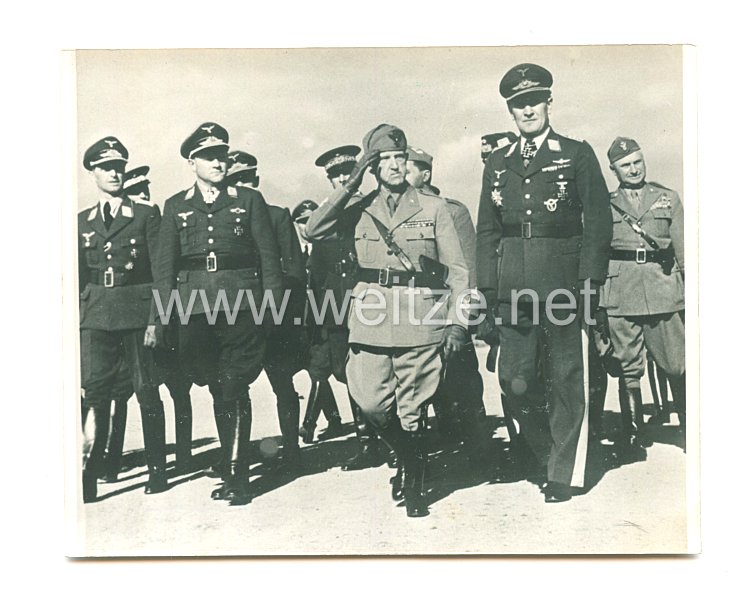
Luftwaffe Press Photo: Italian Delegation Visiting the Luftwaffe
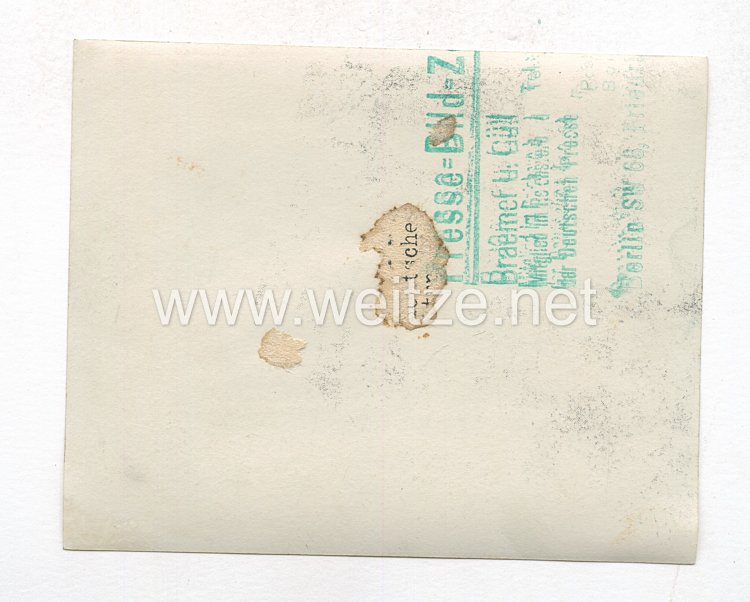
The object in question is a Luftwaffe press photograph from the Second World War era, showing an Italian delegation visiting the German Air Force. With dimensions of approximately 11 x 13 cm, it conforms to the typical formats of official press photography of that period. The absence of any text on the reverse suggests that the photograph may not have been intended for immediate publication or that its original markings have been lost.
Historical Context of German-Italian Military Relations
Military relations between the German Reich and Fascist Italy under Benito Mussolini developed intensively particularly after the formation of the Rome-Berlin Axis in October 1936. The Pact of Steel of May 22, 1939 further consolidated this alliance and created a formal framework for military cooperation, technology exchange, and mutual visits by military delegations.
The Regia Aeronautica, the Italian Air Force, and the German Luftwaffe maintained active exchanges throughout the 1930s and 1940s. Italian officers regularly visited German Luftwaffe facilities, flight schools, and production sites to exchange experiences and study training methods. Conversely, German Luftwaffe officers traveled to Italy to inspect facilities there.
The Role of Press Photography in National Socialism
The Propaganda Companies of the Wehrmacht and specifically the press offices of individual service branches produced an enormous quantity of photographs during the war. The Reich Ministry of Public Enlightenment and Propaganda under Joseph Goebbels strictly controlled photographic reporting and used it to portray military strength and international solidarity among the Axis powers.
Press photographs like the present one served multiple purposes: they documented official events, were distributed to domestic and foreign newspapers and magazines, and were intended to demonstrate the unity of allied nations. The Luftwaffe, as the most modern and prestigious branch of the Wehrmacht, was particularly frequently the subject of such photographs.
Technical Aspects of War Photography
The format of approximately 11 x 13 cm corresponds to a common print size of that era. Press photographs were typically developed on baryta paper, characterized by high durability and good reproduction properties for printing. Many images bore stamps on the reverse from the issuing office, image numbers, dates, photographers' names, and often pre-formulated captions for the press.
The absence of reverse markings on this specimen is unusual but could have various reasons: it might be a preliminary print, an archive copy, or an image not cleared for publication.
Italian-German Luftwaffe Cooperation
The cooperation between both air forces encompassed various areas: During the Spanish Civil War (1936-1939), both the German Legion Condor and Italian air forces fought on Franco's side and gained combat experience together. These experiences were evaluated in both countries and led to tactical and technical developments.
After Italy's entry into the war on June 10, 1940, operational cooperation intensified. German Luftwaffe units were temporarily relocated to Italy or operated from Italian bases, particularly during fighting in the Mediterranean region and North Africa. The X. Fliegerkorps, for example, operated from Sicily from December 1940 against British targets in the Mediterranean.
Collector Value and Historical Significance
Press photographs from the Second World War era are important historical documents today. They not only provide visual insights into military events but also show how the Nazi regime wanted to portray its relationships with allies. For collectors of military-historical photographs, such images are of particular interest as they represent authentic period documents and help understand the complex relationships between the Axis powers.
The condition of such photographs varies greatly. Many specimens were damaged during and after the war, improperly stored, or faded due to light exposure. Well-preserved specimens with complete reverse markings are correspondingly more sought after by collectors and researchers.