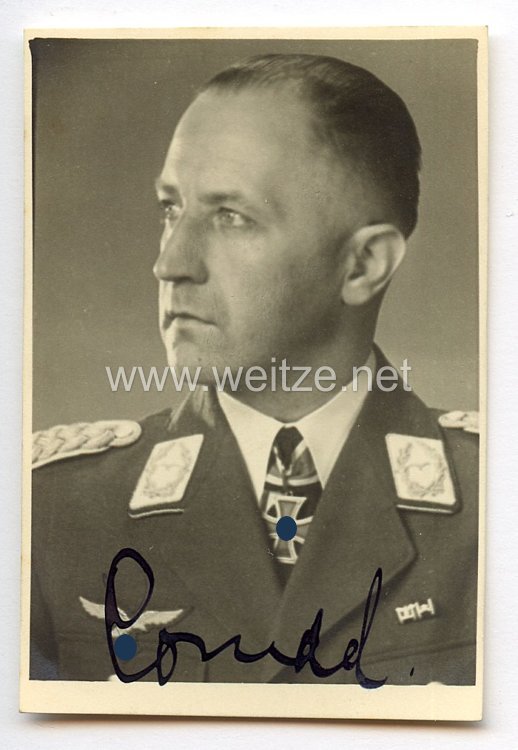
Luftwaffe - Original Signature of Knight's Cross Recipient Generalmajor Dipl.-Ing. Gerhard Conrad

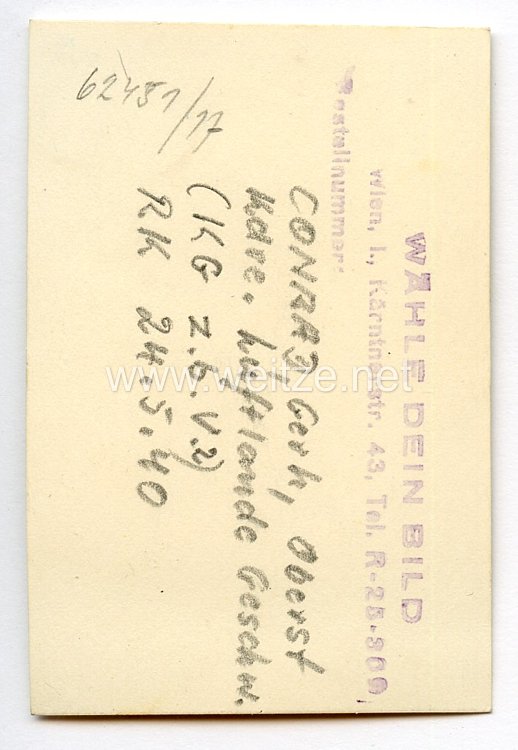
on an excellent passport photograph, with very fine ink signature “Conrad”, pencil notations on reverse, condition 2.
302552
230,00

Luftwaffe - Original Signature of Knight's Cross Recipient Generalmajor Dipl.-Ing. Gerhard Conrad

The original signature of Generalmajor Dipl.-Ing. Gerhard Conrad on a passport photograph represents a significant historical document from the history of the German Luftwaffe during World War II. Such signed photographs of Knight's Cross recipients constitute important historical artifacts today, documenting both the military hierarchy and the propaganda and memorial culture of that era.

Gerhard Conrad was born on September 15, 1911, and pursued a remarkable career in the Luftwaffe. As a certified engineer (Diplom-Ingenieur), he combined technical expertise with military leadership competence, which was particularly valued in the technically demanding Luftwaffe of the Wehrmacht. He received the Knight's Cross of the Iron Cross, one of the highest military decorations of the Third Reich, awarded for exceptional bravery and military leadership performance.

The Knight's Cross was instituted on September 1, 1939, by Adolf Hitler as a renewal of the Prussian Iron Cross. Throughout the war, approximately 7,300 individuals received this decoration, with Luftwaffe members representing a significant proportion. Knight's Cross recipients were intensively portrayed as heroes in Nazi propaganda and utilized for morale and recruitment purposes.

The practice of signing photographs was widespread in the military context of World War II. Knight's Cross recipients were frequently asked to sign photographs for comrades, subordinates, or for propaganda purposes. These autographs served various functions: they strengthened camaraderie, documented personal encounters, and were preserved as mementos. Additionally, they played a role in the hero worship that the Nazi regime systematically promoted.

The present passport photograph corresponds to the standardized photographic format of that time. Passport photos were required for military identification papers, pay books (Soldbuch), and other official documents, typically showing the bearer in uniform with decorations. The quality of the photography and the type of signature can provide insights into the context of its creation – whether it was an official photograph or a private dedication.

The ink signature “Conrad” on the photograph is a characteristic feature of such autographs. The use of ink was common, as fountain pens were the standard writing instrument of the time. The style of signature – whether elaborate or abbreviated, with or without rank – varied according to personal style and occasion. The pencil notations on the reverse are typical of collectors or contemporary viewers who recorded additional information such as date, location, or special circumstances of the encounter.

From a historical perspective, such documents are of multiple interest today. They serve military-historical research by documenting persons, units, and events. For biographical research, they provide concrete evidence of military careers and decorations. In collecting history, they reflect the culture of remembrance and the handling of the past.

The Luftwaffe as an independent branch of service was officially founded in 1935, after its existence had initially been kept secret. Under the leadership of Hermann Göring, it developed into a powerful air force that achieved significant operational successes in the early war years. Engineers and technically trained officers like Conrad played an important role in the development, testing, and deployment of aircraft and air force systems.

The rank of Generalmajor was the lowest general rank in the Wehrmacht and corresponded to Brigadier General in other NATO armies. Promotion to this rank required years of military experience and proven leadership qualities. Combined with the academic qualification as a certified engineer, this underscores Conrad's special position in the technically oriented Luftwaffe.

In the historical assessment of such objects, critical distance is required. They are testimonies of a criminal dictatorship and a war of aggression that cost millions of lives. Their preservation and study serve historical understanding and warning, not glorification. Modern military-historical collections and museums contextualize such objects accordingly and place them in the larger contexts of war, dictatorship, and crimes.