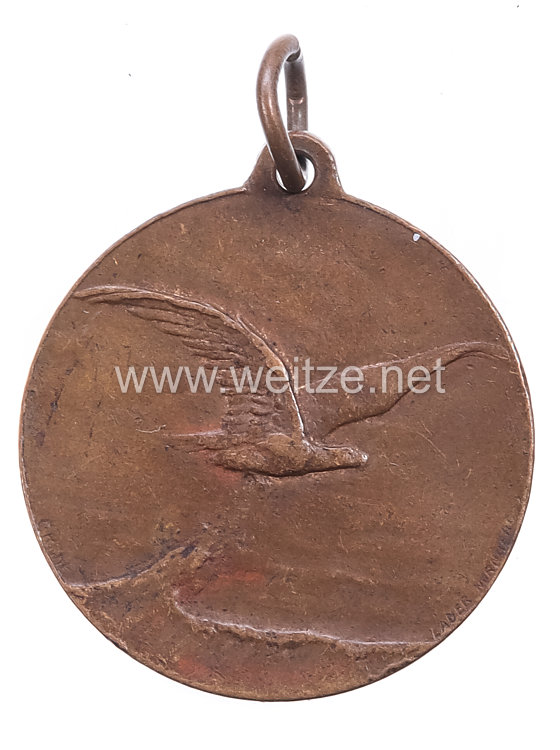
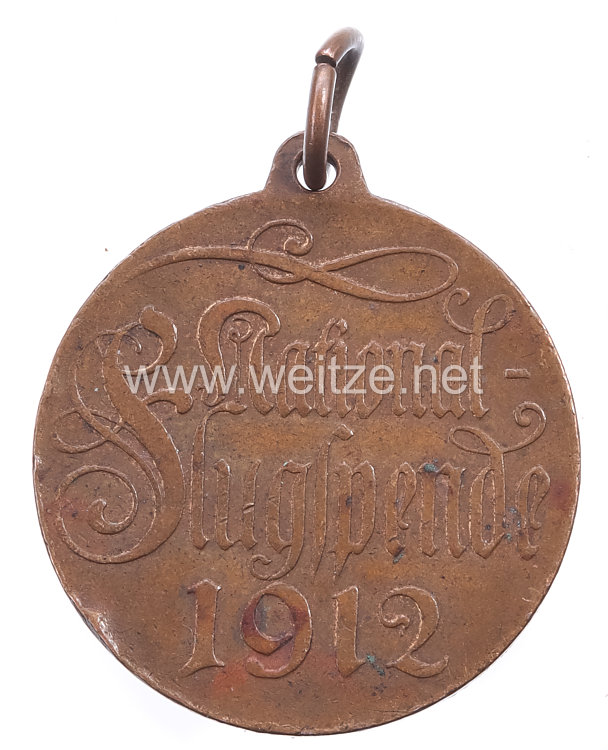
Wearable Donation Medal "National-Flugspende 1912"
The National-Flugspende was a national fundraising campaign, initiated by Prince Heinrich von Preussen, to advance the development of the German aircraft industry.
The portable donation medal of the National-Flugspende 1912 represents a significant testimony to early German aviation history and documents the patriotic mobilization of the population for the development of military aviation in the German Empire shortly before World War I.
At the beginning of the 20th century, the German Empire recognized the strategic importance of aviation for modern warfare. While France had already invested considerable resources in developing its air forces, Germany lagged significantly behind in this area. This situation prompted Prince Heinrich of Prussia, the younger brother of Kaiser Wilhelm II, to launch the National-Flugspende (National Aviation Donation) initiative in 1912.
The National-Flugspende was an unprecedented national fundraising campaign aimed at gathering funds from all social classes to support the expansion of the German aircraft industry and strengthen military aviation. Prince Heinrich, himself an enthusiastic promoter of technology and automobile sports, used his influence and popularity to transform the campaign into a patriotic cause.
The 1912 campaign mobilized large segments of German society. Patriotic sentiments and growing concerns about Germany's military position in Europe motivated citizens from all classes, from workers to industrialists, to participate. Schoolchildren collected pennies, associations organized events, and wealthy patrons donated substantial sums. The donation drive was part of a broader movement of military armament and technological competition among European powers.
As recognition for participation in the National-Flugspende, these portable medals were issued. The medals were typically manufactured from bronze with appropriate toning. They served not only as thanks to donors but also as visible signs of patriotic sentiment that could be worn on lapels or watch chains.
The design of such donation medals followed the iconographic conventions of the era. They typically displayed representations of aircraft, patriotic symbols such as the Prussian eagle or the German imperial eagle, as well as inscriptions referring to the National-Flugspende and the year 1912. The artistic execution corresponded to Wilhelmine taste with its preference for powerful, monumental symbolism.
The National-Flugspende 1912 was extraordinarily successful, raising several million Marks. These funds went toward the development and procurement of military aircraft, the construction of airfields, and the training of pilots. The campaign significantly contributed to Germany's substantial improvement in military aviation by the outbreak of World War I in 1914.
The donation medals themselves became symbols of patriotic mobilization and the belief in technological progress characteristic of the Wilhelmine era. They document the population's willingness to actively support military armament and reflect the patriotic atmosphere that prevailed in Germany in the years before World War I.
Today, these medals are sought-after objects for collectors of military-historical decorations and documents of early aviation history. They are testimonies to an era when aviation evolved from a technical curiosity to a decisive military factor. The medals of the National-Flugspende exemplify the mobilization of civil society for military purposes and the close intertwining of technological progress, nationalism, and military armament in the German Empire.
The preservation of such objects in collections and museums helps maintain and deepen understanding of the prehistory of World War I and the social dynamics of the Wilhelmine era.