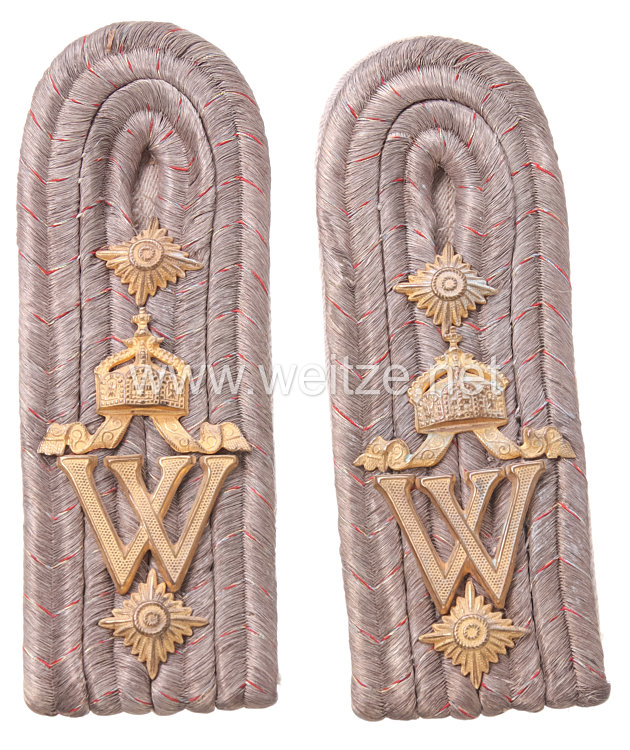
Mecklenburg-Schwerin Pair of Shoulder Boards for a Captain (Hauptmann) in the Grand Ducal Mecklenburg Fusilier Regiment No. 90 Kaiser Wilhelm
These shoulder boards represent a significant piece of Prussian-German military history from the late Imperial era. They belonged to the uniform of a Captain (Hauptmann) in the Grand Ducal Mecklenburg Fusilier Regiment No. 90, which bore the honorary title “Kaiser Wilhelm.”
Regiment No. 90 was one of the most traditional military units of the Grand Duchy of Mecklenburg-Schwerin. The peacetime garrisons in Rostock and Wismar made the regiment an integral part of the military presence in the region. As a Fusilier Regiment, it belonged to the infantry and was part of the XVII Army Corps of the Prussian Army, to which the Mecklenburg contingents were assigned.
The dating of these shoulder boards is precisely established by the description “in the manner of wear from March 19, 1912.” This date marks an important uniform-technical change in the German Army. The 1912 uniform reform brought various modifications to the wardrobe of the Imperial troops, with details such as insignia, rank badges, and shoulder boards being standardized and partially redesigned.
The shoulder boards themselves display characteristic features of the officer's uniform of this epoch. The gilded cipher was an essential identifying feature and designated regimental affiliation. The white cloth base was the traditional branch color of the infantry in the German Army, distinguishing it from the colors of other branches such as cavalry (various colors) or artillery (red).
The rank of Captain (Hauptmann) corresponded in the Imperial Army hierarchy to that of a company commander. Captains were typically experienced officers who bore direct responsibility for leading and training 150 to 250 men. A captain's shoulder boards differed from those of lower officer ranks through specific execution details in the braiding and rank stars.
The Fusilier Regiment No. 90 held particular historical significance. The honorary title “Kaiser Wilhelm” bestowed additional prestige upon the regiment and symbolically bound it closely to the Prussian royal house. Such honorary titles were granted only to selected regiments and reflected historical merit or special relationships to the Crown.
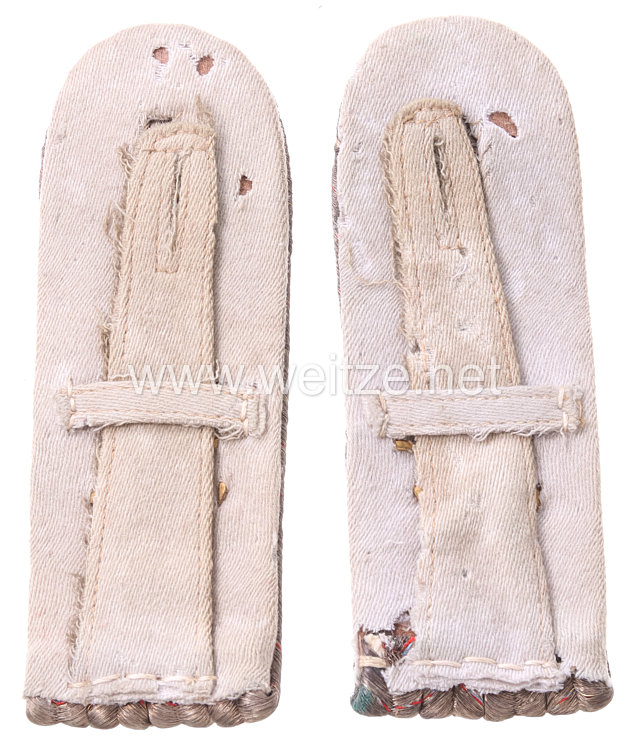
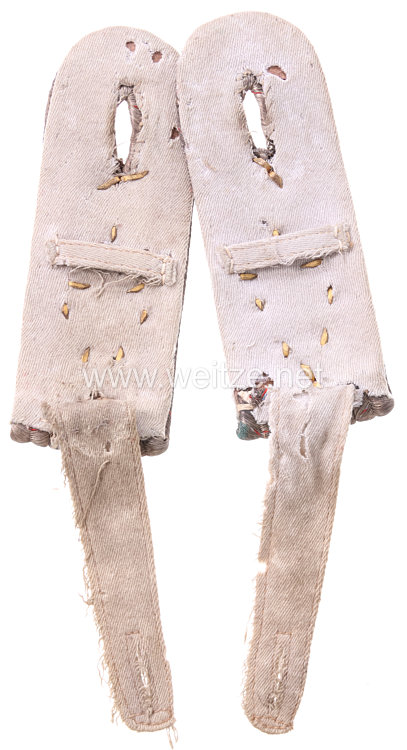
The construction with loops was the practical attachment method for shoulder boards. These were slipped onto the shoulder portion of the uniform and fixed there, allowing them to be exchanged when necessary. This was particularly important since different uniform types (parade uniform, service uniform, field uniform) required different shoulder board variants.
In the context of German military history, these shoulder boards stand at the end of a long tradition of Prussian-German uniform design. The period between 1912 and the beginning of World War I in 1914 was the last peacetime period of the Imperial Army. With the outbreak of war, uniforms changed rapidly: the conspicuous, shining equipment items were replaced by field-gray, matte versions to meet the requirements of modern warfare.
The Grand Duchy of Mecklenburg-Schwerin, as a federal state of the German Empire, had its own military tradition but was militarily closely connected with Prussia. The Mecklenburg regiments were fully integrated into the Prussian Army structure but retained their regional peculiarities and identity.
The preservation of such shoulder boards is of great historical value today. They document not only the military rank structure and uniform design of the Imperial era but also the regional organization of the German armed forces before 1918. The condition described as “lightly worn” indicates that these pieces were actually used in service, which additionally increases their historical value.
For collectors and military historians, such objects are particularly valuable as they represent authentic testimonies of a vanished military world. The rarity of these shoulder boards results from several factors: the specific regimental affiliation, the precise dating period from 1912 onwards, and the fact that many such equipment items were lost or destroyed over time.
These shoulder boards thus serve as tangible links to the final years of the German Empire, representing both the splendor of pre-war military tradition and the organizational sophistication of one of Europe's most powerful armies on the eve of the Great War.