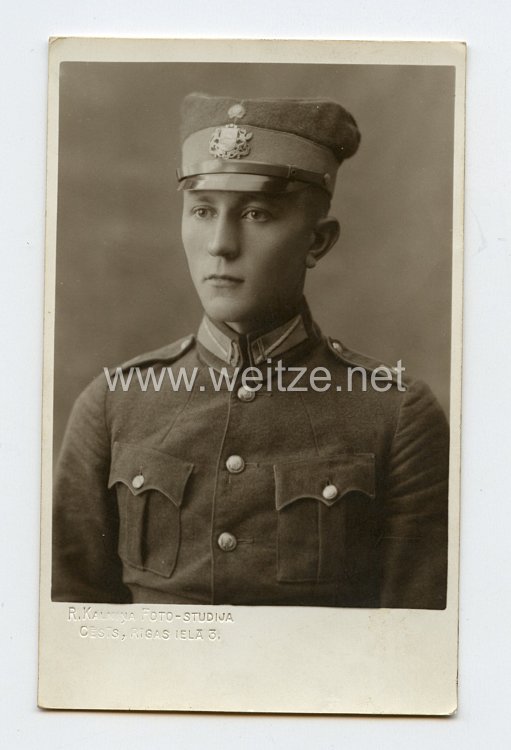
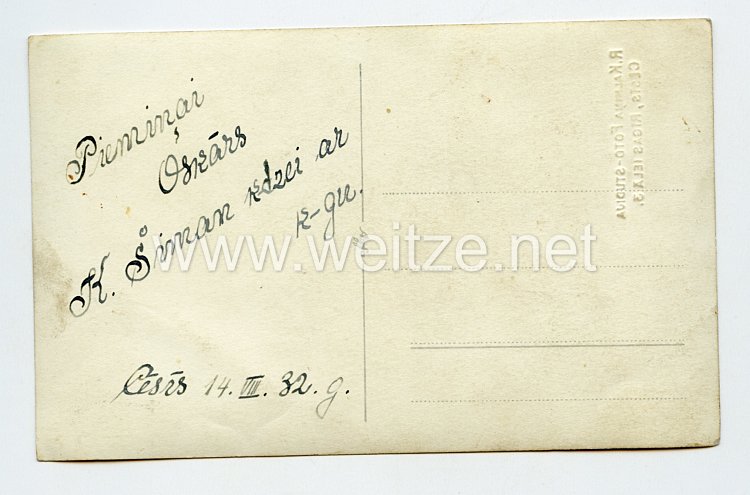
Latvia Portrait Photograph of a Soldier

1930s, postcard size, used condition.
413251
20,00

Latvia Portrait Photograph of a Soldier

Latvian Soldier Portrait from the 1930s: Document of a Young Nation

The object in question is a portrait photograph of a Latvian soldier from the 1930s in postcard format, a typical example of the photographic military culture of the interwar period. Such photographs were widespread throughout European military culture of this era and served both personal and official purposes.

Historical Context: Latvia in the Interwar Period

The Republic of Latvia gained its independence in November 1918 following the collapse of the Russian Empire and the German Empire. The subsequent years until 1920 were marked by the Latvian War of Independence, during which the young nation had to fight against Soviet Russian, Baltic German, and Bermondt-Russian forces. After the recognition of independence through the Treaty of Riga in August 1920, the construction of regular state structures began, including the Latvijas armija (Latvian Army).

The 1930s, from which this photograph originates, were a particularly significant period in Latvian history. Following the coup d'état by Kārlis Ulmanis on May 15, 1934, Latvia transformed from a parliamentary democracy to an authoritarian regime. This political transformation also affected the armed forces and their public representation.

The Latvian Army of the 1930s

The Latvian Army of the interwar period was a relatively small but professional force. According to the provisions of the Conscription Law of 1919, every able-bodied Latvian man served for a certain period in the armed forces. The peacetime strength of the army in the 1930s was approximately 20,000 to 25,000 men, but could be increased to over 100,000 men in case of mobilization.

The uniform of Latvian soldiers of this period followed Central European standards, with clear influences from French and British military traditions. The typical field uniform consisted of khaki or gray-green fabric, with characteristic Latvian national insignia and rank badges.

Military Photography in Postcard Format

The postcard format (typically 9 x 14 cm or similar dimensions) was the standard format for personal photographs in the first half of the 20th century. Soldier portraits in this format fulfilled several important functions:

First, they served as personal mementos for the soldiers themselves and their families. Military service was an important life stage, and a professional portrait in uniform documented this rite of passage. Second, such photos were frequently sent to family members, friends, or sweethearts to maintain connections during service. Third, they held social significance, as the uniform symbolized status and belonging to the defense of the nation.

Photographers, often established near barracks, specialized in military portraits. They possessed professional equipment and backgrounds that portrayed soldiers in a dignified and representative manner. Studio portraits followed certain conventions: the soldier was usually photographed frontally or in three-quarter profile, in full uniform with all badges and decorations.

Photography and National Identity

For the young Latvian nation, such military photographs held special significance. They visualized national sovereignty and the ability to defend one's own state. After centuries under Swedish, Polish, German, and Russian rule, having one's own army was a powerful symbol of independence.

The 1930s also saw increased militarization of society under the Ulmanis regime. Military virtues such as discipline, order, and patriotism were emphasized in propaganda. Soldier portraits fit into this cultural context as expressions of duty fulfillment and national pride.

The End of an Era

The world captured in this photograph would not endure for long. In June 1940, following the Molotov-Ribbentrop Pact, the Soviet Union occupied Latvia. The Latvian Army was dissolved and integrated into Soviet units or deported. Many officers and soldiers fell victim to Stalinist purges. The German occupation from 1941 to 1944 and subsequent Soviet rule until 1991 meant the end of independent Latvian armed forces for half a century.

Collector Value and Historical Significance

Today, such photographs are valuable historical documents. They provide insights into uniforms, equipment, and the appearance of the Latvian Army of the interwar period. For historians, militaria collectors, and descendants, they are irreplaceable testimonies of a vanished era. The “used condition” of the present example underscores its authenticity as a personal document that was actually used and preserved by people of that time.

Each such photograph tells a silent story of individual duty fulfillment, family bonds, and national identity in a turbulent period of European history.