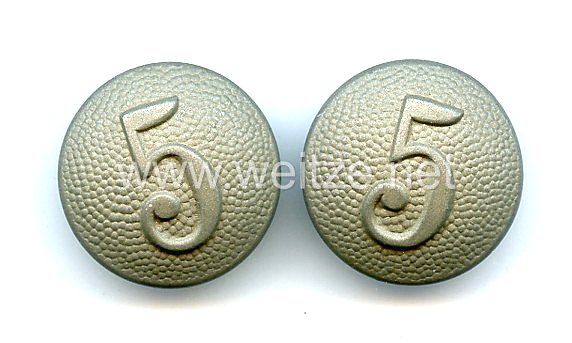
Hitler Youth (HJ) Pair of Gefolgschaft Shoulder Boards No. 5
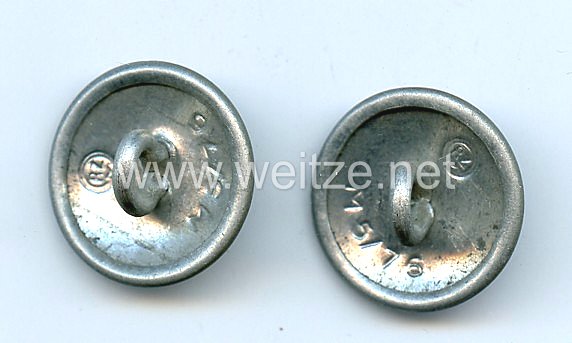
The present shoulder buttons of Gefolgschaft No. 5 of the Hitler Youth (HJ) represent a significant example of the uniform technical design of the National Socialist youth organization. This pair of shoulder strap fastening elements bears the characteristic RZM manufacturer marking on the reverse side and demonstrates the standardized production methods of HJ uniform components during the Third Reich era.
The Hitler Youth was founded in 1926 and developed after the seizure of power in 1933 into the state youth organization of National Socialist Germany. With the introduction of compulsory youth service on December 1, 1936, membership became effectively obligatory for all German youths between 10 and 18 years of age. The organization was structured by age groups: the Deutsches Jungvolk (German Young People, ages 10-14) and the actual Hitler Youth (ages 14-18) for boys, as well as the Jungmädelbund (Young Girls' League) and the Bund Deutscher Mädel (League of German Girls) for girls.
The territorial organization of the HJ followed a hierarchical structure modeled on the NSDAP organization. A Gefolgschaft (unit) formed a basic element and typically comprised 120 to 160 boys. It was subdivided into three to four Scharen (troops), each consisting of several Kameradschaften (companionships). The Gefolgschaft corresponded roughly to the size of a company in military structures. The numbering of Gefolgschaften occurred within the superior units, the Bann, which encompassed several Gefolgschaften.
The Reichszeugmeisterei (RZM) (Reich Supply Master Office) was founded in 1929 as the central procurement and inspection agency of the NSDAP. From 1933 onwards, it assumed control over the production and distribution of all uniforms, insignia, and equipment of the party organizations, including the Hitler Youth. Each licensed manufacturer received a specific RZM number that had to be affixed to the produced items. This system was intended to ensure quality standards and prevent the production of unauthorized reproductions. The RZM marking on the reverse side of the shoulder buttons confirms their official origin and complies with the manufacturing regulations of the time.
The uniforming of the Hitler Youth followed detailed regulations laid down in various service instructions and uniform orders. The basic uniform consisted of a brown shirt, black uniform trousers or short black pants, black neckerchief with leather slide, and a black shoulder strap. The shoulder straps served to identify membership in specific units and were attached to the shirt by means of special buttons. These buttons were not merely functional elements but also contributed to the uniform appearance of the formation.
The numbering on the shoulder straps with the Gefolgschaft number enabled clear identification of an HJ member's unit affiliation. This was particularly important at larger events, parades, and field exercises where members of different Gefolgschaften came together. The number 5 on these shoulder buttons identified the wearer as a member of the fifth Gefolgschaft within his Bann.
The material quality and workmanship of HJ uniform parts varied considerably during the course of the war. While high-quality materials were still used in the 1930s, raw material shortages and the war economy from 1939 onwards increasingly led to quality deterioration. The stated condition 2 of these shoulder buttons indicates a well-preserved state with only minor signs of wear, which is remarkable for objects over 80 years old.
From a historical perspective, such uniform components are important testimonies to the indoctrination and militarization of youth in National Socialism. The HJ served not only ideological education but also pre-military training. Field exercises, marches, and sporting competitions were intended to prepare young people for their later service in the Wehrmacht. Uniforming reinforced the sense of community and subordination to the National Socialist hierarchy.
Today, such objects are of military-historical and collecting interest. They document the material culture of the Third Reich and serve as illustrative material for researching the youth organizations of that era. Handling such objects requires historical sensitivity and contextualization within the criminal context of the Nazi regime.