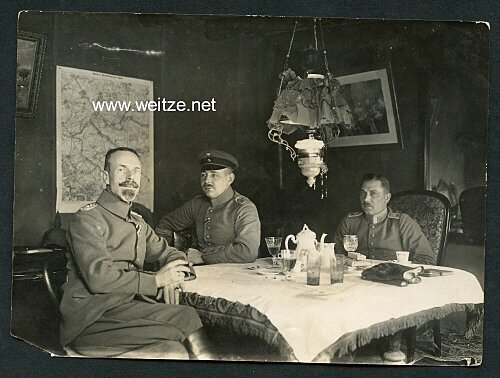
World War I Press Photograph, Conference with Officers of the German Army

, approx. 12 x 17 cm, condition 2.
200951
8,00

World War I Press Photograph, Conference with Officers of the German Army

This press photograph from World War I documenting a meeting with officers of the German Army represents an important aspect of military communication and propaganda during the Great War of 1914 to 1918.

War press photography developed during World War I into an indispensable instrument of public opinion formation and military reporting. Unlike earlier conflicts, visual documentation played a central role in conveying war events to the home front. The German Army recognized early on the importance of photographic documentation both for propaganda purposes and for the historical recording of military operations.

From 1915 onwards, German war reporting was systematically organized. The Bild- und Film-Amt (BUFA), officially founded in 1917, coordinated the photographic documentation of war events. Press photographers received special accreditations and often worked in uniform at the front. They documented not only combat operations but also military daily life, meetings, strategy sessions, and command structures.

Photographs of officer meetings served multiple functions: they provided internal documentation of military decision-making processes but were also prepared for the press to give the public insight into the professional conduct of the war. Such images were meant to convey competence, order, and strategic thinking – important elements in maintaining morale on the home front.

The officer corps of the German Army followed a strict hierarchical structure. Meetings between officers of various ranks were essential for coordinating military operations. These ranged from high-level situation conferences at the Oberste Heeresleitung (OHL, Supreme Army Command) to tactical meetings at division or regimental level at the front.

The format of approximately 12 x 17 cm corresponds to the common formats of press photography of that era. This size allowed for practical handling and was ideal for reproduction in newspapers and illustrated magazines such as the “Illustrierten Zeitung” or the “Berliner Illustrirten Zeitung,” which reached circulations of several million copies during the war.

The technical capabilities of photography had improved considerably since the beginning of the 20th century. Glass plate negatives were increasingly replaced by more flexible film materials, which made the work of war photographers easier. Nevertheless, photography under front-line conditions remained a challenge requiring special equipment and permissions.

The portrayal of officers in press photos followed certain conventions: they usually showed uniformed men engaged in concentrated work, often bent over maps or engaged in serious conversations. These stagings were meant to communicate professionalism and strategic superiority, while brutal combat scenes or losses were frequently omitted.

After the war, such press photographs developed into important historical sources. They document not only military structures and personnel but also uniforms, equipment, maps, and the spatial conditions under which military decisions were made. For military historical research, they offer valuable insights into the organization and daily life of World War I.

The condition of such photographs varies considerably. Many press photos were printed on acidic paper and today show signs of aging such as yellowing, staining, or tears. Professionally archived specimens in good condition are now sought-after collector's items and important documents of contemporary history.

The collection and preservation of such historical photographs has both cultural and scientific value. They enable subsequent generations to visually grasp the reality of World War I and understand the mechanisms of military propaganda and reporting. Archives such as the Bundesarchiv in Koblenz or the Bavarian Main State Archive preserve extensive collections of such war photographs.