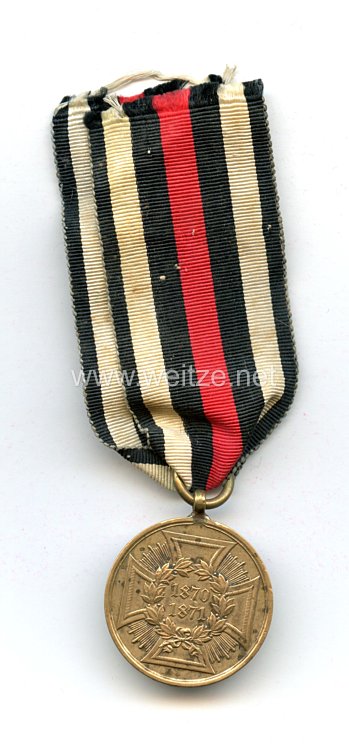
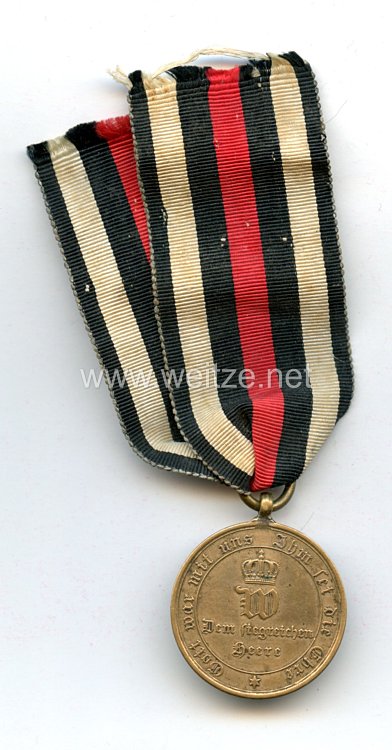
Prussia War Commemoration Medal 1870-1871 for Combatants

Bronze, with edge inscription “Aus erobertem Geschuetz” (From Captured Cannons), on ribbon.
422150
40,00

Prussia War Commemoration Medal 1870-1871 for Combatants

The Prussian War Commemorative Medal 1870-1871 for Combatants represents one of the most significant military decorations of the German Empire and symbolizes the successful unification of Germany under Prussian leadership. This medal was instituted to commemorate the Franco-Prussian War of 1870-1871, which culminated in the proclamation of the German Empire in the Hall of Mirrors at Versailles on January 18, 1871.

King Wilhelm I of Prussia instituted this war commemorative medal on May 20, 1871, through an All-Highest Cabinet Order. The decoration was awarded to all Prussian soldiers who had actively participated in combat operations. The distinction between combatants and non-combatants was particularly significant: combatants received the medal on a black-and-white ribbon with orange edges, while non-combatants who served in logistical or administrative functions received the same medal on a purely black-and-white ribbon.

A particularly remarkable feature of this war commemorative medal is the edge inscription “Aus erobertem Geschütz” (From Captured Guns). This inscription indicates that the medal was manufactured from the bronze of French cannons that had been captured as war trophies by the Prussian and allied German troops during the war. This practice gave the decoration additional symbolic meaning, as it was literally created from the material of the defeated enemy. The use of captured weapons to manufacture orders and medals had already been a tradition in Prussia and was intended to document military triumph in a particularly impressive manner.

The obverse of the medal typically displays the crowned monogram “W” (for Wilhelm) beneath the Prussian royal crown, surrounded by an oak leaf wreath. The reverse bears the inscription “KÖNIGGRÄTZ PARIS” with the dates 1870-1871, whereby the mention of Königgrätz (Battle of 1866) emphasized the continuity of Prussian military successes, even though that battle belonged to the Austro-Prussian War of 1866 and not to the war of 1870-1871.

The Franco-Prussian War was a decisive turning point in European history. It began on July 19, 1870, triggered by tensions over the Spanish succession and the famous Ems Dispatch. The Prussian troops, supported by their South German allies, achieved swift and decisive victories. The Battle of Sedan on September 1-2, 1870, led to the capitulation of Emperor Napoleon III and his army. Paris was besieged and finally capitulated on January 28, 1871. The Treaty of Frankfurt on May 10, 1871, sealed the French defeat and forced France to cede Alsace-Lorraine and pay a considerable war indemnity.

The war commemorative medal was struck in enormous quantities, as it was awarded to hundreds of thousands of soldiers. The Prussian army alone mobilized over one million men during the course of the war. The medal was awarded not only to Prussian soldiers but also to members of other German contingents who fought under Prussian command, provided their own states did not institute their own war commemorative medal.

From a military-historical perspective, this decoration documents the transition from traditional methods of warfare to modern industrial warfare. The war of 1870-1871 was characterized by the use of railways for troop transport, the deployment of telegraphy for communication, and the use of modern breech-loading rifles and rifled artillery. The Prussian General Staff work under Helmuth von Moltke set new standards for military planning and execution.

Today, these war commemorative medals are highly sought after by collectors of military-historical decorations. The version for combatants with the correct ribbon composition and the edge inscription “Aus erobertem Geschütz” is particularly desirable. Authentic specimens from the period of origin can be identified through material analysis, striking characteristics, and patina. The medal represents not only a military conflict but marks the birth of the modern German nation-state and the beginning of a new era in European politics that would last until World War I.