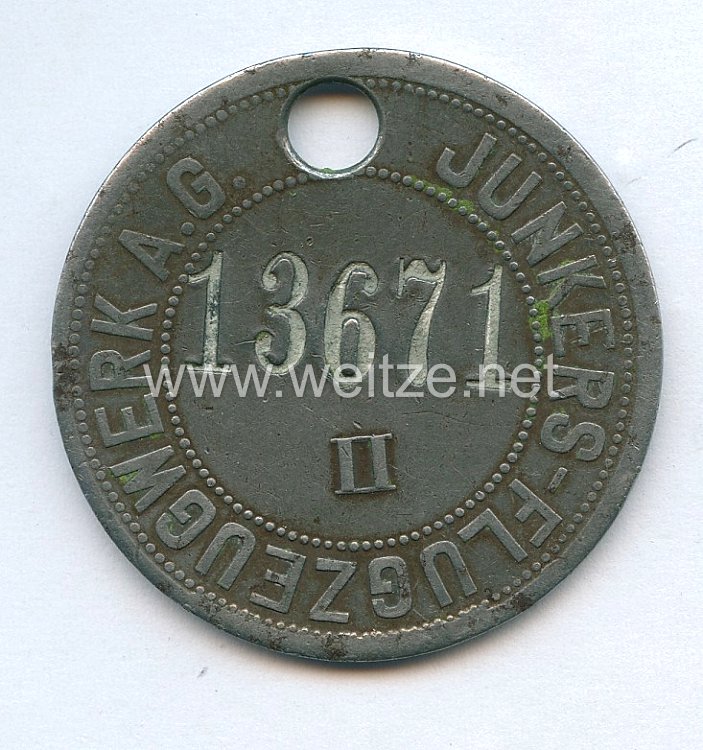
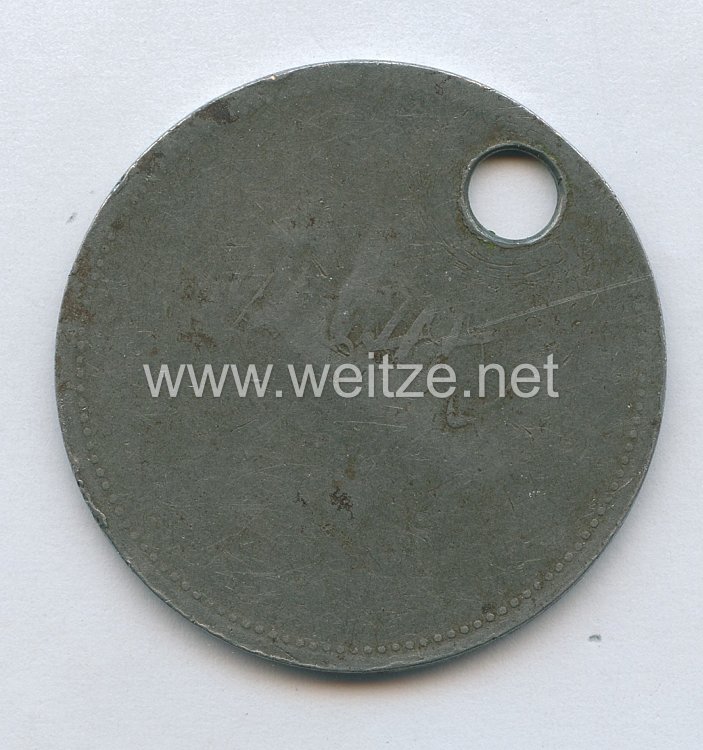
Factory Badge for Civilian Employees of Junkers Flugzeug- und Motorenwerke A.G.

Round fine zinc badge, serial number 13671 II, centered hole at top for chain or cord for wearing around the neck, condition 2.
336849
180,00

Factory Badge for Civilian Employees of Junkers Flugzeug- und Motorenwerke A.G.

The works badge for civilian employees of Junkers Flugzeug- und Motorenwerke A.G. represents a significant artifact from the German aviation industry during World War II. These badges were issued to civilian workers of one of the most important armaments companies in Nazi Germany and document the organization and identification of the workforce in the war economy.

Junkers Flugzeug- und Motorenwerke A.G. was among the most significant aircraft manufacturers in the German Reich. The company was founded by Hugo Junkers and developed into one of the leading producers of military and civilian aircraft. During World War II, the company employed tens of thousands of workers and employees at various production sites, including Dessau, the headquarters, as well as factories in Magdeburg, Aschersleben, Bernburg, and other locations.

The works badges served several important functions within the framework of the war economy. Primarily, they were identification and access passes for the factory premises, which as war-essential operations were subject to strict security regulations. The serial number, in this case 13671 II, enabled the unambiguous identification of the wearer and was part of a comprehensive registration system. The Roman numeral II might indicate a specific department, factory, or work classification.

The manufacture from fine zinc was typical for works badges of this period. Due to material shortages during the war, non-ferrous metals such as copper and brass were reserved for war-essential purposes, which is why zinc was used as a substitute material for such passes. The design was generally functional and practical, often featuring the company logo or emblem.

The hole at the top of the badge was used for attachment by means of a chain or cord, so that it could be worn around the neck. This ensured that the badge was always visible and readily accessible during work, which was essential for factory security and access control. The constant visibility enabled security personnel to quickly identify authorized persons.

The Junkers works produced various significant aircraft types during the war, including the Ju 87 Stuka and the Ju 88, one of the most produced German bombers. The civilian employees who wore such badges worked in different areas: from actual aircraft manufacturing to administrative tasks and technical and engineering activities.

Working conditions in the Junkers works during the war were characterized by increasing burdens. In addition to German civilian employees, forced laborers and prisoners of war were also employed on a large scale. The different categories of workers were distinguished by different identification systems, with works badges like the present one reserved for regular German civilian employees.

After World War II, the Junkers works were dissolved as part of the demilitarization and dismantling of the German armaments industry. Production facilities were partially dismantled as reparations, and the company no longer continued to exist in its original form. The preserved works badges are today important historical artifacts that provide insight into the organization of the Nazi war economy.

For collectors and historians, such badges are of considerable interest, as they document the everyday reality of war production. The stated condition 2 indicates well-preserved quality, with only minor signs of use, which is remarkable for objects from this period. The serial number theoretically allows assignment to historical records, provided that corresponding archives are accessible.

These works badges are part of the material culture of World War II and serve as a reminder of industrial mobilization and the role of the civilian population in warfare. They document a system of surveillance and control that was characteristic of totalitarian regimes and are thus important objects of study for research into Nazi rule and the war economy.

r