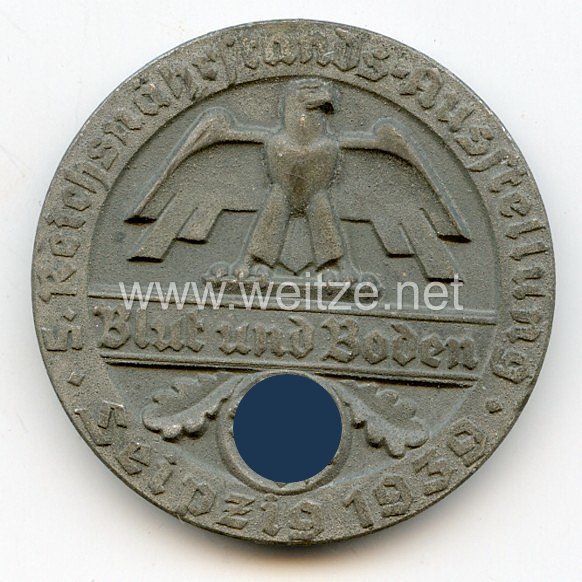
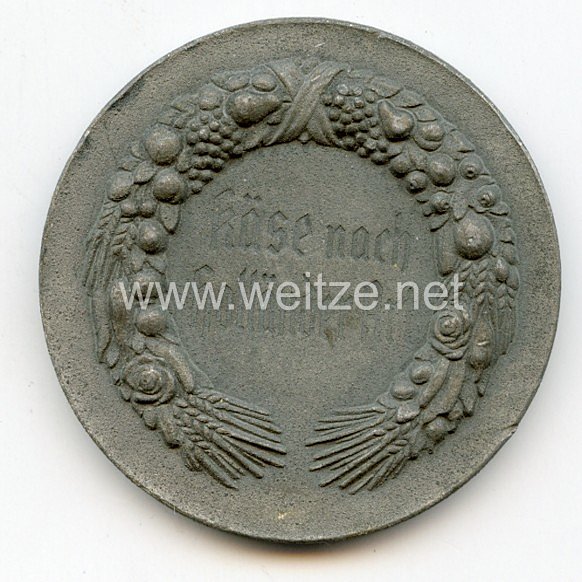
Reichsnährstand - “5th Reichsnährstand Exhibition Leipzig 1939”
This medal originates from the 5th Reichsnährstand Exhibition held in 1939 in Leipzig. It represents a fascinating chapter of National Socialist agricultural policy and its efforts to organize and promote German agriculture and food production.
The Reichsnährstand (Reich Food Estate) was established on September 13, 1933, through the Reichsnährstandsgesetz (Reich Food Estate Law) and represented the compulsory organization of all persons and enterprises involved in agriculture, forestry, and food processing. Under the leadership of Reichsbauernführer Richard Walther Darré, this organization was to ensure complete control over food production and distribution in the German Reich. Darré, who was also Reich Minister of Food and Agriculture, pursued an ideology of the “Blood and Soil” movement and saw the peasantry as the core of the German Volksgemeinschaft (people's community).
The Reichsnährstand Exhibitions were important propaganda events held annually to showcase the achievements of German agriculture. The 1939 Leipzig exhibition was particularly significant as it took place just months before the outbreak of World War II. Leipzig was traditionally an important trade fair location and offered ideal infrastructure for such large-scale events.
This particular medal was awarded as a winner's medal for Dutch-style cheese. The award illustrates several interesting aspects of the food policy of that era. First, it demonstrates the regime's efforts to promote and standardize the quality of German food production. Second, the category “Dutch-style cheese” indicates attempts to produce traditional foreign products domestically – an important aspect of the autarky policy aimed at making Germany independent of imports.
The medal is made of fine zinc with a diameter of 38 mm and has a silver appearance. The use of zinc instead of precious metals was typical for the period and already hints at the beginning resource shortage that would intensify with the outbreak of war. Zinc was a strategic material needed for military purposes, yet was still available for such awards, underscoring the importance the regime attached to agricultural propaganda.
The quality rating of condition 2 according to numismatic standards means the medal is well preserved with only minor signs of wear, which is remarkable for an object over 80 years old.
In the context of National Socialist economic policy, the Reichsnährstand played a central role in preparing for war. The Erzeugungsschlacht (Battle for Production), as the campaign to increase agricultural production was called, was intended to enable Germany to feed its population in case of war. The Reichsnährstand's exhibitions and competitions served not only as showcases of achievement but also to motivate farmers and food producers.
The recognition of cheese products also had a practical background. Cheese was an important source of protein and fat and could be stored well – an important aspect for food security. The promotion of cheese production following Dutch models demonstrates the pragmatic approach of adopting and adapting proven foreign methods.
The 1939 exhibition took place in a tense political atmosphere. By this time, the regime had already annexed Austria and Czechoslovakia, and war preparations were in full swing. The emphasis on food self-sufficiency reflected the lessons learned from World War I, when the British naval blockade had caused severe food shortages in Germany.
Today, such medals are important historical documents providing insight into the everyday history of National Socialism. They show how the regime attempted to penetrate and instrumentalize all areas of social and economic life for its purposes. Collectors and historians value such objects as contemporary documents that record reality beyond major political events.