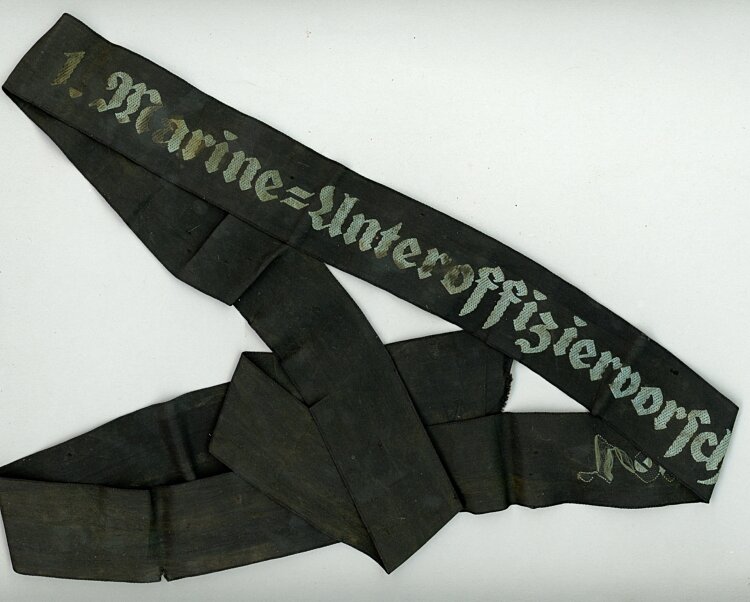
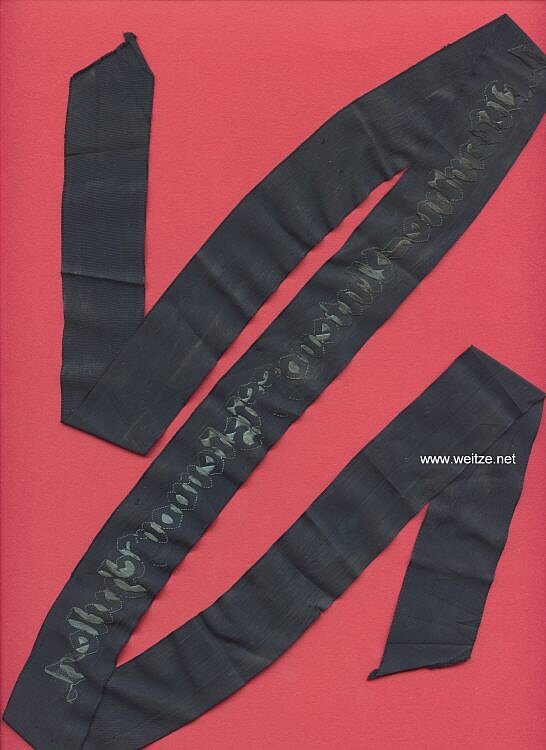
Kriegsmarine Cap Tally “1. Marine-Unteroffiziervorschule 1.”

The cap tallies of the Marine-Unteroffiziervorschulen were woven in light blue on black. Worn condition, length: 113 cm, condition 2-. Very rare.
140049
250,00

Kriegsmarine Cap Tally “1. Marine-Unteroffiziervorschule 1.”

The cap tally of the 1st Naval Petty Officer Training School represents a significant artifact documenting the training structure of the German Kriegsmarine during World War II. These cap tallies were integral components of the naval uniform, serving both identification purposes and the maintenance of tradition within the maritime armed forces of the German Reich.

The Naval Petty Officer Training Schools were established during the 1930s as part of the rearmament and expansion of the Kriegsmarine. Following the Nazi seizure of power in 1933 and the gradual abandonment of the restrictions imposed by the Treaty of Versailles, Germany began systematically building up its naval forces. The training of qualified petty officers was of central importance, as they formed the backbone of the military organization, serving as the crucial link between enlisted personnel and the officer corps.

Kriegsmarine cap tallies traditionally bore ship names or designations of duty stations. The light blue lettering on black background, characteristic of the Naval Petty Officer Training Schools, differed from the standard golden-yellow inscriptions of regular ship crews. This color differentiation enabled immediate recognition of personnel from training facilities and emphasized their special status within the naval hierarchy.

The designation “1. Marine-Unteroffiziervorschule 1.” (1st Naval Petty Officer Preparatory School 1) indicates one of the first and most important training establishments for aspiring Kriegsmarine petty officers. These schools were located in various coastal cities and provided comprehensive military and technical education. The curriculum encompassed navigation, weapons technology, seamanship, military leadership, and ideological instruction. The training lasted several months and was extremely demanding.

The standard length of a cap tally was approximately 110-120 centimeters, corresponding to the present length of 113 centimeters. The tallies were manufactured from woven material with the inscription applied through specialized weaving techniques. Production was carried out by specialized textile companies that executed Kriegsmarine contracts and were subject to strict quality standards.

The wearing of cap tallies was strictly regulated by the Kriegsmarine dress regulations. The tally was worn around the peaked cap, with the ends tied in a characteristic bow at the back of the head. Correct wearing was part of military discipline and was practiced extensively during training. Violations of uniform regulations could result in disciplinary consequences.

The rarity of such cap tallies from training institutions can be explained by several factors. First, the number of graduates from these schools was limited compared to crews of regular warships. Second, cap tallies were often replaced with those bearing the designation of the new duty station after completion of training. Many of these pieces were also lost during the war or destroyed after its end.

From a museological and collector's perspective, cap tallies from training establishments are particularly valuable for researching the organizational structure of the Kriegsmarine. They document the complex training landscape and enable conclusions about personnel policies and recruitment strategies of the German Navy between 1935 and 1945. The indicated condition 2- suggests a worn but well-preserved example showing typical signs of use without significant damage.

The historical significance of such objects lies not in glorifying military traditions but in their documentary value as material witnesses of a past era. They enable historians and researchers to reconstruct the everyday reality of naval personnel and better understand the institutional structures of the Nazi regime.