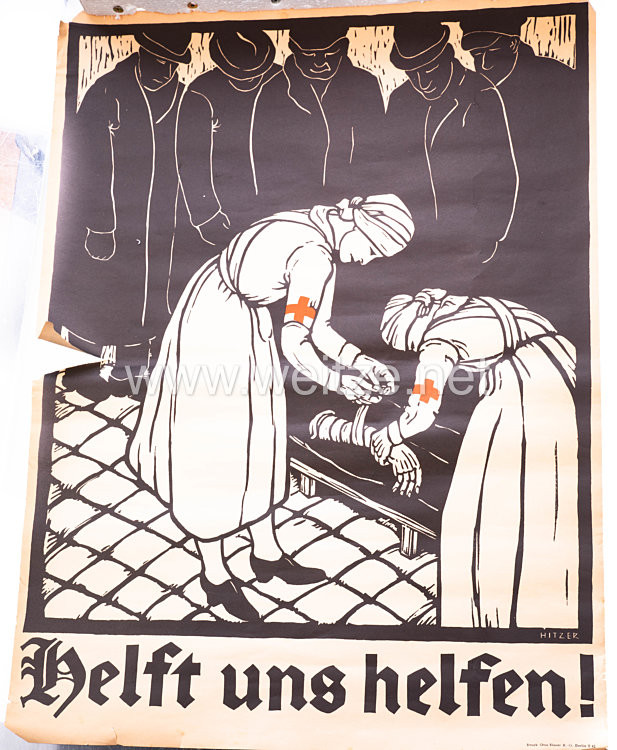
German Red Cross (DRK) Propaganda Poster "Help Us Help!"
German Red Cross Propaganda Poster “Help Us Help!” - Historical Context
The German Red Cross (Deutsches Rotes Kreuz, DRK) played a complex and often contradictory role during the National Socialist regime. Propaganda posters like this example with the appeal “Helft uns helfen!” (Help us help!) were part of a comprehensive mobilization campaign that combined humanitarian rhetoric with the ideological goals of the Nazi regime.
The DRK Under National Socialism
Following the Nazi seizure of power in 1933, the German Red Cross was gradually brought into line with the regime. In December 1937, the Law on the German Red Cross completed its full integration into the National Socialist state. The organization lost its independence and was placed under the Reich Ministry of the Interior. Dr. Ernst-Robert Grawitz, SS-Gruppenführer and Reich Physician-SS, assumed the presidency of the DRK in 1937, symbolizing the close entanglement between the humanitarian organization and the SS apparatus.
This coordination represented a fundamental break with the universal principles of the Red Cross movement, particularly with the principles of impartiality and aid for all war victims regardless of their nationality or race.
Propaganda Posters as Mobilization Tools
Posters were a central medium of mass influence in the “Third Reich.” The Reich Ministry of Public Enlightenment and Propaganda under Joseph Goebbels strictly controlled visual communication. DRK posters served multiple purposes: they were meant to collect donations, recruit volunteers, and simultaneously strengthen the image of the Nazi state as a caring “Volksgemeinschaft” (people's community).
The slogan “Help us help!” was typical of the duplicity of Nazi propaganda. It appealed to solidarity and compassion, while actual assistance was primarily limited to “Volksgenossen” (fellow Germans) and excluded those persecuted on racial or political grounds.
Otto Elsner Printing House
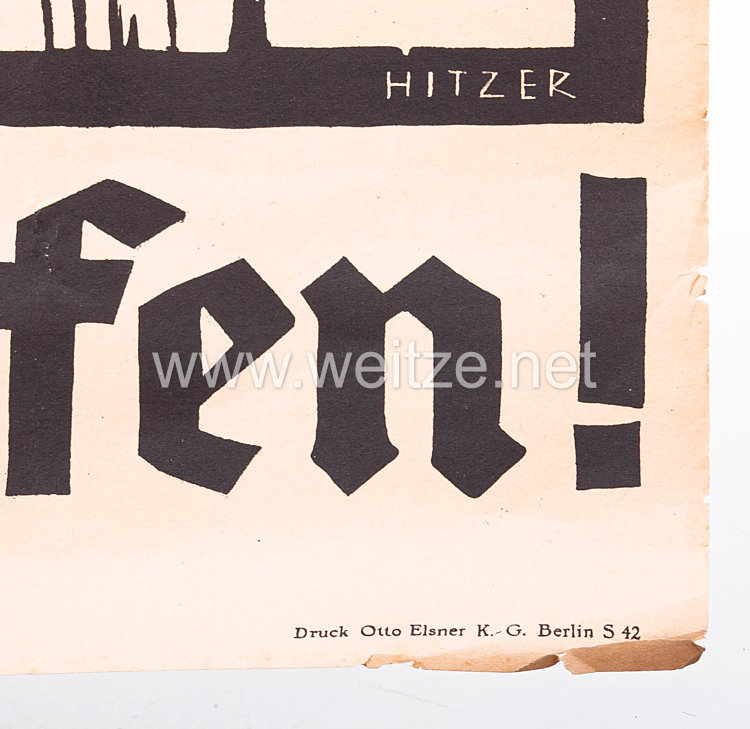
The notation “Druck Otto Elsner K.-G. Berlin S 42” refers to a Berlin printing house that produced numerous official documents and propaganda materials during the Nazi era. The address designation “S 42” refers to postal district Berlin South 42, emphasizing its location in the Reich capital. Many printing houses worked on behalf of state agencies and thus contributed to the dissemination of Nazi ideology.
DRK Activities During the War
With the outbreak of World War II in 1939, the DRK massively intensified its activities. The organization was responsible for wounded care, medical services, hospital management, and organizing blood donations. DRK nurses served on all fronts, often under extreme conditions.
Simultaneously, the DRK was involved in activities that violated the Geneva Conventions. Participation in the “euthanasia” Action T4, involvement in medical experiments, and selective treatment of prisoners of war constituted grave violations of humanitarian principles.
Collection and Donation Campaigns
Posters like the one described were part of extensive collection campaigns. The Nazi regime constantly organized donation appeals for various organizations: the Winter Relief Fund, the NS People's Welfare, and also the DRK. These campaigns served not only to raise funds but also for ideological indoctrination and demonstration of “willingness to sacrifice” for the “people's community.”
The population was under considerable social pressure to donate. Those who refused faced denunciation or professional disadvantages. The supposed voluntariness was thus severely limited.
Design and Iconography
DRK posters followed certain design conventions: use of the Red Cross symbol, frequently depicting nurses in traditional white uniforms with caps and red crosses, and emotional appeals. The visual language aimed to inspire trust and appeal to viewers' compassion while simultaneously conveying National Socialist values.
Post-War Period and Historical Reckoning
After 1945, the German Red Cross had to confront its role in the Nazi state. In both German states, Red Cross organizations were rebuilt, in the Federal Republic as DRK, in the GDR as the German Red Cross of the GDR. A comprehensive examination of the Nazi past occurred only decades later.
Today, such posters serve as important historical documents. They illustrate how an originally humanitarian organization was instrumentalized and how propaganda functioned. For historical research and educational work, they are valuable testimonies of a time when even symbols of humanity were ideologically misused.
Collector Value and Ethical Considerations
Nazi propaganda materials are today subjects of historical collections and are preserved for research and educational purposes. Their possession and use are subject to legal restrictions in Germany, particularly when unconstitutional symbols are depicted. The Red Cross symbol itself is protected by the Geneva Conventions and must not be used improperly.
Handling such objects requires historical sensitivity and the obligation to contextualize them without relativizing the crimes associated with them.