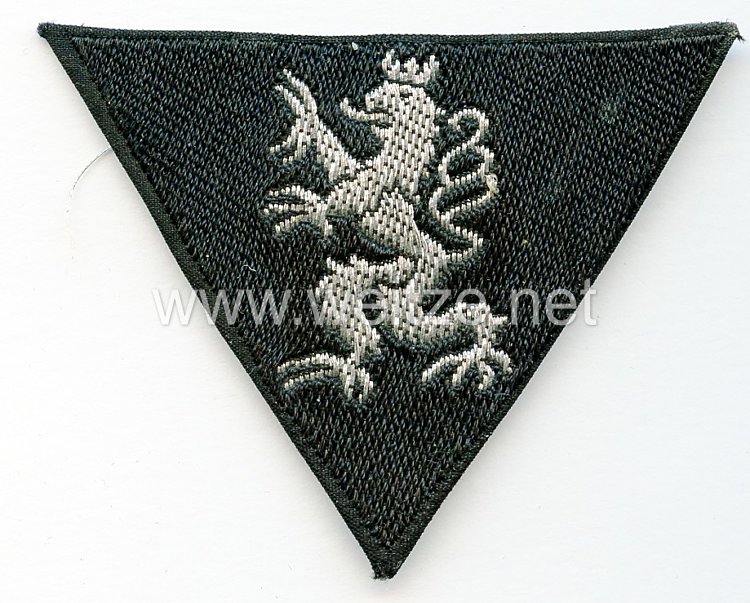
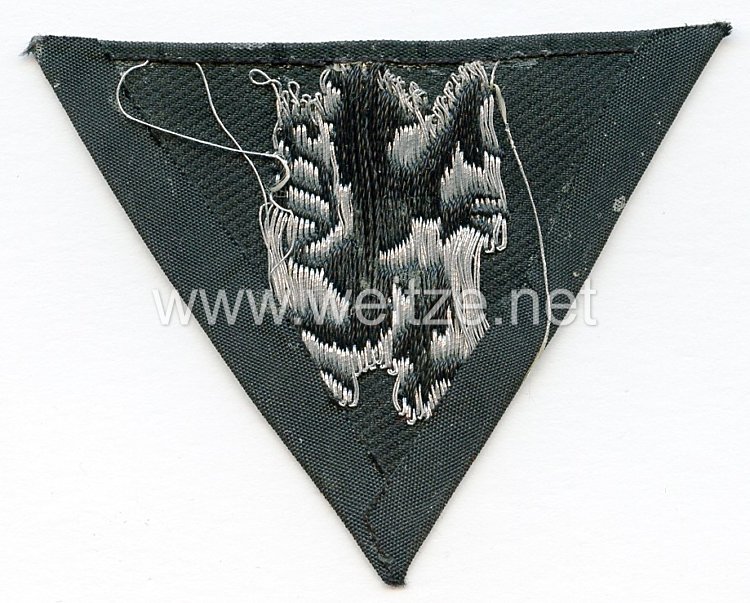
Belgium Overseas Cap - Badge for the Limburg Youth Organization “Serment de la Jeunesse”
The "Serment de la Jeunesse" garrison cap badge (Youth Oath) represents a remarkable testimony to the complex political and social developments in the Belgian province of Limburg during the interwar period. This metal thread woven example represents a youth organization that emerged in an era when Belgium was marked by profound social tensions between various political and ideological currents.
The Belgian province of Limburg, historically an area with a mixed Flemish and Walloon population, experienced an intense phase of youth organization and political mobilization in the 1920s and 1930s. The "Serment de la Jeunesse" fits into this context, with its French name indicating a francophone or Belgicist orientation, in contrast to the Flemish nationalist movements of the time.
Historical Context of Youth Organizations
After World War I, numerous youth organizations emerged in Belgium covering various ideological spectra. These movements were part of a Europe-wide phenomenon in which young people were organized in paramilitary or quasi-military structures. The organizations ranged from Catholic scout groups and socialist youth associations to nationalist and authoritarian movements.
The badge itself, manufactured in the characteristic garrison cap shape, follows a military tradition of headgear insignia. Metal thread weaving was a common manufacturing technique for high-quality uniform badges and indicates a certain organizational professionalism. This technique, in which metal threads were woven into patterns on a fabric backing, required specialized craftsmanship and was typical for badges of the interwar period.
The Limburg Particularity
The province of Limburg occupied a special position in Belgian politics. As part of the language conflict between Flemings and Walloons, the region became the scene of intense disputes over cultural identity and belonging. The French-language name "Serment de la Jeunesse" is significant in this context, as it possibly marked a Belgicist or Francophile position in a predominantly Flemish-speaking region.
Function and Significance
Such badges fulfilled several important functions: they served for the identification of members, created a sense of belonging and camaraderie, and signaled outwardly the affiliation with a particular organization and thus with a specific ideological position. In a time of political polarization, such symbols were of considerable importance for social and political positioning.
The fact that the badge was designed as a garrison cap badge connects it with military traditions. The garrison cap (Belgian: "calot" or "bonnet de police") was a standard military headgear that was also adopted by many paramilitary and youth organizations to emphasize a military character.
Manufacturing Technique and Material
Metal thread weaving was an elaborate technique in which gold or silver threads (often made of silver-plated or gold-plated copper) were processed into patterns on a cotton or silk backing. This technique had a long tradition in military insignia manufacturing and was performed by specialized workshops. The quality of such badges varied considerably depending on the manufacturer and purpose.
Political Classification
Without clear historical documentation about this specific organization, an exact political classification is difficult. However, the name "Serment de la Jeunesse" evokes the tradition of youth oaths and pledges as they were common in many European youth organizations of the interwar period. These oaths typically emphasized loyalty, discipline, and patriotism.
Collector Value and Historical Significance
Today, such badges are important historical artifacts that provide insight into the complex political landscape of interwar Belgium. They document the diversity of political movements and the importance of youth mobilization in this turbulent epoch. The indicated condition 2 (lightly worn) suggests authentic use and increases the historical value of the object as evidence of actual organizational activity, not just as an unused production piece.
The study of such insignia contributes to our understanding of how political movements sought to capture the loyalty and enthusiasm of youth during a period of profound social and political transformation in Europe. The Serment de la Jeunesse badge from Limburg thus stands as a small but significant artifact of Belgium's complex interwar history, reflecting the tensions and aspirations of a divided nation seeking to forge unity among its youth.