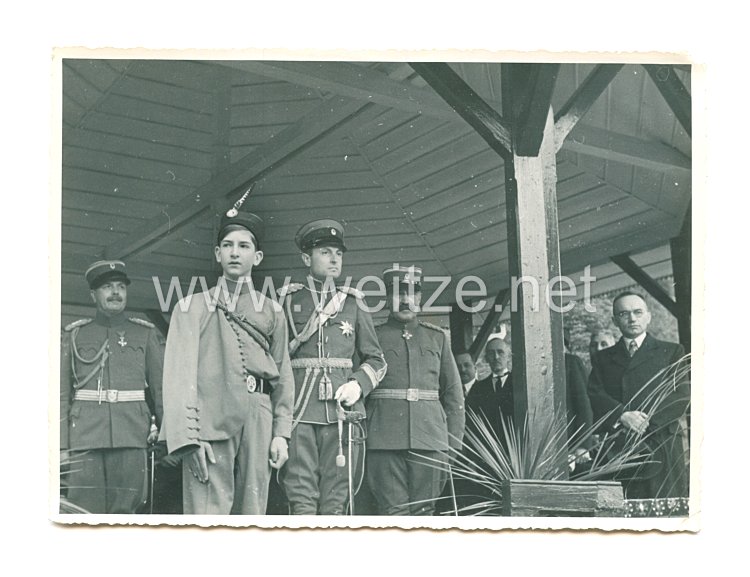
Third Reich Press Photograph: Prince Regent Paul at an Event
Press Photography in the Third Reich: Prince Regent Paul of Yugoslavia
This press photograph shows Prince Regent Paul of Yugoslavia at a public event and dates from the Third Reich era, presumably between 1934 and 1941. Such press photos were an important instrument of Nazi propaganda while simultaneously documenting the complex diplomatic relations between National Socialist Germany and the Kingdom of Yugoslavia.
Prince Regent Paul Karađorđević (1893-1976) assumed the regency for the underage King Peter II following the assassination of his cousin King Alexander I in October 1934. Paul, who had been educated at Oxford and was known as anglophile and culturally refined, found himself in an extraordinarily difficult position. He had to hold together the multi-ethnic Yugoslavia while Europe became increasingly polarized and the great powers competed for influence in the Balkans.
German press photography during the Nazi period was strictly controlled and organized. After seizing power in 1933, the regime established a comprehensive system for controlling photographic reporting. The Reich Ministry for Public Enlightenment and Propaganda under Joseph Goebbels supervised all press publications. Photographers required special accreditation, and all images had to be approved before publication. Press photographs like this were distributed through agencies such as Scherl, Hoffmann, or the German Press Agency.
Relations between the Third Reich and Yugoslavia were of strategic importance. Germany had great interest in Yugoslavia as a trading partner and as a transit country to the Balkans. Economically, Yugoslavia became increasingly dependent on Germany, which became the most important purchaser of Yugoslav agricultural products and raw materials. Despite his personal sympathies for Great Britain, Prince Regent Paul attempted to balance between the Axis powers and the Western powers.
Several official visits and diplomatic meetings took place during this period. In June 1939, Prince Paul visited Berlin and met Adolf Hitler, Hermann Göring, and other Nazi leaders. These encounters were extensively documented photographically and distributed in the German and international press. Nazi propaganda used such images to convey the impression of successful diplomacy and growing influence.
The photographic technique and materials of this era are characteristic: most press photos were printed on baryta paper, typically in formats between 13x18 cm and 18x24 cm. The present format of approximately 17x12 cm corresponds to a common press format. Many of these photos bore stamps from photo agencies, censorship marks, or handwritten captions with information about persons, location, and date on the reverse. The absence of such inscriptions on this specimen may have various reasons: it could be an archive copy, a duplicate, or a press photo produced later.
The dramatic turn in German-Yugoslav relations came in March 1941. Under massive German pressure, the Yugoslav government signed accession to the Tripartite Pact in Vienna on March 25, 1941. This decision triggered massive protests in Yugoslavia. Only two days later, on March 27, Serbian nationalist officers staged a coup, overthrew the government, and declared the young King Peter II of age. Prince Regent Paul was deposed and went into exile. Hitler reacted with fury and ordered the immediate attack on Yugoslavia, which began on April 6, 1941 (“Operation Punishment”). Within days, Yugoslavia was occupied and dismembered.
Press photos like this one are important historical sources today. They document not only events and persons but also the manner in which the Nazi regime presented itself and its diplomatic successes. The image composition, the selection of persons and scenes shown, the distribution of photos – all followed propagandistic considerations. At the same time, these photographs offer insights into the reality of the 1930s, into the atmosphere of official events and the personalities of the actors.
For collectors and historians, such press photos have varying value. They document a dark chapter of European history and remind us of the complex entanglements between diplomacy, propaganda, and the path to war. The preservation and scholarly analysis of such materials is important for historical understanding of this era.