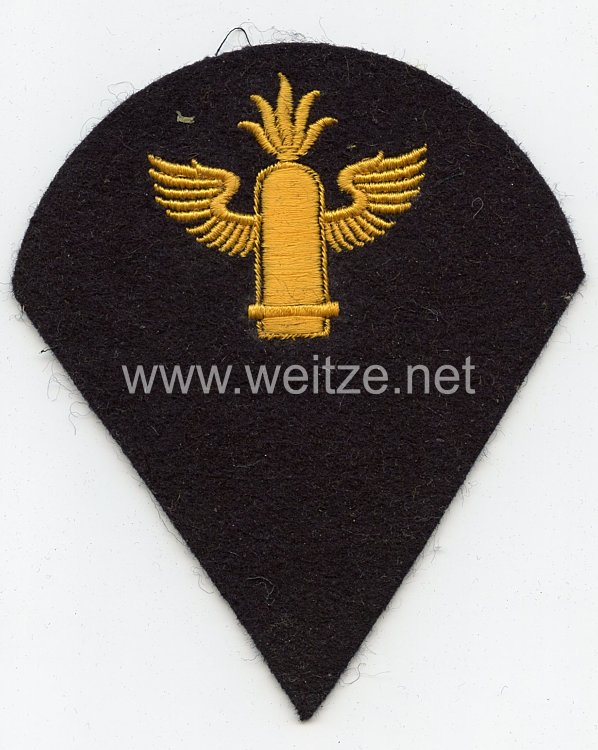
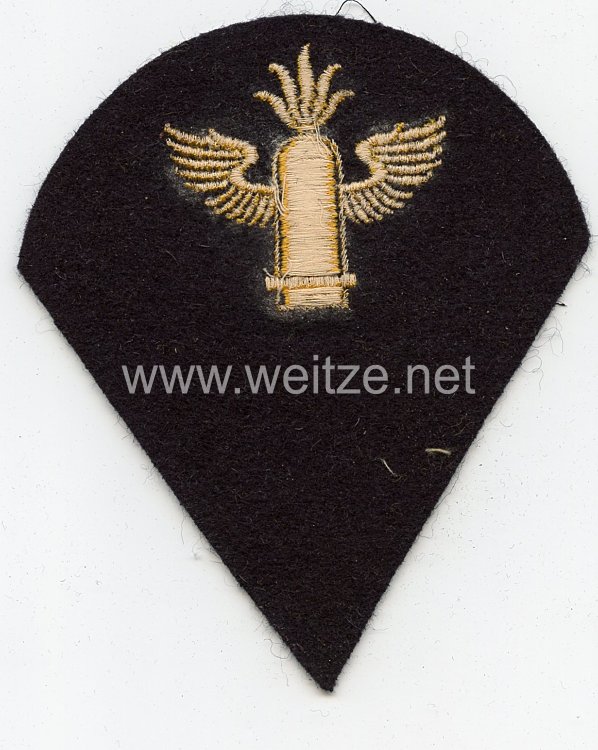
Kriegsmarine Enlisted Ranks Sleeve Insignia Naval Artillery Career Path
The Kriegsmarine sleeve badge for enlisted personnel in the naval artillery career path represents an important element of uniform identification in the German Kriegsmarine during World War II. These badges served for quick visual identification of a sailor's career specialization and were an integral part of the complex system of military rank insignia and specialization markings.
The Kriegsmarine, as the naval force of the Wehrmacht from 1935 to 1945, developed a comprehensive system of uniform insignia that built upon the traditions of the Imperial German Navy. After the Nazi seizure of power in 1933 and the official reintroduction of conscription in 1935, the Kriegsmarine was established as the successor organization to the Reichsmarine. The uniform regulations and badge systems were systematically elaborated in the following years and codified in various service regulations.
This badge was specifically designated for the naval artillery career path, one of the most important specializations within the Kriegsmarine. Naval artillerymen were responsible for the operation, maintenance, and employment of ship's guns, ranging from small-caliber anti-aircraft guns to heavy naval guns with calibers exceeding 380mm. This career path required extensive technical knowledge and a lengthy training period.
The version for the Colani refers to attachment on the dark blue working and shipboard uniform of the Kriegsmarine. The Colani, also known as the sailor's working dress, was the standard working uniform for enlisted personnel aboard ship and differed from the dress uniform through more practical characteristics and more robust material. These uniform pieces were designed for daily service and had to withstand the harsh conditions aboard warships.
Kriegsmarine sleeve badges were typically worn on the left upper arm and displayed career affiliation through various symbols. For the naval artillery career path, this was usually crossed gun barrels or similar artillery-specific symbolism, frequently in the form of embroidery or a woven badge. The colors and execution were precisely specified in uniform regulations, with different versions for enlisted men than for non-commissioned and commissioned officers.
The production of such badges was carried out by various authorized manufacturers who had to comply with the strict quality regulations of the Kriegsmarine. The badges were either sewn directly on or, in higher-quality versions, embroidered onto a fabric backing that was then applied to the uniform. The craftsmanship quality varied depending on the time of manufacture and production conditions, with earlier war years generally showing higher manufacturing quality.
The condition rating 2 in military historical collections typically designates a good to very good state of preservation with minor signs of use. This indicates that the badge was used but shows no significant damage, heavy wear, or discoloration. For collectors and historians, the state of preservation is an essential criterion for evaluation and authentication of militaria.
The significance of such badges extends beyond their purely functional role. They document the complex organizational system of the Kriegsmarine and the importance attached to military hierarchy and specialization. For the wearers themselves, these badges were an expression of their affiliation with a particular branch of service and often associated with pride in acquired skills.
From today's military historical perspective, such objects are important sources for understanding the organizational structure, uniform studies, and daily life in the Kriegsmarine. They complement written sources and photographic material and enable detailed reconstructions of the uniforms of various ranks and career paths. Museums and scientific collections preserve such objects as part of material cultural heritage, whereby the historical context and critical examination of this era must always remain paramount.
The study of such insignia contributes to a broader understanding of naval warfare organization and the hierarchical structures that governed military life during this period. These artifacts serve as tangible links to the past, allowing researchers and the public to better comprehend the complex realities of naval service during World War II.