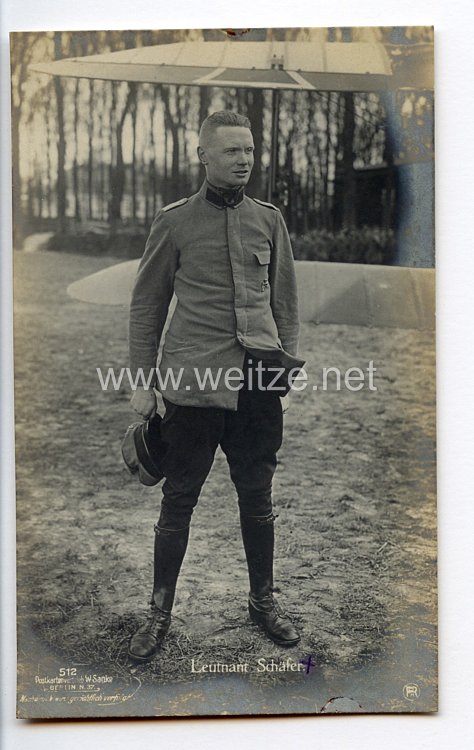
World War I Aviation - Photo Postcard - German Flying Aces “Lieutenant Schäfer”

on Sanke card no. 512, unmailed, condition 2.
330448
30,00

World War I Aviation - Photo Postcard - German Flying Aces “Lieutenant Schäfer”

This Sanke postcard No. 512 belongs to one of the most renowned series of propaganda postcards from World War I, glorifying German fighter pilots and their heroic deeds. These cards were produced by the Photographische Gesellschaft Sanke in Berlin and achieved immense popularity throughout the German Empire during the war.

The Sanke cards were produced from approximately 1914 onwards and quickly developed into an important instrument of war propaganda and hero worship. The Sanke company, under the management of Gustav Liersch and Wilhelm Sanke, recognized early on the public's interest in the pilots of the Imperial Air Service. The photographs typically showed the pilots in their uniforms, often with medals and decorations, sometimes standing before their aircraft.

Lieutenant Karl Schäfer was one of the most successful German fighter pilots of World War I with a total of 30 confirmed aerial victories. Born on December 18, 1891, in Krefeld, Schäfer initially entered the army as an infantryman before transferring to the aviation service in 1915. His career as a fighter pilot began in Jagdstaffel 11, where he served under the legendary Manfred von Richthofen. He later commanded Jagdstaffel 28 and was awarded the Pour le Mérite, the highest Prussian military order.

The Sanke cards served multiple functions: they provided the home front with a connection to the battlefield, strengthened civilian morale, and created a cult of celebrity around the pilots. The air force was a relatively new element of warfare, and pilots were romanticized as modern knights of the sky. In contrast to the anonymous mass death in the trenches, aerial combat appeared as a kind of chivalrous duel where individual bravery and skill still mattered.

The Sanke series comprised several hundred different cards and documented nearly all significant German fighter pilots of the war. Besides the photographs, the cards often included the number of victories achieved and decorations awarded. The numbering of the cards enables precise cataloging and dating today.

The production of these cards was a lucrative business. Soldiers at the front sent them home, collectors acquired them in large quantities, and they were used as patriotic wall decorations. The pilots themselves often received copies that they could sign, further increasing their collectible value. The card described here is unmailed, meaning it was never sent through the postal system and therefore bears no postmarks, addresses, or messages.

Condition 2 according to philatelic or cartophilic grading scales indicates a very well-preserved card with possibly only minimal signs of wear. This is remarkable for an object over a century old.

After the war, these cards became important historical documents. They not only provide iconographic material on the uniforms and decorations of the Imperial Air Service but also document the propaganda methods and hero worship of the German Empire. For military historians, aviation researchers, and collectors, the Sanke cards represent an invaluable source.

The significance of such postcards goes beyond their material value. They represent an era when aerial warfare was still in its infancy but when the foundations for modern military aviation were already being laid. The pilots of World War I were pioneers who fought under extreme conditions in fragile wood and fabric constructions. Their public veneration reflected both genuine admiration and the belligerents' necessity to create heroes to maintain morale.